Radio Dismuke – New Selections 11/18/21


Ten 78 rpm audio restorations are being added to 
Radio Dimuke’s music library this week and will begin airing on Thursday. Below are a few highlights.


“Sugar Foot Stomp”
Fletcher Henderson & His Orchestra
March 19, 1931 (Columbia 2513-D mx 151442)
“Yes Sir That’s My Baby”
Blossom Seeley, vocal
May 15, 1925 (Columbia 386-D mx 14608)
“Misty Mornin'”
Duke Ellington And His Cotton Club Orchestra
May 3, 1929 (Bluebird B-6565-B)
“A Star Is Born”
Eddy Duchin And His Orchestra; Buddy Clark, vocal
May 14, 1937 (Victor 25589-B)
“Arcady”
Paul Whiteman And His Orchestra
December 6, 1923 (Victor 19217-B)

Co-composed by King Oliver and Louis Armstrong,  “Suger Foot Stomp” was first recorded in 1923 under the title of “Dippermouth Blues” by King Oliver’s Creole Jazz Band.  In 1925 Fletecher Henderson’s orchestra recorded a version for Columbia arranged by Don Redman under the name “Sugar Foot Stomp.”   Louis Armstrong performed in both the 1923 and 1925 recordings.   In 1931 the Fletecher Henderson orchestra recorded an additional version for Columbia – the one presented here – this time without Armstrong.

“Yes Sir, That’s My Baby” was a big 1925 hit that was recorded by a number of artists.  The recording here is by Blossom Seeley who was a top star on the vaudeville circuits.  Seeley recorded this in May 1925, not long after Columbia and Victor began releasing recordings using the new electrical process that employed microphones instead of acoustic recording horns.  Even though such recordings were issued throughout 1925, both companies delayed making any public announcement of the new technology until the latter part of the year for fear that it would result in their current inventory of acoustically made records becoming unsaleable.  Notice how Seely “belts out” the vocal on this recording.  Being able to loudly project one’s voice was essential on recordings and in large venues prior to the advent of the microphone and amplified speakers.   With the arrival of radio and electrical recording, however, such a style of singing was soon regarded as old-fashioned as “crooners,” who sang in a more intimate, conversational manner, became increasingly popular.

Duke Ellington’s excellent recording of “Misty Mornin'” was originally issued on Victor V-38058.  However, in 1936 Victor reissued the recording on its budget-priced Bluebird label from which the copy presented here was transferred.

“A Star Is Born” was the title song of the 1937 film A Star is Born which starred Janet Gaynor and Fredrich March.  The film was remade in 1954, 1976, and 2018.   The song, however, was not used in any of its subsequent remakes.

“Arcady” was introduced by Al Jolson in the 1923 return engagement of the Broadway musical Bombo.
 

Posted in Uncategorized | Leave a comment

Radio Dismuke New Selections 11/4/21


Eleven 78 rpm audio restorations are being added to Radio Dimuke’s music library this week and will begin airing on Thursday. Below are a few highlights.

“My Little Boy”
Marek Weber and His Orchestra; Leo Monosson, vocal
August 1931   (HMV B-6102 mx 60-1697)
“Potpourri From Blume von Hawaii
Marek Weber and His Orchestra; Comedian Harmonists, vocal
September 4, 1931  (HMV EH-723 mx 62-936, 62-937)
“Talkin’ to Myself”
Eddie Bush’s Biltmore Trio
November 1, 1934  (Decca 332 A)
“Smoke Rings”
Leo Reisman And His Orchestra; Harold Arlen, vocal
July 11, 1933   (HMV B-6403 mx 40-5897)
“I Was True”
Ray Noble And His New Mayfair Orchestra; Al Bowlly & The Three Ginx, vocal
December 19, 1931  (HMV B-6118 mx 30-7896-A)
“Ya No Soy Mas Aquel”
Julio Pollero y su Orquesta Tipica
Circa early 1928   ( Victor 79990 B)
“I’ll Close My Eyes To Everyone Else”
Joe Green & His Orchestra; Jack Parker, vocal
August 14, 1934 (Vocalion 2776 B mx 15615)

Our first two selections feature performances by the Marek Weber orchestra of songs from Paul Abraham’s jazz operetta Blume von Hawaii (Flower of Hawaii).  The production was highly successful and a film version was made starring Marta Eggerth.  After the Nazis came to power, however, it was subsequently banned as “degenerate art” partially on grounds that Abraham was Jewish and because its storyline involved a German sailor falling in love with a Hawaiian lady.  “Potpourri From Blume von Hawaii” features a medley of songs from the production with vocal passages provided by The Comedian Harmonists, a harmony group that was at the height of its international fame. Paul Abraham, Marek Weber, Leo Monosson, who provides the vocal on “My Little Boy,” and several members of the Comedian Harmonists ultimately fled Germany to escape Nazi persecution.

Eddie Bush’s Biltmore Trio was a group that had previously achieved West Coast fame on records and live radio broadcasts as part of Earl Burtnett’s Los Angeles Biltmore Orchestra which performed out of the Biltmore Hotel in Los Angeles   Bush left the Earl Burtnett band in 1930 but revived the Biltmore Trio name for the 1934 Decca recording session that the selection featured here came out of.

The most famous versions of “Smoke Rings” were recorded by the Casa Loma Orchestra which recorded it for Brunswick in 1932 and again, in 1937, after the band began recording for Decca.  This version here that the Leo Reisman Orchestra cut for Victor is quite different and features a vocal by the famous composer Harold Arlen.  This song, however, was not one of Arlen’s compositions.

“I Was True” features a vocal by Al Bowlly, one of Great Britain’s top 1930s crooners along with The Three Ginx, a vocal trio that was also popular at the time.  Bowlly’s career was cut short when he was killed during a 1941 air raid on London.  Some of bandleader Ray Noble’s British recordings were issued in the United States on Victor and were so successful that Noble moved to that country in 1934.  His American band became the house band of several network radio programs.  Ray Noble was one of several bandleaders credited on records as the leader of the New Mayfair Orchestra. The group, in fact, was just a recording pseudonym used by the HMV label between 1928 and 1942.

“Ya no soy más aquél” was recorded in Buenos Aries by Julio Pollero’s tango band.  The song’s composer was Alberto Carbone.

Joe Green was one of three xylophone-playing brothers who came to fame through their Green Brothers Novelty Band.  His brother, George Hamilton Green, was regarded as one of the 20th century’s top xylophonists.


Posted in Uncategorized | Leave a comment

Radio Dismuke New Selections 10/28/21


Twelve 78 rpm audio restorations are being added to Radio Dimuke’s music library this week and will begin airing on Thursday. Below are a few highlights.


“I Can’t Sleep In The Movies Anymore”
Radio Syncopators; Arthur Fields, vocal
August 1929  (Madison 50051 B mx 183)
“Feeling Drowsy”
Henry Allen, Jr And His Orchestra
July 17, 1929 (HMV JK 2524)
“Just One More Chance”
Jack Payne And His BBC Dance Orchestra; Billy Scott-Coomber, vocal
September 18, 1931 (Columbia CB 356 mx CA 11982)
“Absence Makes The Heart Grow Fonder For Somebody Else”
Bernie Cummins And His New Yorker Hotel Orchestra; Paul Small, vocal
May 12, 1930 (Victor 22425 A)
“Venetian Moon”
Geraldo And His Gaucho Tango Orchestra; Monte Rey, vocal
August 23, 1935 (Columbia FB 1320 mx CA 15196)
“On A Certain Sunday”
Ozzie Nelson And His Orchestra; Ozzie Nelson, vocal
May 27, 1931 (Brunswick 6131)
“The ‘Can’ Song”
Debroy Somers Band; Tom Barratt, vocal
December 12, 1930 (Columbia CB 202 mx WA 10975)

“I Can’t Sleep In The Movies Anymore” is a topical novelty song about a certain disadvantage of the advent of talking pictures which, at the time, were rapidly replacing silent films.  The band credited on the label, The Radio Syncopators, was a pseudonym for Fred Hall’s novelty orchestra.  The pressing used for this audio restoration is on the Madison label which was sold through the F.W.Woooworth dime store chain.  But the same recording was also issued on Madison’s parent label, Grey Gull, as being performed by The Casino Jazzers.  There was also a British release under the name of The Broadway Merrymakers issued by Goodson Records which manufactured flexible records made out of an opaque celluloid material trademarked as Rhondoid.  For a certain period Goodson sourced their musical content from imported Grey Gull masters.  Grey Gull is notorious among record collectors for frequently having less-than-excellent recording quality and for using low-quality material that caused their pressings to be noisy and quickly wear out. Compare the fidelity on this recording to any of the others presented in this update and you will definitely be able to hear a difference.

“Feeling Drowsy” provides a nice hot jazz performance by Henry “Red” Allen leading a band comprised of members of the Luis Russell band, including Russell himself on the piano.  The recording featured here comes from a different take than the one issued at the time of the recording.  The initial release in the USA on Victor V-38080 in Victor’s “Hot Dance” catalog series and on HMV B-4970 in the UK used the third take from the recording session.  The recording here is from a British reissue that HMV made at some point in the 1940s using the second take from the recording session.

“Just One More Chance” was a big 1931 hit that helped launch Bing Crosby’s solo vocal and film career. Crosby, at the time, was a vocalist with the Gus Arnheim band and performed the song during one of Arnheim’s popular broadcasts from the Cocoanut Grove at the Ambassador Hotel in Los Angeles.  That performance was heard by a film producer who signed Crosby to star in a musical short feature Just One More Chance.  His recording on Brunswick quickly topped the sales charts.  The recording here by Jack Payne And His BBC Dance Orchestra is one of many other versions that were issued in the USA and the UK.

“Absence Makes The Heart Grow Fonder For Somebody Else” is a recording that has been in my personal record collection for many years and somehow got overlooked for inclusion on Radio Dismuke.  Bernie Cummins was a boxer turned drummer whose band was active from 1919 into the late 1950s.  The label credit advertised the band’s engagement at the time with the Hotel New Yorker which had opened just five months earlier, a venue that it would return to on and off many times over the next couple of decades.

“Venetian Moon” is a song from the 1935 British film Invitation To The Waltz.  In 1930, after returning from a tour of Latin American, bandleader Gerald Walcan Bright took the stage name “Geraldo” and switched his band to a tango format.  Within a few years it became one of England’s most popular bands.  The vocal here is performed by Scottish tenor Monte Rey who was born as James Montgomery Fyfe and spent time in Italy training to become a grand opera singer.  His initial stage appearances and recordings were made under the name Montgomery Fyffe.  But it was under the pseudonym of Monte Rey, which he adopted in 1934 when joining the Geraldo orchestra, that he became famous and is best remembered.

“On A Certain Sunday” is performed here by a young Ozzie Nelson who, a year earlier as a Rutgers University law student, seemingly came out of nowhere and, within a matter of months through the help of some promotional creativity, had a nationwide radio broadcast and was making records for Brunswick.  He, of course, went on to leverage his musical career to produce and star in his own situation comedy program The Adventures of Ozzie And Harriott which enjoyed a 22 year run, first on radio and then on television.

“The ‘Can” Song” closes out our selections as we started – with a novelty song – this time in 6/8 tempo performed by the Debroy Somers Band.


Posted in Uncategorized | Leave a comment

Radio Dismuke – New Selections 10/21/21


Twelve 78 rpm audio restorations are being added to Radio Dimuke’s music library this week and will begin airing on Thursday. Below are a few highlights.

“Lingering Lips”
Clicquot Club Eskimos
December 24, 1925 (Columbia 544 D mx 14135)
“Happy Days Are Here Again”
Jack Payne And His BBC Dance Orchestra; Jack Payne, vocal
March 1, 1930 (Columbia CB-9 mx A 10020)
“23 1/2 Hours’ Leave Selection”
Carroll Gibbons And His Boy Friends
circa early May 1937 (Columbia FB 1697 mx CA 16364)
“Copenhagen”
The Benson Orchestra of Chicago
September 8, 1924 (Victor 19470-A)

“Lingering Lips” provides an excellent showcase for the talents of 1920s banjo virtuoso and bandleader Harry Reser.  The Clicquot Club Eskimos was one of several names that his band performed under. Beginning in 1923 the band became the centerpiece of the pioneering radio program The Clicquot Club Eskimos sponsored by the Clicquot Club Company which produced a popular line of carbonated beverages.  The company’s advertising mascot was a cartoon Eskimo boy named Kleek-O.  Reser’s band carried the Eskimo theme into their broadcasts and some of their recordings by incorporating sleigh bells and even barking dogs into the intros of their songs.  This recording features the sleigh bells at the very beginning and end.  Clicquot Club wanted the music on their radio program to sound as “sparkling” as their beverages.  Between Harry Reser’s banjo and the wonderful clarity of Columbia’s still-new “Viva Tonal” electrical recording process, this recording definitely sparkles.   And given that it was recorded on Christmas Eve, the Eskimo-themed sleigh bells seem doubly appropriate.

“Happy Days Are Here Again” is a song most people today are familiar with as a result of Franklin Delano Roosevelt famously using it as his 1932 campaign theme song.  The song, however, dates to 1929 when it was composed by Milton Ager and Jack Yellen for an M.G.M. musical film Road Show. After M.G.M. canceled work on the film, Ager and Yellen had the song published and it subsequently caught the attention of prominent bandleaders such as Ben Bernie and George Olsen who performed it during their network radio broadcasts. The song’s enthusiastic public reception motivated M.G.M. to revive work on the film which was edited to showcase the song. It was eventually released to theaters in February 1930 under a new title, Chasing Rainbows.  The song, with very different lyrics, also became a hit in late Weimar-era Germany under the title “Wochenend und Sonnenschein” (“Weekend and Sunshine.”).

“23 1/2 Hours’ Leave Selection” features songs from the 1937 film 23 1/2 Hours’ Leave, a remake of a 1919 silent film of the same name.  Bandleader Carroll Gibbon’s main band was the Savoy Hotel Orpheans which, for many years, was the resident band at London’s Savoy Hotel.  But he also had a smaller ensemble emphasizing his piano playing that made recordings and appeared on Radio Luxemburg broadcasts under the name Carroll Gibbons And His Boy Friends.

“Copenhagen” was named not after the Danish city but the brand of chewing tobacco.  The first recording of the song was on Gennett by The Wolverines and featured a solo by Bix Beiderbecke.  This version on Victor by the Benson Orchestra of Chicago doesn’t feature Bix but is still plenty jazzy. In 1924 recordings were still made through acoustic recording horns. It wasn’t until five months later in February 1925 that Victor held its first recording session that made use of the microphone.


Posted in Uncategorized | Leave a comment

Radio Dismuke – New Selections 10/14/21


Eleven 78 rpm audio restorations are being added to Radio Dimuke’s music library this week and will begin airing on Thursday.   Below are a few highlights.

“I’m Mad About You”
Al Starita And His Picadilly Band; Eddie Grossbart, vocal
March 9, 1928   (Columbia 4834 mx 7081)


“If You’re Really And Truly In Love”
Billy Cotton And His Band;  Cyril Grantham, vocal
July 16, 1931  (Columbia CB 330 mx CA 11848)


“Tinkle Tinkle Tinkle/Over My Shoulder”
Jessie Matthews, vocal
May 4, 1934 (Columbia DB 1404 mx 14476)


“Tangolita (Ball im Savoy)”
Ilja Livschakoff Tanz Orchester; Paul Dorn, vocal
Circa late 1932/early 1933  (Polydor 25040 B mx 1919 1/2 BN 7)


“I’m Mad About You” is one of several songs featured on Radio Dismuke from Noel Coward’s 1928 revue This Year Of Grace.

“If You’re Really And Truly In Love” not only has a nice interpretation by the Billy Cotton Band,  the recording’s fidelity is excellent given that it was recorded in 1931.  At the time the major labels were experimenting with improved microphones and cutting lathes and some releases during this period were quite impressive.  Sadly, it was necessary for the labels to dial back the improvements as the higher fidelity grooves were quickly destroyed by the steel needles on the wind-up phonographs still in widespread use

“Tinkle Tinkle Tinkle/Over My Shoulder” are two songs from the 1934 British movie musical Evergreen performed here by actress Jessie Matthews who also starred in the film.  Matthews sang “Over My Shoulder” in the film but “Tinkle Tinkle Tinkle” was performed by Sonnie Hale.

“Tangolita” is a pretty and very haunting song from Paul Abraham’s jazz operetta Ball im Savoy which opened in Berlin on December 23, 1932.  A month later Adolf Hitler became Chancellor of Germany.  Soon afterward Abraham and several cast members, who were all Jewish, were forced to flee Germany. The production closed in April 1933 due to audience members being attacked and harassed by Nazi gangs.   All of the principals associated with this recording were ultimately impacted by the horrific events that followed.  Paul Abraham survived the Holocaust from the safety of the United States but was unable to find work.  He ended up spending a decade confined in mental hospitals.  Ilja Livschakoff also had to flee Germany but was able to resume his career in Argentina.  Vocalist Paul Dorn, who was featured on hundreds of German dance band recordings beginning in the early 1930s, was drafted into the Wehrmacht in 1940 and was eventually sent to the Eastern front.  He was killed in late March 1945 during the bombing of Danzig

Posted in Uncategorized | Leave a comment

A Vintage Fourth of July Concert

Independence Day in the United States is one of the rare occasions when it is still common for people of all ages to gather and enjoy – often at live performances – festive music from the late 19th and very early 20th centuries.

The virtual “concert” presented here is anything but live. All of the recordings are over 100 years old and were made prior to the advent of the microphone. But the instruments used by concert style military bands reproduced well enough through the old acoustic recording horns to yield performances that are still enjoyable over a century later.

Below you will find an option to hear all of the recordings play though continuously in “concert style” followed by a section with background information where you can listen to each recording individually.


Listen “Concert Style”Click on the arrow in the audio player to hear all recordings play through continuously.


About The Recordings – Listen Individually 


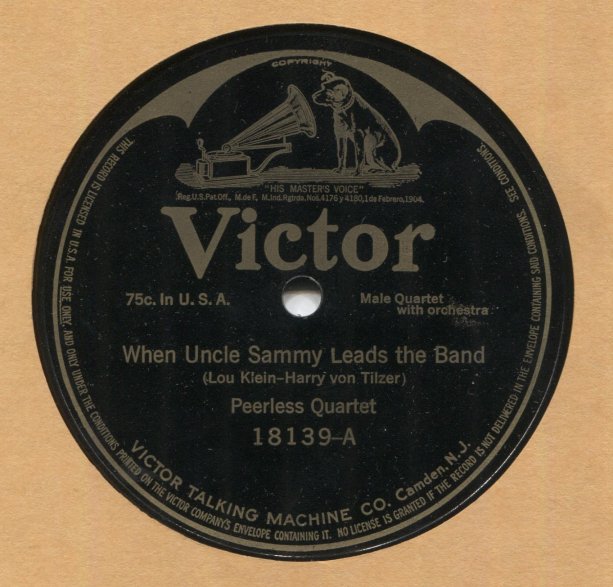
“When Uncle Sammy Leads The Band”
Peerless Quartete, vocal
July 18, 1916   (Victor 18139-A)

Patriotic themes were a popular subject for Tin Pan Alley song writers throughout the 1910s decade. When this Harry Von Tilzer/Lou Klein composition was recorded in July 1916, World War I was raging in Europe. The United States would not enter the conflict until April of the following year. The Peerless Quartet was a vocal group that made hundreds of recordings between 1901 and the late 1920s.   During this recording session, the quartet consisted of Henry Burr, John H Meyer, Albert Campbell and Arthur Collins.


“Who’s Who In Navy Blue”
Sousa’s Band
June 10, 1920 (Victor 18683-B)

This march was composed by “March King” John Philip Sousa in 1920 as the official march of the 1921 graduating class of the US Naval Academy. Sousa’s band toured extensively between the 1890s and his death in 1932 and made over 1,700 recordings. But Sousa was not a fan of “canned music” and was personally present for only a handful of his band’s recording sessions.


“L-I-B-E-R-T-Y” 
Henry Burr, vocal
August 8, 1916 (Victor 18139-B)

This patriotic themed composition was written by Tin Pan Alley songwriter Ted S Barron who was responsible for both its music and lyrics. Henry Burr was a Canadian tenor who was perhaps the most prolific vocal recording artist during the first quarter of the 20th century. In addition to his many solo and duet recordings, he also recorded as part of the Peerless Quartet, the Sterling Trio and the American Quartet.


“Col. Stuart March”
Conway’s Band
May 8, 1919 (Edison 50614-R)


This march, composed by Alfred F Weldon, dates back to 1901. Weldon was the bandmaster for the Second Regiment Band of Chicago which eventually was known as Weldon’s Band. Conway’s Band, led by Patrick Conway, was formed in 1895 in Ithaca, New York and was originally known as the Ithaca Band. While the band had made records since 1912, the May 1919 performance presented here was the band’s first appearance on the Edison label. The recording here was taken from an Edison Diamond Disc but Edison also released it as a Blue Amberol cylinder.


Comrades Of The Legion
Sousa’s Band
June 10, 1920 (Victor 18683-A)

This John Philip Sousa march was published in 1920 and was dedicated to the American Legion.


“Rainbow Division March”
Arthur Pryor’s Band
December 10, 1918 (Victor 18559-A)

This march was published in 1917 and composed by Danny Nirella who, for many decades, led marching and concert bands in the Pittsburgh area. Arthur Prior was John Philip Sousa’s star trombone player and assistant bandleader. He left Sousa’s band to form his own in 1903 which became famous in its own right. Because John Philip Sousa disliked recorded music and refused to attend recording sessions, most of the Sousa’s pre-1904 recordings were, in fact, conducted by Arthur Pryor. Because of Pryor’s association with Victor, he continued to step in as conductor for Sousa’s recording sessions for a number of years after he left the band.


Posted in Uncategorized | Leave a comment

Benny Kruger And His Orchestra – 1924

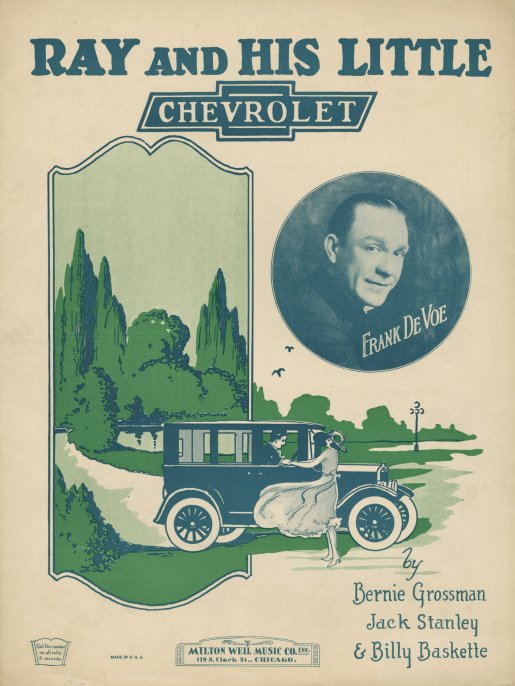
"Ray And His Little Chevrolet" Vintage Sheet Music Cover


“Ray And His Little Chevrolet”
Benny Kruger And His Orchestra; Billy Jones, Ernest Hare vocals
June 30, 1924 (Brunswick 2641-A)


As automobiles became more affordable and an increasingly important part of modern American life during the 1910s and 1920s, the songwriters for the big Tin Pan Alley music publishers churned out countless songs about the machines and their owners.  Two common themes centered around their lack of reliability and young men hoping that having a car might result in success in gaining the affection of young ladies.  Sometimes, the songs were about both, as in the case of the 1910s hit “He’d Have to Get Under — Get Out and Get Under (to Fix Up His Automobile)”

Songs that referred to specific brands of automobiles were most often about Fords.  As the 1920s progressed, Ford’s Model T was increasingly viewed as old fashioned compared with more attractive offerings from its rivals – and songs began to portray them as unstylish and cheap.

Song about Chevrolet and other competitors were not as common.  But here’s one from 1924 that was successful enough to attract the interest of the record labels.

The vocalists on this recording, Billy Jones and Ernest Hare, were highly successful on early radio where they billed themselves as “The Happiness Boys.”  A few weeks after they cut this recording with Benny Kruger’s band for Brunswick, they recorded the song again on Okeh with top billing as The Happiness Boys.

A couple of other famous musicians participated on this recording session as well.  On piano is Phil Ohman, half of the famous Arden-Ohman piano duo and later co-leader of the Arden-Ohman Orchestra which he and Victor Arden headed up.   On banjo is Harry Reser, the most famous banjoist of the 1920s and leader of the house band on the highly successful early network radio program The Clicquot Club Eskimos.   Neither of the musicians are prominently featured on this recording.  But in those days, recording sessions were lucrative work for musicians as participants were usually paid a flat fee per side recorded regardless as to whether the eventually issued record sold well or not.

Posted in Uncategorized | Leave a comment

Jack Berger And His Hotel Astor Orchestra – 1931


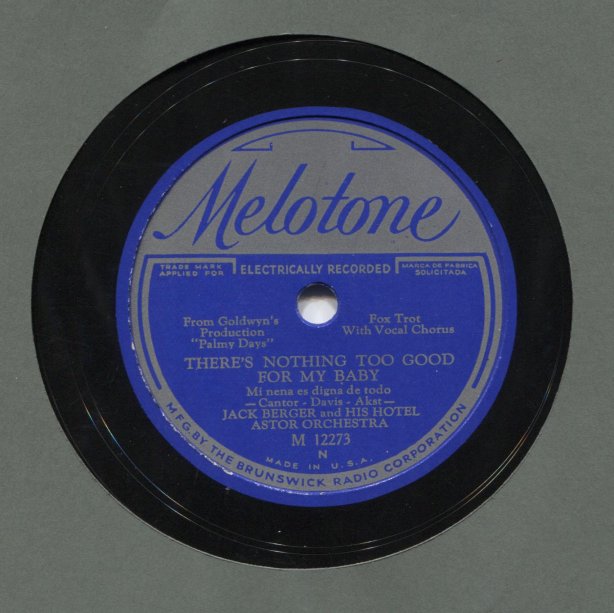
“There’s Nothing Too Good For My Baby”
Jack Berger And His Hotel Astor Orchestra; Peter Cantor, vocal
September 5, 1931 (Melotone M 12273)


Here’s a catchy tune that Eddie Cantor introduced in the 1931 musical comedy Palmy Days which was one of that year’s top grossing films.  The fact that the uncredited vocalist on this recording is named Peter Cantor is mere coincidence and the two were not related.

Jack Berger’s orchestra appeared at New York City’s Hotel Astor for at last six years ending in 1936.  Its broadcasts from the hotel over WEAF were carried by the NBC Red Network and heard nationally.  In addition to Melotone, the band cut records for both the Crown and Bluebird labels.

Very little has been written about Jack Berger or of what became of him after the conclusion of his engagement at Hotel Astor when his name suddenly disappears from newspaper mentions and radio listings.  However, I recently stumbled across this extremely informative article that fills in a lot of blanks about Berger and his career.

– Dismuke

Posted in Uncategorized | Leave a comment

Bessie Smith – 1929

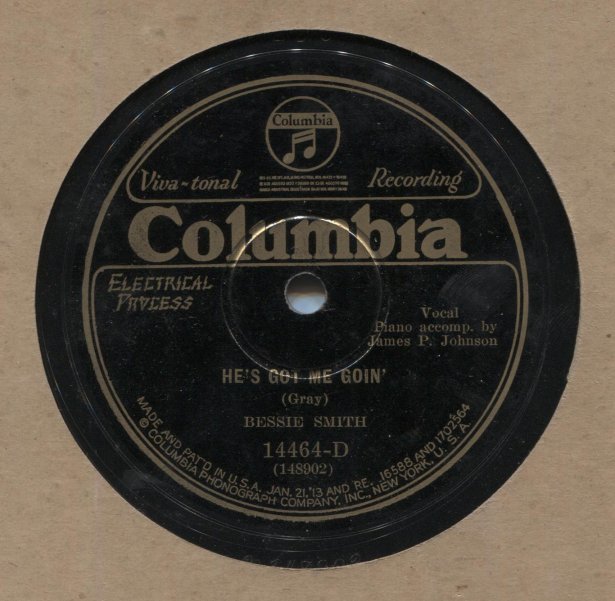
“He’s Got Me Goin'”
Bessie Smith, vocal; James P. Johnson, piano
August 20, 1929  (Columbia 14464-D mx 148902)


This recording brings together two musical giants of the 1920s.  Bessie Smith was the era’s most popular and influential female blues singer.   James P. Johnson was the one of the originators of the stride piano style and had a major influence on artists such as Duke Ellington and Fats Waller.  He was also the composer of the song that is most frequently associated with the 1920s, “The Charleston.”


Posted in Uncategorized | Leave a comment

The Three Keys – 1932

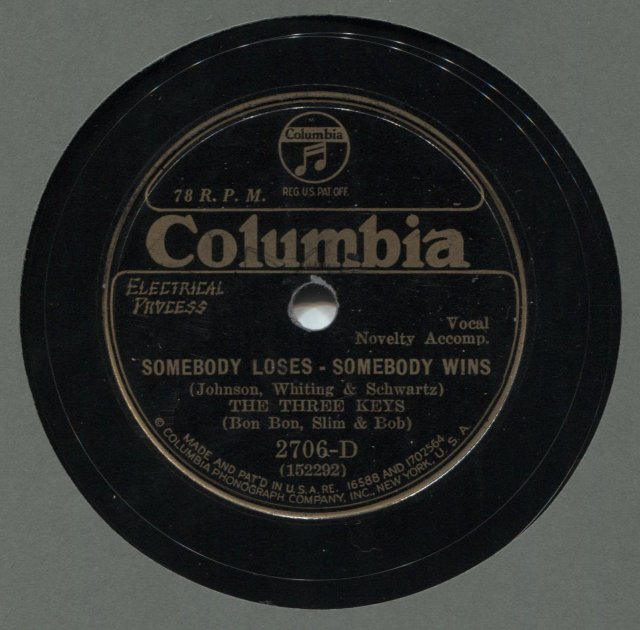
“Somebody Loses – Somebody Wins”
The Three Keys (Bon Bon, Slim & Bob)
August 29, 1932 (Columbia 2706-D mx 152292)


“Mood Indigo”
The Three Keys (Bon Bon, Slim & Bob)
August 29, 1932 (Columbia 2706-D mx 152270)


The Three Keys were a vocal harmony group that first performed together in Chester, Pennsylvania in 1931.  It was comprised of John E. “Slim” Furness, Robert “Bob” Pease and George “Bon Bon” Tunnell.

According to promotional material from the time none of the members of the group were able to read music.  After broadcasting locally in Philadelphia they were able to land national exposure over NBC which led to stage appearances on what was still remaining of the old vaudeville circuits and opportunities to cut records for Columbia and Brunswick/Vocalion.

The record here was the group’s first record and their only one that was issued on Columbia.  Less than two weeks later they had their first recording session on Brunswick which led to a handful of sides being made for that label in 1932 and 1933.   Some of their Brunswick sides were reissued on Vocalion in 1934.

Apparently personal difficulties among the group’s members slowed down it’s professional momentum just as its fame was starting to take off.  The Three Keys continued to perform and broadcast through the early 1940s but were never able to recapture their initial success.

Under the leadership of “Slim” Furness the group eventually morphed into The Four Keys and cut records backing up Ella Fitzgerald after she stepped down as the leader of the former Chick Webb Orchestra. Furness brought members of his own family into the group and by the 1950s it was making records as The Furness Brothers.  A number of Furness Brothers recordings can be accessed by searching the group’s name on YouTube.  One that I thought was quite nice was a doo-wop era selection which can be heard at this link.  The Furness Brothers continued performing into the 1980s.

For more information about the group, Marv Goldberg has done a great job researching and documenting its evolution over the decades and what became of its original members in an article that you can access at this link.


Posted in Uncategorized | Leave a comment