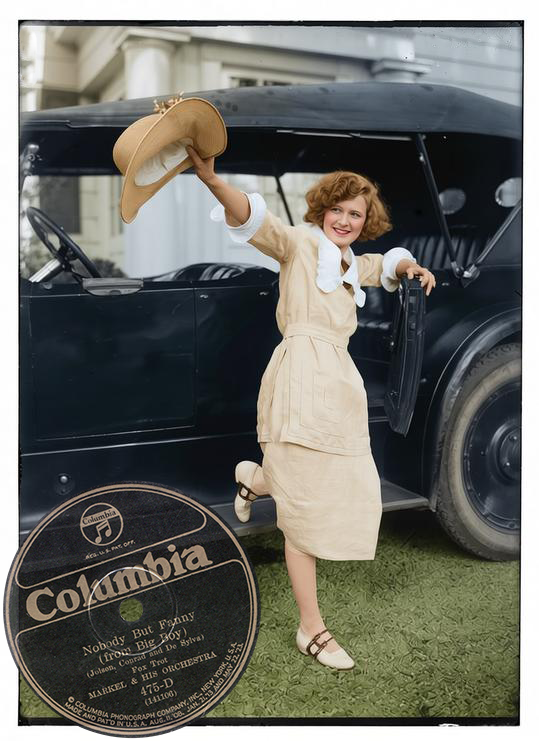
| “Nobody But Fanny (from Big Boy)” Markel & His Orchestral November 19, 1928 (Columbia 475-D mx 141106) |
| “Sugar Plum (from Gay Paree Revue)” Markel & His Orchestra November 20, 1928 (Columbia 475-D mx 141107) |
From the Edward Mitchell collection, here are two songs from musical stage productions running in New York City in the autumn of 1925, performed by a then well-known society band.
“Nobody But Fanny” is an Al Jolson, Buddy G. de Sylva, and Con Conrad composition from the musical comedy Big Boy, in which Jolson starred. The production opened at the Winter Garden Theatre on January 7, 1925, and ran for 56 performances before closing on March 14. It was revived on August 24, 1925, at the 44th Street Theatre for 120 performances before closing again in December.
“Sugar Plum,” composed by Joseph Meyer with lyrics by Buddy DeSylva, was featured in the Gay Paree Revue of 1925, which opened at the Shubert Theatre on August 18, 1925, and enjoyed a run of 181 performances before closing on January 30, 1926. Among the production’s cast was a then-unknown chorus girl, future film and television star, Barbara Stanwyck. (There was also a subsequent Gay Paree Revue of 1926.)
Ukrainian-born pianist and bandleader Mike Markels (sometimes spelled as “Markel”) made his first recordings during World War I for Victor under the name Sergeant Markel’s Orchestra. By the early 1920s, he led one of New York City’s more prominent society bands, which became known for mixing elements of hot jazz into its still-danceable arrangements, and was especially popular with affluent Upper East Side audiences.
Markels was one of several bandleaders of the era who simultaneously operated multiple bands, sometimes under their own name or under the name of the person who led a particular unit. Such bandleaders essentially functioned as early band booking agencies.
Among the bandleaders who were famous for having multiple, and sometimes dozens, of bands were Meyer Davis, Jean Goldkette, and Lester Lanin. Even Paul Whiteman, at the height of his popularity in the 1920s, maintained multiple ensembles billed as either the “Paul Whiteman Orchestra under the direction of…” or as “Paul Whiteman Presents … and His Orchestra.”
Markels specialized in providing society bands for well-to-do audiences at country clubs, private parties, and other venues in the Northeast.
Markels’ flagship band was also busy in the recording studios, cutting several hundred sides for a variety of labels, including Columbia, OKeh, Edison, Brunswick, and various low-priced and dime-store labels distributed by the Plaza Music Co. between 1921 and 1928.
After 1928, the only mention of him being back in the recording studio was in March 1932, when he provided the piano accompaniment for a side by a tenor vocalist named A. M. Limburg that was never issued. I was not able to locate any information about who A. M. Limburg was.
The few mentions I found about Markel after 1928 suggest that he began to focus more on booking bands than leading them.
By the late 1930s, there were occasional mentions of him in Billboard magazine as head of the then-dominant band booking agency Music Corporation of America’s club division, responsible for booking MCA’s talent into country clubs and other high-end venues.
A 1952 mention indicates that Markels had been hired to book talent for television conductor Ray Bloch, who had opened a talent management firm still in business as a New York City event production company.
Both of the recordings featured here include prominent banjo passages. Unfortunately, a listing of the personnel of the band at the time is not available. It is possible that the banjo player was Frank Gravito, who appeared on Markels’ recordings a few years earlier, though it is unclear how long he remained in the band. Famous banjoist and bandleader Harry Reser also worked as a sideman in Mike Markels’ band during the early 1920s, though as a saxophone player.
On “Sugar Plum,” starting at 1:52 into the recording, you can hear an unusual instrument that was occasionally included in early 1920s dance bands, the musical saw.