| “Lullaby” Max Fisher And His California Orchestra; Johnny Murray, vocal December 9, 1927 (Columbia 1226-D mx 145290) |
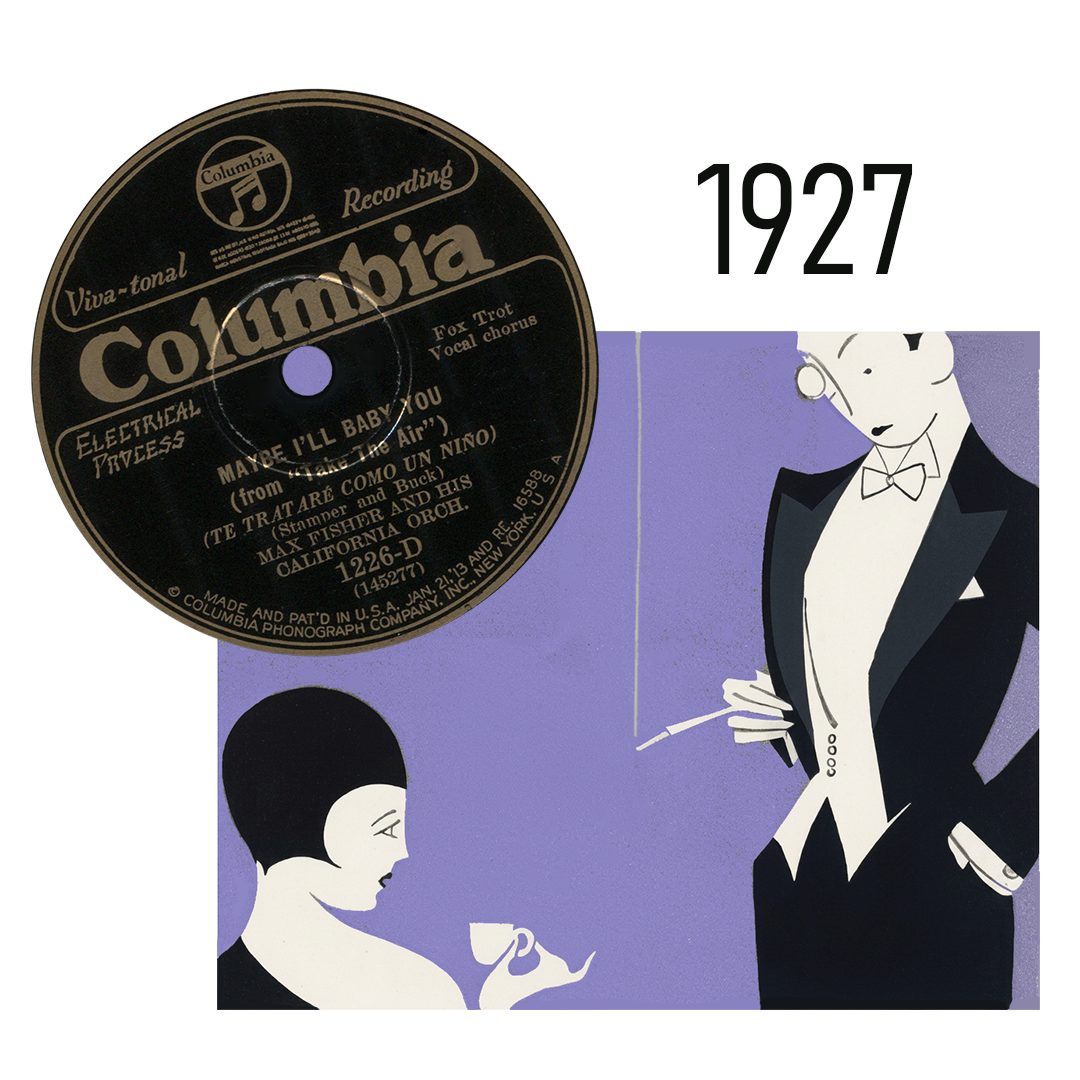
| “Maybe I’ll Baby You” Max Fisher And His California Orchestra Leonard Layson, Johnny Murray, Richard Newlin, vocal December 6, 1927 (Columbia 1226 D mx 145277) |
From the Edward Mitchell collection, here are two songs from the 1927 musical Take the Air, composed by David Stamper with lyrics by Gene Buck, who produced and directed the show. Buck was a friend and neighbor of F. Scott Fitzgerald. Some historians have suggested that Buck’s lifestyle and lavish parties may have inspired certain elements of Fitzgerald’s novel The Great Gatsby.
Bandleader Max Fisher is largely forgotten, even among enthusiasts of 1920s popular music, it seems. When I started writing this post, I knew little about him and was unable to find any online summary of his life or career. After I began going through old news articles and trade journals, I was surprised to learn that his band was highly prominent during the 1920s, performing at elite venues, catering to wealthy audiences on both coasts.
Max E. Fisher was born in Cripple Creek, Colorado, on May 26, 1894, to Hyman and Matilda Fisherson and raised in Los Angeles, where he learned to play violin.
A February 28, 1914, article in Goodwin’s Weekly mentions a “ragtime violinist” named Max Fisher appearing at the Pantages Theater (now called the Arcade Theater) in Los Angeles. I was not able to confirm that this was the same Max Fisher, but the chances are good that it was.
At some point during the 1910s, Fisher was recruited by famed film director Cecil B. DeMille to become his on-set violinist/music director at the Famous Players-Lasky studio. That might seem like a rather strange job, given that all films in those days were silent. But silent film sets could be noisy and chaotic. DeMille wanted Fisher to provide “mood music” while a scene was being filmed to help put the cast in the proper emotional state.
During World War I, Fisher served as director of the band at the Liberty Theater, located within the Camp Lewis military base near Tacoma, Washington.
1921 provided Fisher with two significant career breaks, which came in rapid succession.
On New Year’s Day, the legendary Ambassador Hotel (which I discussed in my last blog post) opened in Los Angeles with Max Fisher leading the hotel’s first resident band. The band performed at the Ambassador’s high-priced restaurant/nightclub, the Zinnia Grill. The venue was so successful that hotel management converted the hotel’s huge ballroom into a nightclub, the Cocoanut Grove, which would remain one of the nation’s premier celebrity hotspots for decades.
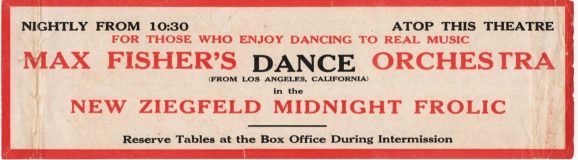
The Cocoanut Grove opened on April 21, 1921, a little over four and a half months after the hotel’s opening. Max Fisher’s band, however, would not be part of that opening, as it had been invited to New York by Florenz Ziegfeld to perform at Ziegfeld’s Midnight Frolic, a rooftop nightclub atop the New Amsterdam Theatre that Ziegfeld established to capture the money that patrons would have spent elsewhere after the performance of his Follies downstairs had concluded.
Even though the band had only been at the Ambassador for a few months, it must have been highly regarded by the hotel, as a farewell party was held at the Zinnia Grill, and the hotel’s manager presented each member of the band with a Morocco leather and gold-bound billfold with his name stamped on it.
Art Hickman’s band, which had appeared at the Zirgfield Follies the year before, as well as previously, replaced Fisher’s in time for the opening of the Cocoanut Grove. Fisher’s band would once again become the Ambassador’s house band in 1924 when Hickman’s successor, Abe Lyman, stepped down to take his band on a national tour with the Orpheum Circuit.
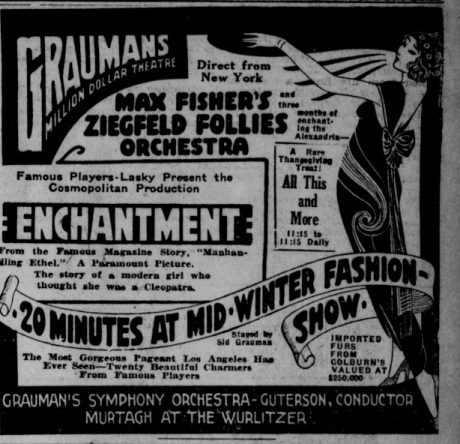
After concluding its run at the Midnight Frolic, the band was booked at the recently opened Ritz-Carlton Hotel in Atlantic City. The band then returned to Los Angeles for an engagement at the Alexandria Hotel, owned by the same company that owned the Ambassador, billed as “Max Fisher and his Midnight Frolics Orchestra from the Ziegfeld Roof” followed by another engagement at Grauman’s Million Dollar Theater, billed as “Max Fisher’s Ziegfeld Follies Orchestra.”
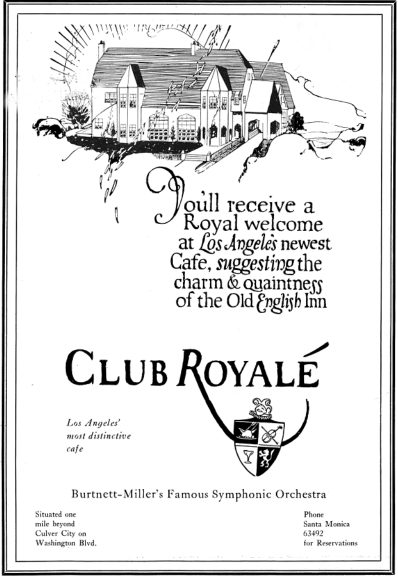
In October 1922, Fisher started his own high-end nightclub, which some referred to as a speakeasy, the Club Royale, on Washington Boulevard in Culver City, a street with multiple nightspots known to attract “gamblers, prostitutes and members of the movie crowd.” Because Culver City was, at the time, relatively remote, though still close to Hollywood and Beverly Hills, enforcement of Prohibition laws was a bit more lax.
A June 1925 hotel trade publication reported that Fisher had “signed a contract to appear for six months at the new Prince of Wales Club, the most exclusive supper cafe in London’s West End.” I don’t know whether this engagement actually took place, as this was the only reference to it that I could find.
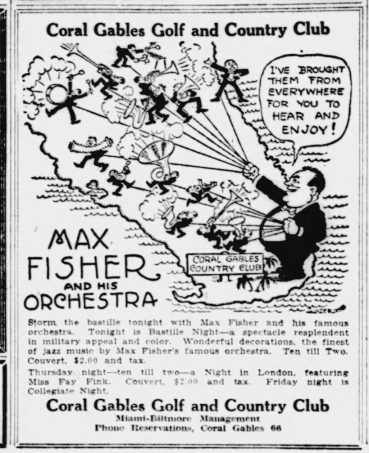
In April 1926, the band had another high-profile engagement when it followed the Paul Whiteman and Jan Garber bands for a thirteen-week engagement at the Coral Gables Golf and Country Club near Miami at the tail end of Florida’s frenzied 1920s real estate boom, which was brought to an abrupt end a few months later by the devastating 1926 Miami hurricane.
In 1928, the band appeared in and was the subject of a ten-minute single-reel Fox Movietone musical short feature titled Max Fisher and His California Orchestra. I have not been able to determine if copies of the film still exist or if, like many other films from the 1920s, it has been lost.
Among Fisher’s sidemen who went on to lead their own bands was Earl Burtnett, Fisher’s pianist, who eventually led the house band at the Ambassador Hotel’s archrival, the Los Angeles Biltmore. Harry Owens, whose band at the Royal Hawaiian Hotel in Waikiki became famous for Hawaiian-themed dance music, played trumpet with the Fisher band. In 1925, Fisher’s trombone player, Glenn Miller, came to the attention of highly regarded bandleader Ben Pollack, who offered Miller his next opportunity on his road to eventual international celebrity.
All of the above information comes from period source material I located through quick online searches and likely only scratches the surface of Fisher’s 1920s accomplishments. So why has so little been written about him since then, and why has he become relatively obscure even among record collectors and 1920s enthusiasts?
My theory is that much of it has to do with the fact that his band did not make very many records. It recorded a single side in 1921 for Vocalion while in New York, appearing at Ziegfeld’s Midnight Frolic. In October 1922, it recorded two sides for Gennett Records at their studio in Richmond, Indiana, neither of which were issued.
The band did not record again until April 1927, when it made two sides for Columbia in New York. It recorded an additional side for Columbia in New York the following month.
The recordings here come from a New York Columbia session held on December 6 and December 9, 1927, during which they also recorded a third side, “Is She My Girlfriend.”
The band recorded its final two sides in Chicago at the end of March 1928, also for Columbia.
Given how well-known and well-received the band was in various parts of the country, why did it only have a one-off side with Vocalion in 1921 and just eight sides for Columbia in 1927 – 1928?
I suspect we will never know for sure. But my speculation is that much of it has to do with the fact that the band spent most of its time either in the Los Angeles area or on tour. Prior to Brunswick setting up a recording studio in Los Angeles in December 1927, the only label with a permanent studio in California was Victor. Prior to that, Brunswick and Columbia relied on occasional field trips to record West Coast talent.
The most prolific West Coast band of the era in terms of recordings was Abe Lyman’s band, which recorded for Brunswick. But the majority of his 1920s sides were recorded either in New York or Chicago, where Brunswick was headquartered.
My guess is that all of Fisher’s recorded sides coincided with the band’s touring schedule. If the band was elsewhere when the labels were in Los Angeles, then its only option for recording was to travel elsewhere. Even if the record label was willing to pay for the band’s travel expenses, it still might not have made sense for a band to do so. Then, as now, most musicians earned their living through live performances, not through record sales. The cost of a couple of days’ worth of gigs to record in a distant city might very well have exceeded what they would have earned from the recording session.
Sadly, no matter how prominent a band might have been on radio and at various nightspots around the country, to the degree that it did not make records, it was doomed to be forgotten, as all that remains to remember it by are references in old newspapers and trade publications.
As for what became of Max Fisher after his last recording session with Columbia and his Movietone musical short feature in 1928, period media mentions become less frequent. And, unfortunately, research on what bands were up to after 1930 becomes more difficult, as many archives are reluctant to make copies of publications less than 95 years old available online due to fears of copyright infringement.
I was able to find brief references to his band performing at various venues through about 1933.
The May 8, 1943, issue of Billboard included a brief mention stating:
“Max Fisher, a big name in coast music circles 20 years ago, is rehearsing a crew in Hollywood, with GAC [General Amusements Corporation] set to book…”
This suggests that Fisher had become significantly less prominent by 1943, but it doesn’t indicate whether he had previously retired from leading a band and, if so, how long ago it was. And it is questionable whether that band ever got off the ground, as Fisher died that same year on October 12 at the Veterans’ Hospital in Sawtelle, California. His obituary stated that he had been ill for six months with a heart ailment.
Both of the songs featured here are from the musical Take the Air, which opened at the Waldorf Theater on November 22, 1927. The show’s plot had an aviation theme, in an attempt to capitalize on the aviation craze that followed Charles Lindbergh’s transatlantic flight.
Gene Buck, a longtime collaborator with Florenz Ziegfeld, decided to create his own production and, as a result, wrote, produced, and directed Take the Air. He even went so far as to purchase the Waldorf Theater, which had opened in 1926, and renamed it the Gene Buck Waldorf Theater. The show enjoyed a 206-performance run before closing the following May.
The Waldorf Theater, located at 116 West 50th Street, was ultimately not successful and closed as a live theater in 1933 when its ground floor was converted into retail shops. The theater’s balcony was extended and converted into a cinema. After struggling to compete with the larger, grander Radio City Music Hall and the Roxy Theater, both of which were nearby, the cinema closed in 1941, and the entire building was used as retail space until it was demolished in 1968.