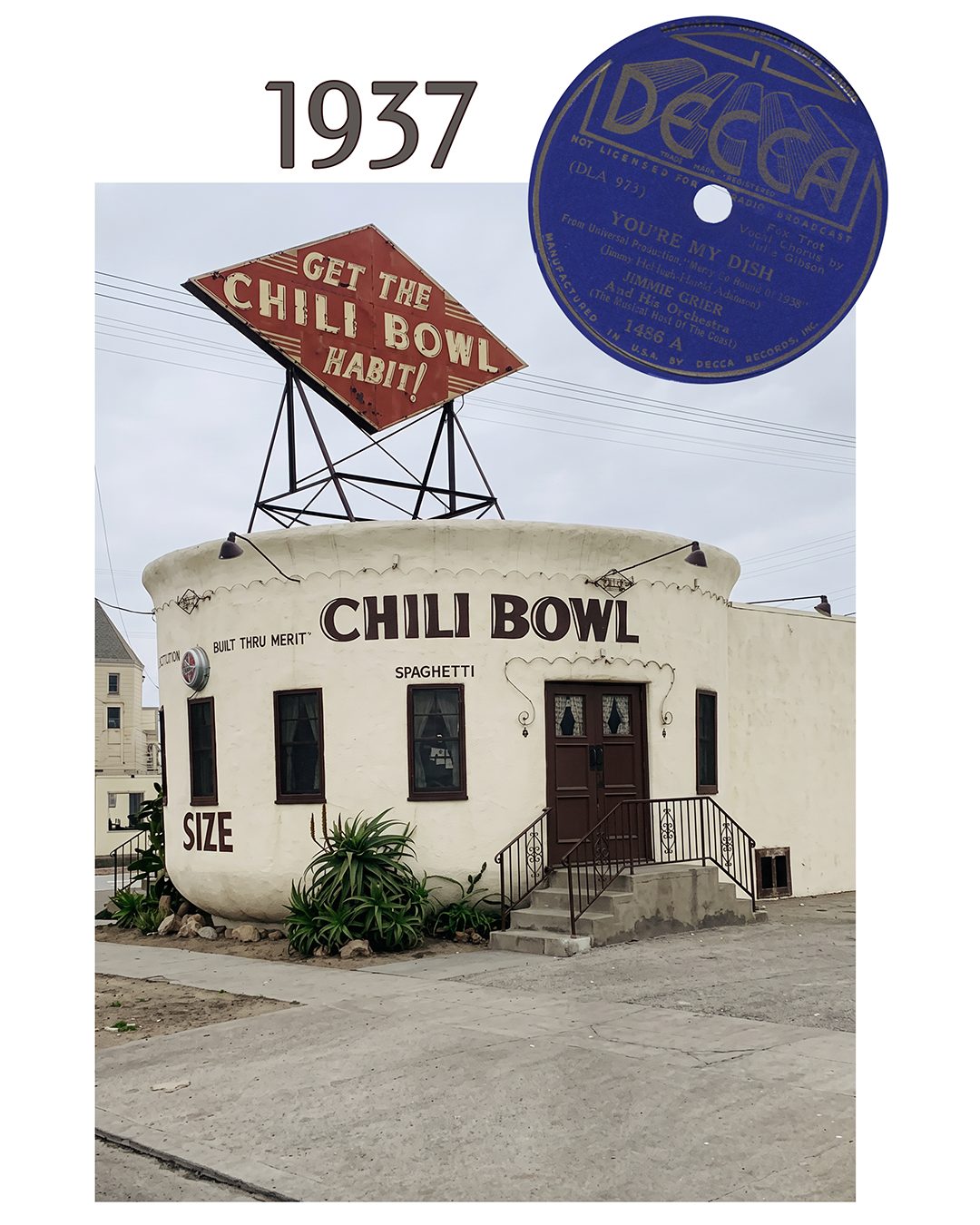
1937 image of the 801 N. La Brea Avenue location of the Chili Bowl restaurant, one of several that existed in the Los Angeles area in the 1930s.
| “You’re My Dish” Jimmie Grier And His Orchestra; Julie Gibson, vocal October 1, 1937 (Decca 1486-A mx DLA 973) |
Here’s a recording by a Los Angeles-based band that enjoyed national fame in the 1930s.
“You’re My Dish,” composed by Jimmy McHugh with lyrics by Harold Adamson, comes from the 1937 Universal Pictures film Merry-Go-Round of 1938. The film was not successful at the box office and proved to be a big financial setback for Universal.
The song is best remembered for Thomas “Fats” Waller’s September 7, 1937 recording of it on Victor, deservedly so, in my opinion. Waller had a special talent for making even trite lyrics sound anything but.
As for this song’s lyrics being trite, in fairness, they are far from being the era’s worst offenders. However, they have always struck me as a not-so-subtle knock-off of Cole Porter’s lyrics for his 1934 composition “You’re the Top,” which I do not consider to be at all trite.
Regardless of the lyrics, I personally think this is a very nice recording. Not only is the tune very catchy, the arrangement and the band’s execution possess a wonderfully opulent, symphonic grandeur.
Julie Gibson, the vocalist on the recording, eventually became Mrs. Jimmie Grier after marrying him in March 1939. The marriage was short-lived, and she filed for divorce in October 1940. She went on to become a film actress with Paramount Pictures, as well as a voice and dialogue coach. She died in 2019 at the age of 106.
During the same session, the band also recorded the very haunting “Everything You Said Came True,” which ranks among my favorite late 1930s dance band recordings. That recording has long been in Radio Dismuke’s playlist, and you can also hear it on demand on YouTube at this link.
Unlike many bands that struggled in obscurity before finding fame, Jimmie Grier’s band debuted in 1932 at one of the West Coast’s most renowned venues, the Cocoanut Grove nightclub at the Ambassador Hotel in Los Angeles. A talented musician proficient with multiple instruments, Grier had been a member of both the Abe Lyman and Gus Arnheim bands during their residency at the Cocoanut Grove.
While with the Arnheim band, Grier also served as its principal arranger and crafted the band’s unique sound. Over time, however, he felt that Arnheim was not compensating him commensurately with his contribution to the band’s success and began to contemplate forming his own band.
That opportunity came in 1932 when Arnheim decided to take advantage of the national fame his band had earned as the featured band on the weekly NBC radio program The Lucky Strike Dance Hour and embarked on a lucrative nationwide tour.
Leveraging close connections he had built over the years, Grier convinced Ambassador Hotel management that he could form his own band to provide the same sound and format that had been so successful under Arnheim. Several of Arnheim’s featured vocalists remained at the Cocoanut Grove and joined Grier’s band, helping provide additional continuity.
As a result of his arrangements, his amiable demeanor, and high-profile radio broadcasts, Grier was soon billed as “The Musical Host of the Coast,” which appears under Grier’s name on this record’s label credits.
In 1933, Grier’s band had moved to the Cocoanut Grove’s archrival, the Biltmore Bowl, where it remained, performing six nights per week until 1937. The Biltmore Bowl was a nightclub with a massive ballroom located in the basement of the Los Angeles Biltmore Hotel. Both venues fiercely competed for the same elite, celebrity-studded clientele.
In addition to its own recordings, Jimmy Grier’s band also provided the uncredited musical accompaniment on several recordings by Bing Crosby, the Boswell Sisters, and Russ Columbo. He also wrote arrangements for motion pictures and, for a while, starred in two different radio programs.
Grier’s biggest hit was his October 1934 Brunswick recording of “The Object of My Affection” with Pinkie Tomlin on vocal, which, by the end of the year, had risen to number 1 on the sales charts. Grier and Tomlin shared composer credit for the song with Coy Poe. That recording enjoyed renewed visibility decades later when it was featured in the soundtrack of the 1973 film Paper Moon.
Two months later, the band made a second recording of the song, this time with a vocal by the Boswell Sisters. That recording made its way to the top of the sales charts in early 1935.
Another highly successful Jimmie Grier recording featured in Paper Moon came from the band’s first recording session in March 1932 for Victor. “One Hour With You” was the title song of the 1932 pre-code film directed by Ernst Lubitsch. Donald Novis, who was a vocalist with the Grier band, performed the song in the film. A few days after the film was released, Novis provided the vocal for Jimmie Grier’s recording of the song, which eventually climbed to the number 2 position on the sales charts.
Paper Moon and One Hour With You are films that I highly recommend for fans of 1930s era recordings and popular culture.
Though the Grier band made its last recordings in 1938, it remained active until 1942, when the wartime military draft made it difficult for bands to find staff. Grier himself enlisted in the Coast Guard and served as assistant director to Rudy Vallee, who had also volunteered for the Coast Guard and led the 11th Naval District Coast Guard Band. When Vallee transitioned back to civilian life in 1944, Grier assumed leadership of the band throughout the remainder of the war.
After the war, Grier formed a new band in 1946 which enjoyed a one-year residency at his old haunt, the Biltmore Bowl. By that time, however, large dance bands and the number of venues willing to book them were in rapid decline. For a period, Grier had a small Hollywood-based musical combo. By the 1950s, after a stint as a radio disc jockey, Grier retired from the music industry and transitioned to a career in real estate.
Sadly, in 2005, despite being a highly significant historical and cultural landmark and organized efforts to save it, the entire Ambassador Hotel complex was destroyed by the Los Angeles Unified School District.
Happily, the Los Angeles Biltmore remains standing with much of its ornate 1920s interior still intact. The Biltmore Bowl, however, did not fare so well and was destroyed by a fire in the 1950s. The space that it occupied in the hotel’s basement was subsequently reconfigured and “modernized.”