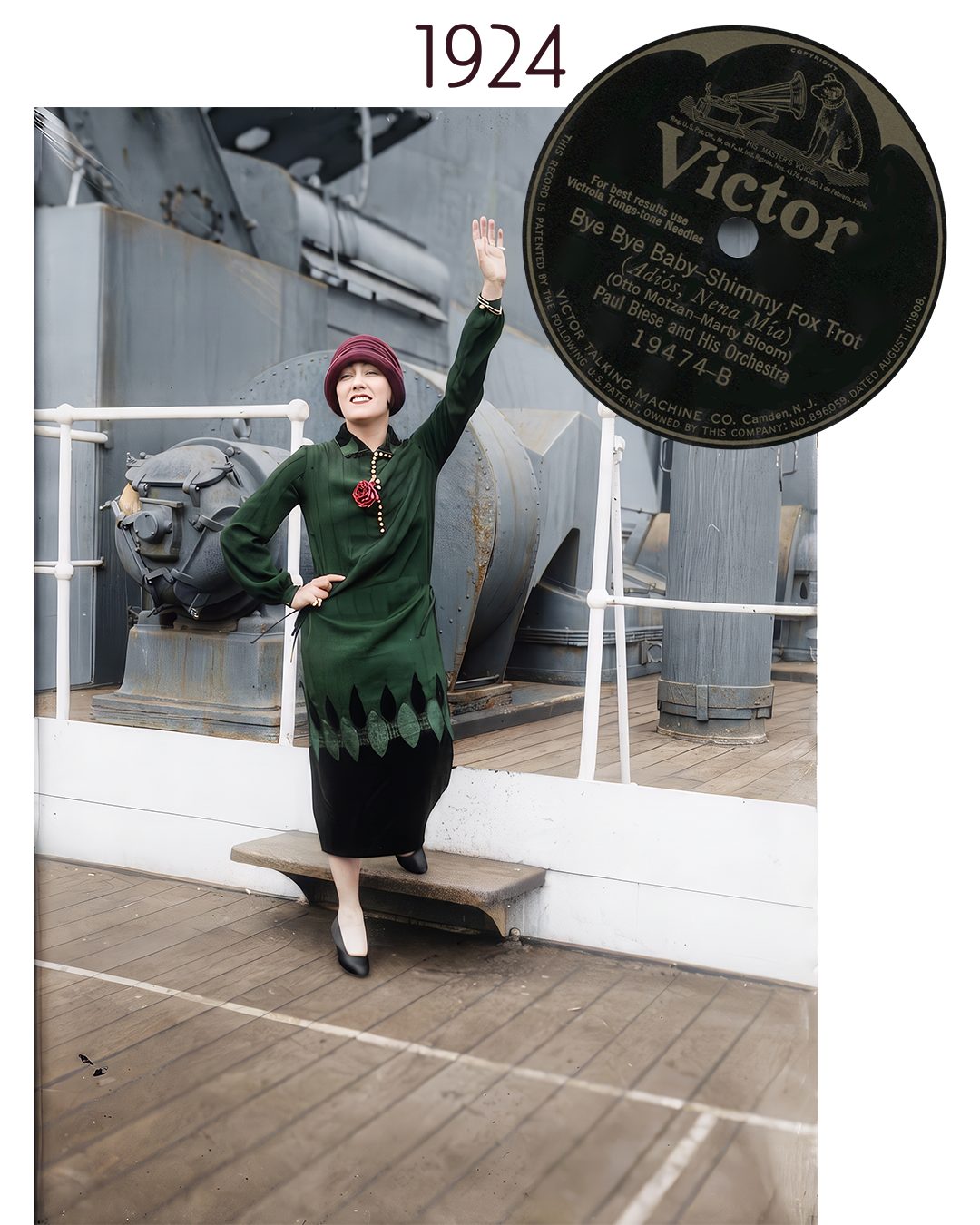
 Actress Gloria Swanson, circa 1924
| “Bye Bye Baby” Paul Biese And His Orchestra September 6, 1924 (Victor 19474-B) |
| “Tessie! Stop Teasin’ Me” Henry Halstead And His Orchestra August 30, 1924 (Victor 19474-A) |
From the Edward Mitchell collection, here are two pre-microphone-era recordings by bands that have been mostly forgotten, but enjoyed significant popularity in the early 1920s.
Paul Biese was born in 1885 as Percy Hawthorne Sudborough. His Chicago-based band entered its brief period of national prominence in 1919, when the dominant inspiration of popular music was rapidly transitioning from ragtime to jazz.
By the time he was a teenager, Biese was already proficient at playing the violin, the clarinet, as well as the instrument he would become famous for, the saxophone. In 1899 and 1900, he spent two seasons touring as a member of Roney’s Boys Concert Company, a then-famous all-boy touring band led by Professor Henry B. Roney that performed for entertainment-starved audiences before the advent of mass media venues ranging from Chautauqua tents in backwoods towns to the White House.
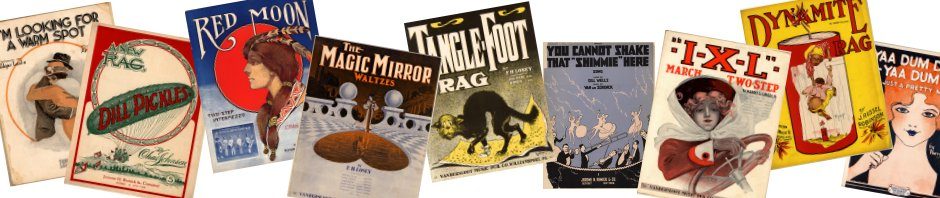
During the 1910s, Biese enjoyed success as the co-composer of several popular ragtime compositions, including “Squirrel Rag” and “Dynamite” (whose sheet music cover can be seen above in this blog’s header image).
Biese’s band and recordings became well-known for his pioneering saxophone style, often billed as the “moaning saxophone.” He was one of several artists who were instrumental in popularizing the once-obscure saxophone and helped make it a key musical component and cultural symbol of the 1920s Jazz Age.
Biese recorded around 50 issued sides for Columbia between 1919 and 1922, both with his full band and as Paul Biese and his Novelty Trio. For a period, his records sold well and received good press coverage and strong promotional support from Columbia. However, after his last recording session with Columbia in December 1922, his contract was not renewed. Biese did not make any more records until an April 1924 Victor field trip to Chicago, during which his band recorded six sides, only three of which were issued.
The recording featured here is from Biese’s last recording session, which was held in Los Angeles on September 6, 1924. Another song, “Tell Me What To Do,” was also recorded during the session but was not issued.
Leading up to the recording session, Biese had been in Los Angeles since July 3, appearing at Solomon’s Penny Dance Arcade, a large, popular ballroom where patrons were charged a penny per dance (two cents a couple). A couple of weeks after the recording session, the band also performed for the grand opening ceremonies of the Wurlitzer Building. The trip westward immediately followed the Biese band’s defection from the Benson Organization, an early Chicago-based band booking agency operated by bandleader Edgar A Benson, to the newly formed Music Corporation of America (MCA), which would eventually become a powerful media conglomerate.
Biese had long struggled with his weight and, at one point, weighed over 400 pounds. In 1922, over half a century before the advent of liposuction, he underwent a procedure by noted surgeon Dr. Max Thorek to remove 100 pounds of fat from his abdomen. Surgery of any sort in the 1920s carried a high risk, as widespread usage of antibiotics was still a couple of decades away. Fortunately, Biese fully recovered from the surgery.
In October 1925, while the band was appearing at the Castle Farm Road House in Cincinnati, Biese became ill and was admitted to a hospital, where he underwent surgery for a strangulated hernia. This time, he was not as fortunate and died of complications shortly after the surgery at age 40.
Biese’s band was subsequently taken over by another MCA-affiliated, heavy-set saxophone player, Jack Crawford, and renamed Jack Crawford and his Slaves of Music, and completed the Castle Farm engagement. Though it only recorded a handful of sides for Victor in 1927, Crawford’s band remained active into the early 1940s.
For more information on Paul Biese’s life and career, see Bill Edwards’ in-depth article at this link.
Henry Halstead was one of the more prominent West Coast bandleaders during the early 1920s, thanks in large part to his band’s residency at San Francisco’s St. Francis Hotel, where its regular radio broadcasts over radio station KGO could be heard throughout California and the wider region.
The year after the recording here was made, the band broke up, and Halstead formed a new one that was eventually billed as the “Favorite Band of Movieland.”
In 1927, the band became one of the first dance bands to appear in a Warner Brothers/Vitaphone sound-on-disc musical short feature, Carnival Night in Paris, which was also the first Vitaphone short feature filmed in Hollywood, rather than at the company’s studios in Brooklyn, New York. It was also the first film appearance of future actor Lew Ayres, who, at the time, played banjo in Halstead’s band.
While Halstead’s band remained active into the 1940s, it made its last records in 1929. The devastating impact and subsequent consolidation that the Great Depression brought to the record industry significantly reduced opportunities for many bands to record. Then, as now, most musicians earned their money from live performances, not through record sales. Indeed, there were countless, perfectly talented bands that remained active throughout the 1920s and 1930s and beyond that never stepped into a recording studio.
You can hear a recording that Halstead made of a rather unusual song a few months earlier in this blog’s July 8 posting.
“Bye Bye Baby” was co-composed by Otto Motzan and Rube Bloom.
“Tessie! Stop Teasin’ Me,” co-composed by bandleader Brook Johns and Ray Perkins, was recorded at Victor’s new West Coast pressing plant in Oakland, California. The title shown on the record differs slightly based on the plant at which it was pressed. The copy in Eddie’s collection was pressed at Victor’s East Coast facilities and contracted the word “teasing” to “teasin’.” Copies pressed at the Oakland plant, which are distinguished by a small letter “O” at the top of the label immediately underneath the word “copyright,” spell the word out in full.
You can read biographical information about Brook Johns and hear one of his band’s recordings in this blog’s June 18 posting.