| “Sadie (You Are The Lady For Me)” Vincent Rose And His Montmartre Orchestra; Buddy Burns, vocal June 12, 1924 (Victor 19511-B) |
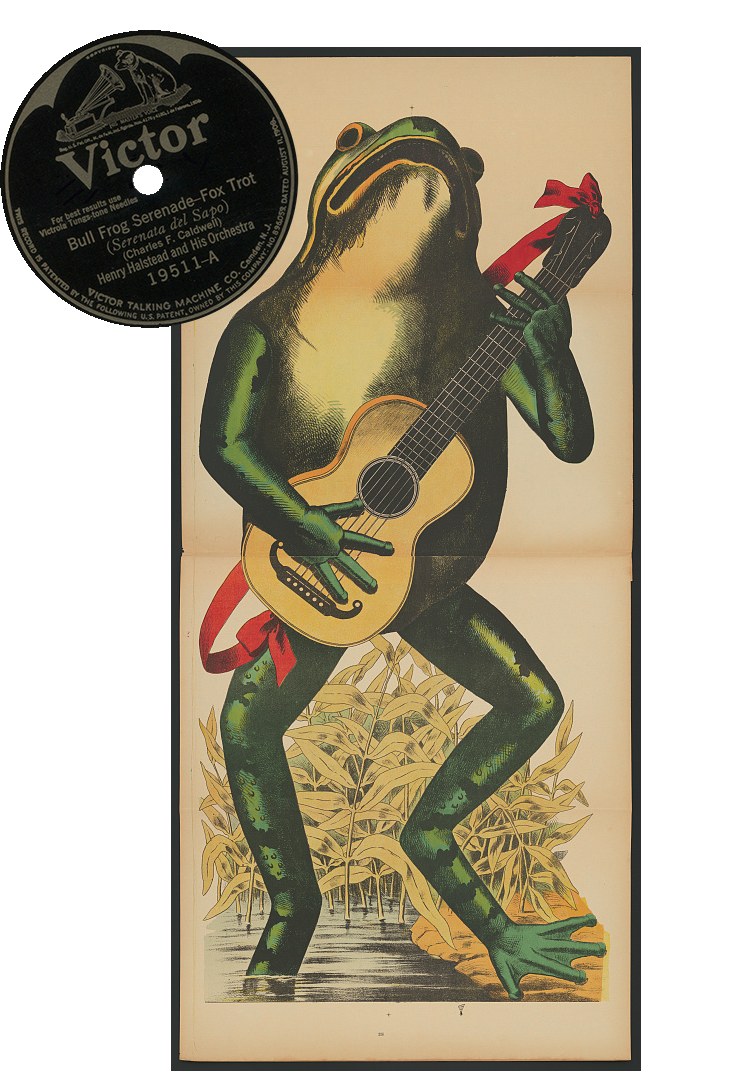
| “Bull Frog Serenade” Henry Halstead And His Orchestra June 19, 1924 (Victor 19511-A) |
From the Edward Mitchell Collection, here is a pre-microphone-era Victor record featuring jazzy selections by two bands prominent on the West Coast during the early and mid-1920s. Both sides were recorded in June 1924, but the record did not appear in stores until February 1925.
Vincent Rose is best remembered today as a prolific composer of famous early 1920s songs such as “Whispering, ” “Avalon,” “Stumbling,” and a personal favorite of mine, “Love Tales.” He also co-composed the song “Blueberry Hill” in 1940, a rock-and-roll version of which by Fats Domino became a big hit in 1956.
Rose’s career as a bandleader dated back to around 1906, when after serving as a music director for hotels in Chicago, he formed his own band in southern California. Thus, his band dated back well before jazz and before the early 1910s dance craze that led to the rise of dance bands, which would dominate and largely define popular music in the United States and beyond into the early 1940s.
As the label credit suggests, when the selection here was recorded, Rose’s band had a long-term engagement at Hollywood’s Café Montmartre, a nightclub famous worldwide as a gathering spot for top Hollywood celebrities. The club’s popularity began to wane at the end of the decade, and it eventually closed in the early 1930s. However, the building in which it was located (on the second floor) still stands at 6763 Hollywood Boulevard, with its original exterior mostly intact.
Rose co-wrote “Sadie (You Are The Lady For Me)” with his band’s trumpet player, Harry Owens, who also wrote the lyrics for Rose’s well-known compositions “Linger Awhile” and “Love Tales.” Owens later formed his own band, which, after securing an engagement at the Royal Hawaiian Hotel in Waikiki, became nationally famous as Harry Owens and his Royal Hawaiians, featuring Hawaiian-themed arrangements.
This recording of the song was made in Los Angeles.
The Henry Halstead Orchestra became famous as the house band of San Francisco’s posh St. Francis Hotel (which had famously survived that city’s devastating 1906 earthquake) from 1922 to 1925 and through its frequent broadcasts on radio station KGO.
“Bull Frog Serenade” is a rather unusual recording, featuring musical notes that imitate the sound of a bullfrog. While the performance here is definitely jazz, the composition itself is ragtime.
I was only able to find limited information about the song’s composer, Charles F. Caldwell. A June 11, 1919, copyright filing for “Bull Frog Serenade” lists Caldwell as its composer with an arrangement by Ed. R. Wagner. The filing indicates that the work was self-published and that Caldwell was based in Los Angeles at the time of the filing.
There was a second copyright filing for “Bull Frog Serenade” in 1924. Most likely, this was related to the Halstead band’s recording, either on the arrangement used in the recording or, perhaps, in anticipation of potential publication in sheet music form if the recording proved successful.
I was able to identify nine additional songs copyrighted by Caldwell between his 1919 copyright for “Bull Frog Serenade” and 1927. But I could only locate additional information on two of them: “Plinka Plunk” from 1923, co-composed with Mike Pingitore, who was best known as a banjo player for the Paul Whiteman Orchestra, and “In the Shadow of the Palm Trees,” for which he shared composer credit with Paul Whiteman, and with lyrics by Dolly Morse. That song’s copyright was renewed in 1954, but I have not been able to find any mention of it being published or of Whiteman ever recording it.
“Bull Frog Serenade” was recorded in Oakland, California, where, a few months earlier, Victor had opened a new West Coast pressing facility.
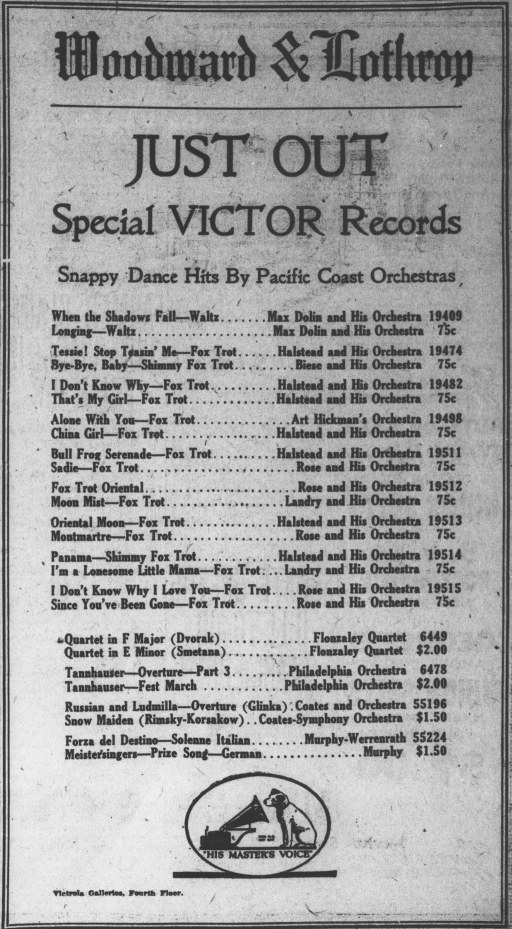
February 17, 1925 Washington Times advertisement for Woodward & Lothrop department store in Washington D.C.