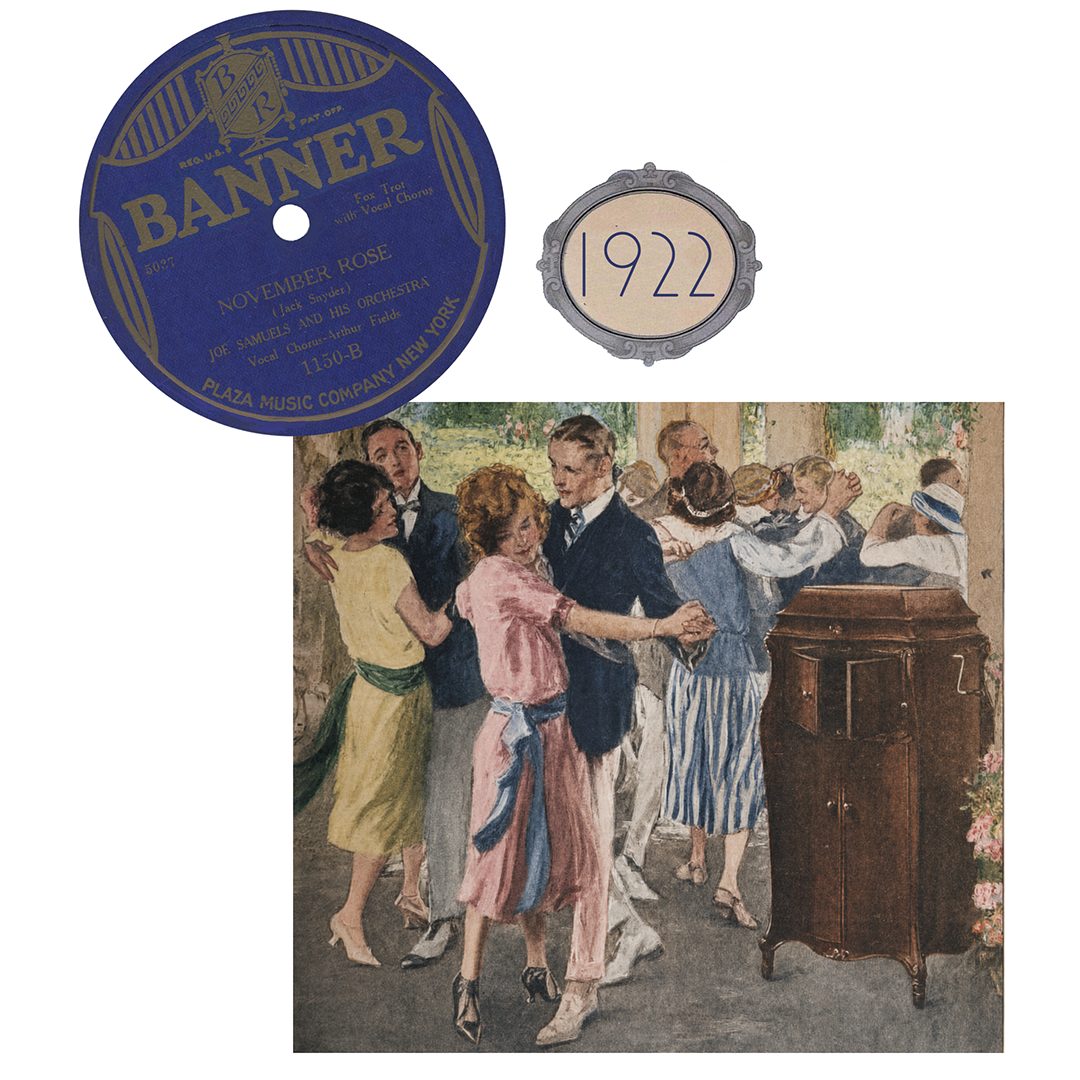
| “November Rose” Joe Samuels and His Orchestra; Arthur Fields, vocal circa December 1922 (Banner 1150-B mx 5027) |
Here’s a recording I recently came across while auditioning records in the Edward Mitchell collection for digitization and inclusion in Radio Dismuke’s playlist. I thought the tune was incredibly catchy and was immediately charmed by it.
What struck me most was the fact that, in many respects, it sounds more like a recording from the World War I era than from late 1922, when the Jazz Age was well underway.
Popular music styles evolved at such a rapid pace throughout the 1920s that recordings from just a very few years earlier were perceived as dated – and that’s not counting the decade’s rapid advances in recording technology.
Indeed, there are passages of this recording that very much remind me of a ragtime-influenced World War I song from 1918, “Oui Oui Marie,” which happens to be among my favorite tunes from that era (which you can hear performed by the same vocalist who appears on the recording here, Arthur Fields, in a YouTube upload at this link).
“November Rose” was composed and published in 1922 by Jack Snyder, who should not be confused with Ted Snyder, who wrote well-remembered hits such as “The Sheik of Araby’ and “Who’s Sorry Now.”
Several recordings of the song were made in late 1922 and early 1923. Most, however, were performed either as a ballad or a waltz. While the few that I have been able to find and listen to online are certainly pleasant, I personally think its delightful melody is much better suited to the sort of happy, peppy dance-tempo arrangement heard on this recording.
Jack Snyder was the son of Herman Snyder, treasurer of the Crown Music Company, a major Tin Pan Alley music publishing firm that had previously been one of Scott Joplin’s publishers (and had no connection to the 1950s-era music publishing company of the same name).
A 1921 trade publication announced that Jack Snyder was forming his own music publishing company, the Jack Snyder Music Company, and that its general manager would be May Waterson, sister of music publisher Henry Waterson, who, at one point, had been one of Herman Snyder’s partners at the Crown Music Company.
Based on mentions in period publications, the Jack Snyder Music Company seems to have enjoyed modest success throughout the rest of the 1920s. But I was not able to determine what became of it or of Jack Snyder afterwards.
Nor was I able to find the answer to whether Herman and Jack Snyder were relatives of the much more famous and previously mentioned Ted Snyder.
Herman Snyder’s partner in the Crown Music Company, Henry Waterson, was also a partner with Ted Snyder and Irving Berlin in the prominent music publishing firm Waterson, Berlin & Snyder.
Because none of the information I found on Ted Snyder suggested a family connection, my strong hunch is that the shared last name and mutual business partner were merely coincidental.
Between 1919 and 1926, Joseph Wilson Samuels’ band was one of the era’s most prolific in the recording studios, with over 400 sides.
For the OKeh label, the band made a number of jazz recordings under its own name and under the pseudonym Tampa Blue Jazz Band. The band also accompanied early black blues vocalists such as Maimie Smith and Lucille Hegamin. It was one of the first, if not the first, white bands to record with black vocalists.
Samuels also recorded for Pathé, Edison, Emerson, Grey Gull, and Gennett. However, the majority of his recordings were with Banner and other affiliated low-priced “dime store” labels, credited under his own name or under a multitude of recording pseudonyms. After 1925, however, his recordings suddenly stopped, and he abruptly disappeared from the public spotlight.
A contributor to Samuels’ Wikipedia entry writes that, per data from Ancestry.com, he lived in Brooklyn, New York, into the 1940s and, in the 1930 census, described his occupation as “musician in a band.” He was described in the 1940 census as an employee of the Kollsman Instrument Co., which made aviation instruments, not musical instruments. He died on July 19, 1953.
The vocal on the recording is provided by Arthur Fields, who was also extremely prolific, recording on over 800 sides between 1914 and the early 1930s. He was also the co-composer of the very charming, and still occasionally performed, 1914 ragtime-era composition “The Aba Daba Honeymoon” (which you can hear performed by Arthur Collins and Byron G. Harlan on YouTube at this link).
As with Joseph Samuels, Arthur Fields also died in 1953. Fields suffered a stroke in March 1953 and, soon after, moved into the Littlefield Nursing Home in Largo, Florida. Early in the morning of March 29, the poorly built and highly combustible building caught fire, resulting in 33 deaths, including Fields.
In addition to Banner 1150, this recording was also issued on Regal 9419 and credited to Joseph Samuels. In Canada, it was issued on the Apex label under the pseudonym The Music Masters.