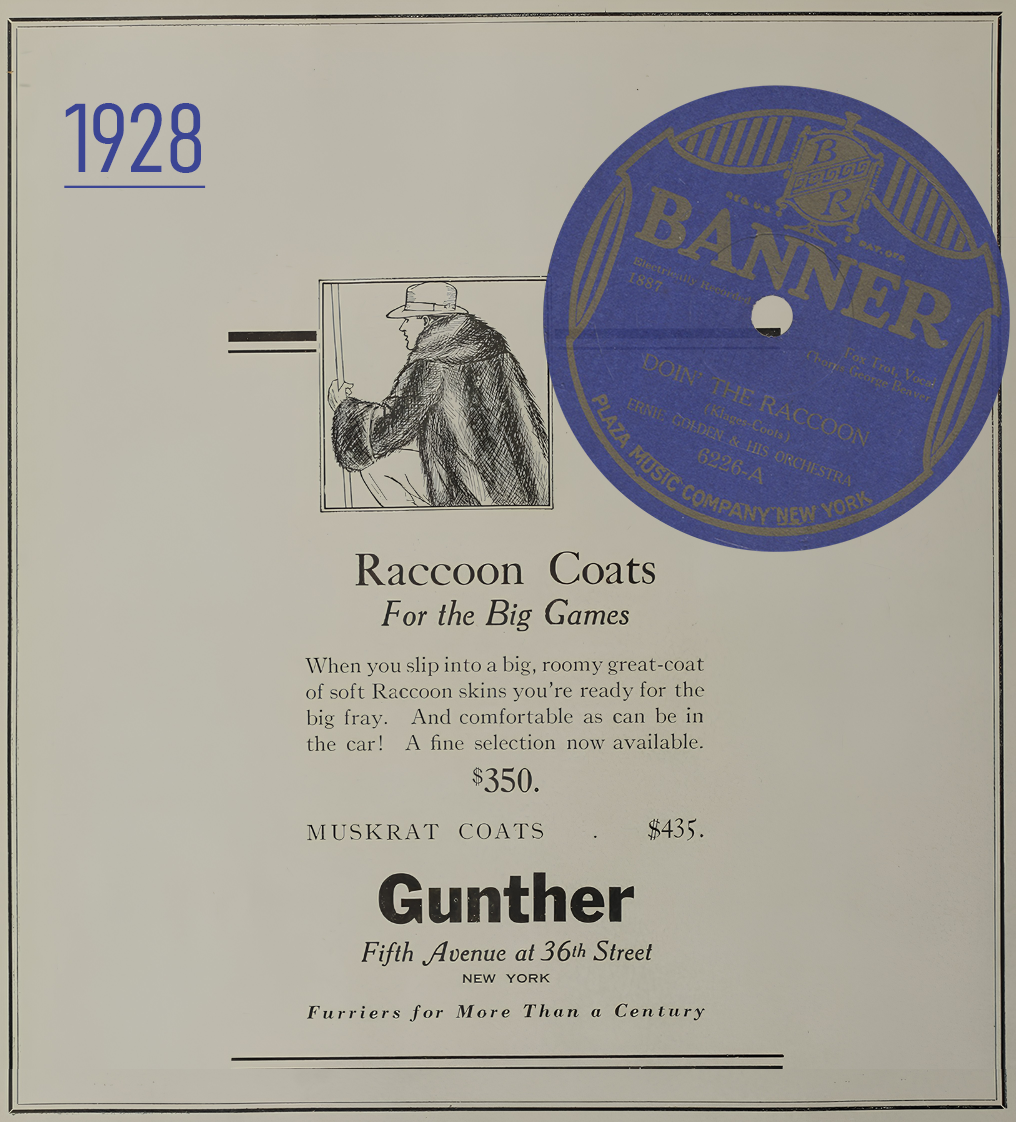
| “Doin’ The Raccoon” Ernie Golden & His Orchestra; George Beaver (Irving Kaufman), vocal November 19, 1928 (Banner 6226-A mx 1887) |
| “Crying Blues” Willie Creager & His Orchestra November 20, 1928 (Banner 6226BB mx 1888) |
From the Edward Mitchell Collection, here are two sides from a record by the low-priced Banner label. Both sides feature “hot” jazzy arrangements, though with quite different moods.
“Doin’ The Raccoon” is a novelty song composed by J. Fred Coots, with lyrics by Raymond Klages, about the culturally iconic 1920s collegiate fashion fad of wealthy Ivy League college men, often with hip flasks of bootleg liquor, wearing full-length raccoon coats while attending college football games and other social events.
While the fad became well-known in the era’s popular culture, because a raccoon coat typically cost $350 in 1928 (approximately $6,800 in 2026 dollars), it was not widespread on most college campuses.
George Olsen and His Music recorded the most famous version of the song, which features more extended lyrics. However, this version by Ernie Golden and His Orchestra features a nice “hot” arrangement after the vocal by Irving Kaufman, who is credited here as George Beaver, one of the many pseudonyms under which he recorded.
Based in New York City, Golden’s band was extremely prolific in the recording studios, cutting records for most of the American labels in existence during the 1920s, with the exception of Victor. Many of the band’s records were credited as Ernie Golden and His Hotel McAlpin Orchestra due to its lengthy engagement at the hotel.
Willy Creager’s band also made records across a wide range of 1920s labels. Creager himself is credited as the composer of “Crying Blues.” I was unable to find any references to other recordings of this composition, nor could I locate a listing or a renewal for it in US copyright records.
Because record labels were required to pay composers’ royalties of 2 cents per record for every copyrighted song they issued, it was not uncommon for low-priced labels to feature the popular song intended to entice people to buy the record on the “A “side, with the “B” side featuring a “throwaway” of a less well-known song as filler.
To save the extra 2 cents royalty per record, these “B” sides often consisted of either public domain songs or unpublished, non-copyrighted material, which in many instances was commissioned directly by the label.
My very strong guess is that “Crying Blues” was such a composition. If so, that certainly doesn’t make the recording any less enjoyable.
The “Crying Blues” side also features a technical glitch.
In the silent passage after the conclusion of the recording and prior to the grooves terminating into the runout area, one can hear some sort of accidental audio from the recording studio. I cannot make out the source of the sound. It occurs to me that it might be a drum or perhaps someone bumped into a microphone or another part of the recording equipment.
I have records from the 1910s where one can hear in the opening grooves the horn that gave the “All Quiet’ signal that sounded just before a recording was made. So perhaps another possibility is that the sound heard at the end of this record was a similar signal to indicate to everyone present that microphones were no longer recording.
Because the glitch occurs after the conclusion of the song, it will not be heard when the recording airs on Radio Dismuke. However, I will post it here so that those who do not have their own copy of the record can hear it.
| Technical glitch in the silent grooves after the conclusion of “Crying Blues” |
Banner was initially created for S.S. Kresge, a dime store chain that, decades later, evolved into the Kmart discount store chain. But, to maximize economies of scale with higher production runs, the label was eventually made available for sale by other retail chains, as well as through wholesale jobbers that supplied smaller chains and independent retailers. During the period these recordings were made, Banner records typically sold for 35 cents each.
To keep Kresge happy, and because of the large size of its orders, an arrangement was made for Kresge to buy the records at a substantial quantity discount. Since they sold for the same 35 cents as those offered by other retailers, this allowed Kresge to enjoy higher margins. Kresge was also guaranteed the widest selection of Banner records of any retailer, and new releases appeared at Kresge before becoming available elsewhere.
The two sides featured here were also issued on the Oriole and Jewel labels, under the pseudonym of Ted White’s Collegians. The use of the pseudonym makes sense given that Oriole Records, sold exclusively through McCrory stores, typically retailed for 25 cents, and Jewel Records, sold through a variety of retail outlets, were often advertised for sale as low as 21 cents. Kresge and other retailers that carried Banner at 35 cents would probably not have appreciated making it easier for customers to discover that identical recordings were available elsewhere at a much lower price.