Background information about the recordings can be found below the audio selections.
“I’d Walk A Million Miles (To Be A Little Bit Nearer To You)”
Frank Black And His Orchestra; Scrappy Lambert, vocal
August 10, 1927 (Brunswick 3619-B)
“Highways Are Happy Ways”
Frank Black And His Orchestra; Scrappy Lambert, vocal
August 10, 1927 (Brunswick 3619-A)
Here is a record from the Edward Mitchell Collection of two songs that were well-known and recorded by several bands in 1927 but quickly forgotten.
“I’d Walk A Million Miles (To Be A Little Bit Nearer To You)”, composed by Gerald Marks with lyrics by Al Lewis, is my favorite of the two.
“Highways Are Happy Ways,” composed by Larry Shay with lyrics by Harry Harris and Tommie Malie, was likely inspired by a “Highways Are Happy Ways” slogan used by the Standard Oil Company of Indiana on advertisements for its Red Crown gasoline and on the road maps distributed by its gas stations.
The vocals on both recordings are provide by Scrappy Lambert.
Frank Black and His Orchestra recorded a couple of dozen or so sides for Brunswick between 1926 and 1928. Black himself was also prominent behind the scenes without label credit on many other recordings and on radio.
Beginning in 1926, he replaced Ed Smalle as the pianist accompanying the popular vocal group the Revelers.
He also directed the Victor recording sessions for the Arden Ohman Orchestra while its stars, the piano duo of Victor Arden and Phil Ohman, were busy playing the prominently featured piano passages.
During the 1930s, Black was music director for the NBC radio network, where he conducted everything from classical music with ensembles such as the NBC String Symphony to popular music with the house bands of several NBC radio programs.
(From 1927 advertisement. Click here to view larger image)
Background information about the recordings can be found below the audio selections.
“Free (Isn’t It The Way It Ought To Be?)”
Flanagan And Allen, vocal
1937 (Columbia FB 1781 mx CA 16606)
“Home Town”
Flanagan And Allen, vocal
1937 (Columbia FB 1781 mx CA 16605)
Here are two recordings by the British comedy duo Bud Flanigan and Chesney Allen, who were immensely popular in Britain during the 1930s and 1940s for their stand-alone comedy act and for being members of the Crazy Gang comedy troupe.
Flanigan and Allen performed both of these songs in musicals featuring the Crazy Gang produced by George Black at the London Palladium.
“Free (Isn’t It The Way It Ought To Be?)” was performed by Flanigan and Allen in the Crazy Gang’s 1936 London Palladium productionO-Kay For Sound, which was subsequently made into a 1937 film of the same name in which they also performed the song.
The song’s reference to LSD, by the way, has nothing to do with the drug, which was not invented until a year later, but rather to£sd, a popular name for Britain’s old pounds, shillings, and pence currency which existed until 1971 when it switched to its current decimal currency.
I think this recording is incredibly catchy and charming. When I first came across it in my collection, I immediately played it back several times.
The film version of O-Kay For Sound can be watched in its entirety on YouTube at this link. You can see Flanigan and Allen perform “Free (Isn’t It The Way It Ought To Be?)” by scrolling to 10 minutes and 10 seconds into the film.
Background information about the recordings can be found below the audio selections.
“Jungle Blues”
Ted Lewis And His Band
April 3, 1928 (Columbia 1525-D mx 145954)
“A Jazz Holiday”
Ted Lewis And His Band; Ted Lewis, vocal
April 3, 1928 (Columbia 1525-D mx 145953)
I have had a copy of this Ted Lewis record in my collection for many years. In 2021, I added the “A Jazz Holiday” side to Radio Dismuke’s playlist.
But, somehow, I have no recollection of ever having listened to the “Jungle Blues” side until a few months ago, as I was looking for records to play on the station’s annual New Year’s broadcast.
How that could happen is beyond me because I think “Jungle Blues,” a Jelly Roll Morton composition, is, by far, the best of the two sides. I prefer Jelly Roll Morton’s recording of the song over Ted Lewis’s. But that does not diminish the fact that I think the Ted Lewis version is also very good.
I do not believe I have a copy of Jelly Roll Morton’s version in my collection. But I have come across a few Jelly Roll Morton records in the Edward Mitchell collection. As I continue to digitize Eddie’s collection for inclusion on Radio Dismuke, I will keep my eye out for a possible copy.
Speaking of Eddie, I acquired the particular copy from which I digitized the two recordings here from him.
In November 2022, I drove to Waco and met up with Eddie to digitize the records he planned on presenting in the upcoming New Year’s broadcast. We recorded the broadcast virtually that year, rather than in person, which required me to digitize everybody’s records before the broadcast.
Before I returned to Fort Worth, Eddie placed several piles of records on a table. They were either duplicates of what he already had or records outside the scope of his collecting interests. He said he didn’t feel like going through the hassle of listing them for sale on eBay. He told me to look through the records for any I might be interested in, and he would let me have them for $1 each.
The record here was one of a boxful that I picked out. When I came across it, I knew I already had a copy of “A Jazz Holiday” in my collection. But I couldn’t recall off the top of my head what sort of condition it was in. But this copy was in beautiful condition. So I went ahead and got it as a possible upgrade copy.
That visit turned out to be the last time I would see Eddie, as he passed away the following August.
So I am now, at long last, correcting whatever oversight caused me to overlook “Jungle Blues” when I added “A Jazz Holiday” to the station in 2021. And I will compare my digitization of “A Jazz Holiday” here with the one I did in 2021 and keep the better of the two in the station.
Background information about the recordings can be found below the audio selections.
“Where’s My Sweetie Hiding?”
Arcadia Peacock Orchestra of St Louis; Chic Harvey, vocal
(OKeh 40254-B mx 8764-A) November 29, 1924
“Let Me Be The First To Kiss You Good Morning”
Arcadia Peacock Orchestra of St Louis
(OKeh 40254-A mx8767-B) November 29, 1924
From the Edward Mitchell Collection, here are two sides by an excellent St. Louis jazz band, directed by violinist Jack Ford, which took its name from the city’s long-since-demolished Arcadia Ballroom.
This band had a rather distinctive, and I think very nice, style. It’s unfortunate that its entire recorded output of twelve sides, made for OKeh between January 1924 and March 1925, was produced with the soon-to-be-obsolete pre-microphone era acoustic recording technology. (The British Parlophone label issued a 1927 electrical recording credited to the Arcadia Peacock Orchestra of St. Louis, but the band on it is the Sol S. Wagner Orchestra.)
In my opinion, both of these recordings are outstanding. “Where’s My Sweetie Hiding?” is by far the jazziest of the two, but I think the band’s arrangement of “Let Me Be the First to Kiss You Good Morning” is incredibly charming, making it my favorite.
While digging around online for information about the band, I came across this interesting article on the Syncopated Times’ website about its banjo player, Porter Brown.
I know that at least one additional record by this band exists in Eddie’s collection. But I am not sure where within the collection it is located. Once I come across it, I will definitely prioritize it for digitization.
Background information about the recording can be found below the audio selection.
“Now’s The Time To Fall in Love” & “After The Ball
Phil Spitalny’s Music; Paul Small, Eton Boys vocal
(Hit of the Week A-2-3 mx 1188) December 1931
Here’s a Depression-era “cheer up” song made popular by Eddie Cantor, who introduced it in the 1931 film Palmy Days and sang it as the theme song on his weekly network radio program.
The recording is from a single-sided cardboard Hit of the Week record and is followed by a shorter “bonus track” featuring a waltz that was a big hit in the 1890s.
Hit of the Week was an attempt to market inexpensive records, sold at retailers such as newsstands and drugstores, featuring the popular songs of the moment during the early years of the Depression.
A few months before this record was released, Hit of the Week expanded the playing time of its discs from approximately three minutes, the standard for 10-inch records of the era, to around five minutes. Sometimes the company would take advantage of the extra playing time by adding a second track. To avoid paying extra royalties, the second track always consisted of a song that was either in the public domain or otherwise not copyrighted.
Phil Spitlany, whose photo appears on the blank back side of the record, was one of the better-known bandleaders who recorded with Hit of the Week regularly. In the band, you can hear xylophonist Sammy Herman, who is prominently featured throughout “Now’s The Time To Fall In Love.” If the “let’s pretend the economy is wonderful” lyrics don’t cheer one up, the xylophone passages will likely do so.
Paul Small worked as a freelance studio vocalist and can be heard on countless popular recordings by most of the major early 1930s record labels. Here he is joined, without any credit given on the label, by the Eton Boys, a male quartet that had become famous through vaudeville and on network radio.
The second track features the 1891 waltz composition “After The Ball.” I find it an interesting pairing with a “cheer-up” song, given that its full lyrics, though not included in the recording, were well-known at the time and are about a tear-jerking tragedy. It is a pretty song, but quite the opposite of cheerful.
Background information about the recordings can be found below the audio selections.
“I’d Love To Go Around With You”
Colonial Club Orchestra; Scrappy Lambert, vocal
(Brunswick 3891-A) March 23, 1928
“I’m Always Smiling”
Colonial Club Orchestra; Scrappy Lambert, vocal
(Brunswick 3891-B) March 23, 1928
From the Edward Mitchell collection, here are a couple of catchy tunes with a pleasant, happy dance band arrangement of style that is uniquely 1920s.
The Colonial Club Orchestra was a recording pseudonym used by Brunswick Records between 1926 and 1931 for dance records of popular songs.
For years, many collectors – including myself – equated the Colonial Club Orchestra with the Bob Haring Orchestra. Some websites, including Bob Haring’s Wikipedia page, continue to do so.
This is entirely understandable because Brian Rust’sAmerican Dance Band Discography credits the vast majority of Colonial Club Orchestra recordings, including the two featured here, to Bob Haring’s band.
However, according to Brunswick’s recording ledgers, the vast majority of Colonial Club Orchestra recording sessions were led by Brunswick’s in-house music director Louis Katzman. Bob Haring led some Colonial Club Orchestra recording sessions in 1929 after he became the music director at Brunswick. But, according to the ledgers and as documented in the Discography of American Historical Recordings (D.A.H.R.), the recording sessions between 1926 and 1928 were led by Katzman.
Harold “Scrappy” Lambert worked as a freelance studio vocalist for most of the major record labels of the 1920s and 1930s. He, and similar studio vocalists such as Irving Kaufman, Smith Ballew, Elmer Feldkamp, and others, made themselves available whenever record labels needed a vocalist to accompany either their in-house bands or even well-known name bands for a recording session.
The recorded output of the studio vocalists mentioned was enormously prolific. D.A.H.R. lists well over 800 sides that Lambert recorded between 1927 and 1931 alone, and he continued to make records well into the 1940s.
Background information about the recordings can be found below the audio selections.
“Lots O’ Mamma”
The Midway Dance Orchestra
(Columbia 33-D mx 81311) October 18, 1923|
“The Black Sheep Blues”
The Midway Dance Orchestra
(Columbia 33-D mx 81312) October 18, 1923
From the Edward Mitchell Collection, here are two 1923 sides by an early Chicago hot jazz band named after a Frank Lloyd Wright-designed indoor/outdoor entertainment complex that was demolished only 15 years after it opened.
The short-lived band, led by Elmer Schoebel, took its name from Midway Gardens, a large entertainment complex designed by Frank Lloyd Wright where the band performed. Earlier in 1923, the band had made recordings for Gennett as the Original Memphis Melody Boys and for Columbia as the Chicago Blues Dance Orchestra.
Elmer Schoebel was a pianist and composer who also worked as an arranger for Isham Jones and music publishing houses, including Warner Brothers. He is best remembered as the composer of jazz standards such as “Bugle Call Rag, ” “Stomp Off! Let’s Go!” “Farewell Blues” and “Prince of Wails.”
Both of these recordings were made during a Columbia field trip to Chicago. Schoebel was also the composer of “Lots O’ Mamma.” “The Black Sheep Blues” was composed by Phil Baker.
Built in 1914, the massive and utterly unique Midway Gardens complex featured both indoor and outdoor dining and entertainment venues. As he did with other projects, Wright designed not only the interior and exterior but also associated items such as furniture, vases, linens, and china. But the endeavor struggled financially, and the arrival of prohibition impacted attendance and cut off a much-needed source of revenue. Sadly, the entire complex was demolished in 1929, just 15 years after it was built.
(Image courtesy University of Chicago Photographic Archive, [apf2-05121], Hanna Holborn Gray Special Collections Research Center, University of Chicago Library.)
Background information about the recordings can be found below the audio selections.
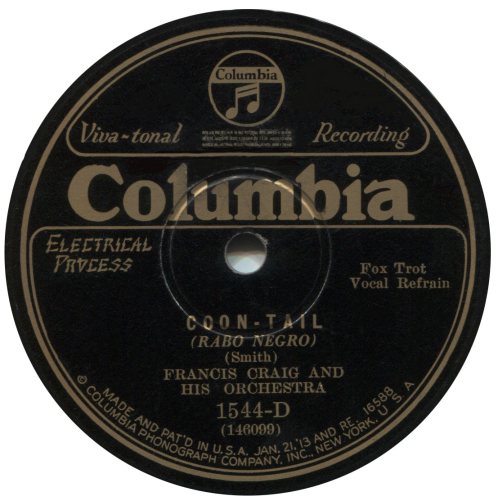
“Coon-Tail”
Francis Craig And His Orchestra
(Columbia 1544-D mx 146099) April 16, 1928
“Red Rose”
Francis Craig And His Orchestra; Billy Scott
(Columbia 1544-D mx 146098) April 16, 1928
This record, from the Edward Mitchell Collection, is among the strangest jazz/dance band records I have come across.
I’m not the only one with that opinion. Here is how the November 1928 edition of The Phonograph Monthly Review described it while reviewing Columbia’s latest dance records:
“…an odd record by Francis Craig, Coon-Tail and Red Rose (1544-D). The latter glorifies in jazz MacDowell’s celebrated wild rose, which, needless to say, grows somewhat wilder still in dance form. Coon-Tail is an exceedingly strange piece with many changes of pace, a veritably lovely smooth middle section, and peculiar ending.”
The Francis Craig Orchestra was based in Nashville, Tennessee. 1925 was a particularly auspicious year for Craig and his band, as they began an engagement at the Hermitage Hotel, an association that would last over 20 years.
That same year, the band also made the first of four trips to Atlanta for a date with Columbia’s mobile recording equipment as part of the company’s regular field trips to record regional talent.
On October 5, 1925, Craig’s band performed on the initial broadcast of radio station WSM, which was owned by two of his uncles and managed by a cousin. WSM’s powerful signal and the band’s regular broadcasts from the Hermitage Hotel made Craig regionally famous, eventually becoming known as the “Dean of Southern Maestros”.
The record featured here was the last Craig would make for almost 20 years. Then, in 1947, when the dance band industry was in steep, irreversible decline and Craig was preparing to wrap up his career, he recorded two sides for an obscure local record label. To everybody’s surprise, it became a huge hit and spent an unprecedented 17 weeks at the top of the music charts, a record that stood for over 50 years. It not only resulted in sudden national fame for Craig, it also helped put Nashville, which today is widely known as “Music City,” on the musical map.
The Phonograph Monthly Review’s description of “Coon-Tail” as “exceedingly strange” is, in my opinion, spot on.
The strangeness begins the moment one looks at the record label, which describes the song as “Fox Trot – Vocal Refrain.” Yet nowhere during the recording is there any sort of vocal.
Then there’s the unusual title “Coon-Tail.” I did quite a bit of digging to find the title’s intended meaning, and came up empty.
A websearch for the terms “coon tail” and “coontail” turned up a few possibilities, including one that is rather unpleasant. But none of them strike me as strong enough to form the basis of a good guess.
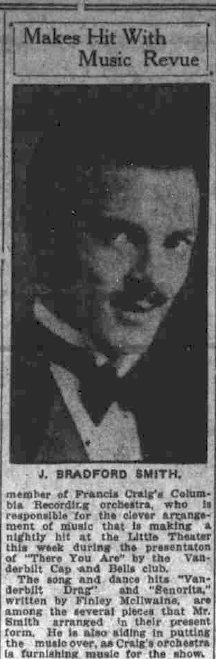
The song was composed by J. Bradford Smith, who worked for Craig as a trombonist and arranger in the late 1920s and early 1930s.
A column in the April 28, 1928 issue of The Billboard referred to the recording session this record is from and provided a listing of the band’s roster at the time:
Francis Craig and his orchestra have just finished recording four sides for Columbia. In the Craig lineup are Francis Craig, piano and director; Charles Nagy Jr., violin; Herbert Guy, Rolly Thatcher and Cecil Bailey, reeds; Billy Scott and Malcolm Crain, trumpets; Bradford Smith, trombone and arranger; Powell Adams, drums; Max Hart, banjo and guitar; and Jack Hamilton, bass.
In 1930, when Francis Craig contracted tuberculosis and spent a year recuperating in a Denver sanitarium, J Bradford Smith filled in as the band’s leader. He left the band sometime around August 1931.
Smith’s November 2, 1928 copyright registration for “Coon-Tail” describes it as “melody with pianoforte accompaniment” and lists Nashville as his location. It also indicates that the song was unpublished, which, since there was no US federal copyright protection for sound recordings at the time, means that it was not printed and made available for public purchase in sheet music form. The copyright listing makes no mention of any lyrics that might provide a clue to the title’s meaning – and given the nature of the song, I don’t know how anyone could set lyrics to it.
Among the possible sources of inspiration for the song’s title is a species of aquatic plants that is sometimes referred to as “coontail” or “coon’s tail.” But period and cultural references to the plant are sparse, which suggests to me that it’s an unlikely guess.
The western diamondback rattlesnake is sometimes referred to as a “coontail rattlesnake.” But the snake’s natural range is nowhere close to Nashville, so it’s difficult to imagine the band’s core audience being familiar with such a reference.
A more likely possibility is that it is a reference to the tail of a raccoon, particularly in the context of the tail hanging from a coonskin cap, which is traditionally associated with Tennessee and surrounding states.
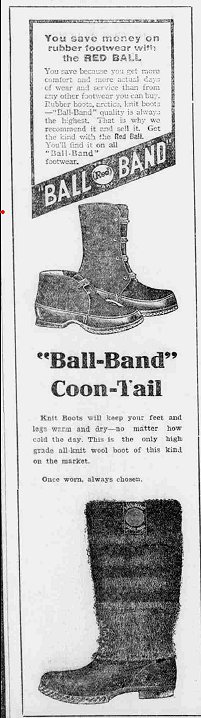
Another possibility is the then-widely advertised “Ball Band Coon-Tail” boot, made by Red Ball, a company that manufactured rubber boots. Their “Coon-Tail” boots featured a knit wool upper portion which, based on drawings in period advertisements, was striped and resembled the markings on a raccoon’s tail.
Finally, given the cultural attitudes of the time, one can’t rule out the possibility that it might be a reference to an extremely disparaging ethnic slur against black people. During the 1900s and into the 1910s, countless recordings of “coon songs” ridiculing blacks were issued. By 1928, however, while racism was still pervasive and deeply institutionalized, the popularity of “coon songs” had mostly died out and new recordings of that genre had become rare.
What gives some credence to this being a possibility is the label’s Spanish translation of the title as Rabo Negro – which translates to “black tail.” Such translations were often provided on records that US-based labels intended to market in various Latin American countries. I was not able to find any reference through online translation tools to Spanish words that in any way equated “black” with either “coon” or “raccoon.” That suggests, to me, that whoever made the translation likely did intend for the word “coon” to refer to the racist slur.
But, even if so, I don’t think it necessarily reflects what J. Bradford Smith or Francis Craig intended for it to mean. It is highly doubtful that either Smith or Craig would have been asked to provide a Spanish translation for the titles of the songs they recorded. Most likely, such translations were the responsibility of someone in whatever department prepared the label text for a given release. Perhaps it was an older, long-time employee who had been with Columbia since the days when “coon song” records were still being widely issued and reflexively assumed that same context when he saw the song’s title. Or perhaps it was just the same genius who placed “vocal refrain” on the label when the recording, in fact, has no vocal.
Regardless, when it comes to instrumental songs, titles don’t matter all that much. What counts most is the music itself. And that’s where the record becomes even stranger.
The song consists of a hodgepodge series of seemingly unrelated musical passages and, to use The Phonograph Monthly Review’s words, “with many changes of pace… and peculiar ending.”
It also contains multiple snippets of musical quotes referencing other well-known compositions. I counted four such compositions, and there may be others that I did not pick up on.
Between 1:17 and 1:25, one can hear passages that sound very similar to those in Rube Bloom’s 1927 composition “Soliloquy.”
Beginning at 1:31, one can hear brief snippets that are clear references to George Gershwin’s “Rhapsody in Blue” and another one at 2:03.
Starting at 2:15, one can hear “Tiger Rag” and, at 2:30, the jazz standard “Copenhagen.”
The recording is, in no way, unpleasant to listen to – but it is….strange.
To add a further mystery to the record, I came across a mention in a local Nashville newspaper about the recording session it is from.
During that recording session, the Francis Craig band recorded two additional selections, “Dream River” and “All Day Long,” both of which were issued on Columbia 1440-D.
The following appeared in the April 15, 1928 Nashville Tennessean:
Francis Craig and his recording orchestra has just returned from a trip to Atlanta where they made four records, the selections recorded being “All Day Long,” “Green River [sic],” “Dinah” and “Red Rose”….
Moreover, neither discography makes any mention of an unissued take of “Dinah” having been made – something they usually do. And the newspaper makes no mention of “Coon-Tail” having been recorded.
D.A.H.R also, by the way, incorrectly lists the recordings as having been made in New York City. But that is incorrect, based not just on the evidence already covered here, but also on its own listings of the matrix numbers of the recordings immediately before and after Craig’s April 16 titles, which state that they were recorded in Atlanta on the same day. An entirely different block of matrix numbers would have been used for recordings made that day in Columbia’s New York studios.
If I were to venture a guess about the recording’s strangeness, it would be based on the fact that Craig’s band did not just perform popular music and jazz during this period. It also performed concerts of classical music and accompanied local theatrical productions. During that period, popular bands would sometimes perform “concert-style” jazz arrangements intended for “highbrow” audiences in venues where one might typically hear classical music, rather than audiences looking for jazzy music they could also dance to. Paul Whiteman’s band, in particular, was well-known for recordings of that genre. “Coon-Tail” strikes me as an attempt in that direction.
But, if so, what is odd here is that “concert” style recordings were usually marketed and clearly labeled as such, and were often issued on 12-inch rather than 10-inch records, and frequently sold for a higher price. But this recording was labeled as a “fox trot” and was offered as part of the same catalog number series as any other Columbia dance band release. Any buyer looking for a typical dance record was definitely in for a surprise when they returned home and placed it on their phonograph.
One possible explanation that occurs to me is that the original intent of both the band and Columbia was for the recording of “Dinah,” mentioned in the newspaper article, to be included with the other three songs recorded that were eventually issued. Perhaps “Coon-Tail” was something recorded to either humor the band or maybe as a de facto audition for Columbia executives in New York for possible future recordings of that ilk. This record was issued about three months after the other record from that recording session. Maybe there was some concern in New York about the recording made of “Dinah,” or maybe someone really liked “Coon-Tail” and a decision was made to issue it instead.
Should I come across any additional information about the intended meaning of the “Coon-Tail” title or the recording of “Dinah” that is not mentioned anywhere else, I will update this posting accordingly.
“Red Rose, ” based on Edward MacDowell’s 1896 “To A Wild Rose,” was composed by Francis Craig in 1928 and dedicated to his wife. Craig used “Red Rose” as the theme song on his band’s WSM broadcasts, and thus it became well-known in Nashville and throughout the South.
In 1947, when the popularity of dance bands was rapidly fading, Craig was preparing to retire from his many years at the Hermitage Hotel. He was approached by the owner of a small, local label, Bullet Records, to make another recording of “Red Rose.” Craig agreed to do so but needed to find a song for the record’s B-side.
The particular choice of song for the B-side was not regarded as extremely important, as the marketing of the record was to be strictly based on the fame of “Red Rose.” Craig chose a tune that he had written called “Near You.” Previously, during a visit to Nashville, lyricist Kermit Goell met up with Craig at the Hermitage Hotel’s restaurant. Craig sounded the tune out on a piano and mentioned he needed lyrics for it, which Goell jotted down on one of the restaurant’s menus. Neither Craig nor Goell had a particularly high opinion of the song, and neither thought it had much potential.
When the record was initially released, sales were slow, as expected. But when a disc jockey in Griffin, Georgia decided to check out the B-side and began playing it, a surge of orders for the record came in. Eventually, the song was picked up by disc jockeys in Atlanta and then, one by one, other large radio markets. Ultimately, two and a half million copies of the record would be sold, and “Near You” would top Billboard’s radio airplay chart for a record 17 weeks. The record’s success is credited by many as helping put Nashville on the musical map and helping it become what is now known as “Music City.”
You can hear Craig’s recording of “Near You” via YouTube at this link. And you can listen to an uploader’s British pressing of Craig’s 1947 version of “Red Rose” at this link, also via YouTube. Reflecting its time, it has an arrangement very different from the one used for the 1928 recording.
Background information about the recordings can be found below the audio selections.
“Just Another Day Wasted Away (Waiting For You)”
The OKeh Melodians; Vaughn De Leath, vocal
(OKeh 40839 mx 81-011) June 14, 1927
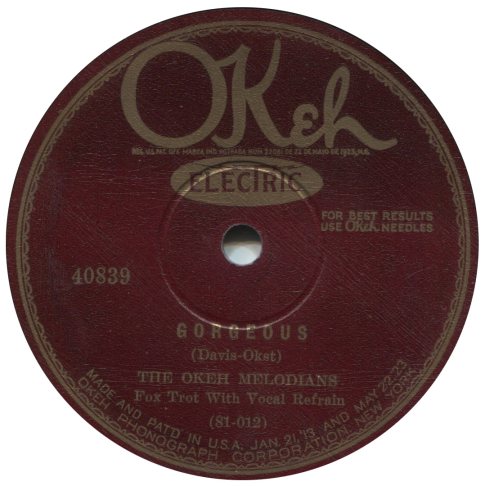
“Gorgeous”
The OKeh Melodians; Vaughn De Leath, vocal
(OKeh 40839 mx 81-012) June 14, 1927
From the Edward Mitchell Collection, here are two sides by the OKeh Melodians, one of many recording pseudonyms used by the Sam Lanin orchestra.
The OKeh label was purchased in late 1926 by Columbia, which allowed it to operate as an independent subsidiary. By the time these recordings were made, OKeh was using the same electric recording process and super-quiet laminated playing surfaces found on Columbia’s “Viva-Tonal” records. In my opinion, they are, by far, the best-sounding 78 rpm records of the period in terms of both production quality and playback quality.
Vaughn De Leath provides the vocals on both recordings. Though she is, unfortunately, largely forgotten today, she was a true pioneer and one of the more ubiquitous and widely recognized female vocalists of the 1920s.
De Leath was among the first to employ a new vocal style made possible by the advent of the microphone, known as crooning. She was the first female vocalist to achieve fame through radio. Her first broadcast took place in January 1920 on an experimental station operated by Lee de Forest, some ten months before the initial sign-on of the very first commercial radio station, KDKA, Pittsburgh. This resulted in her being billed as “The Original Radio Girl” and the “First Lady of Radio,” a title she defended in court when Kate Smith began using it. She was also the first woman to manage a large-city radio station.
Vaughn De Leath did not have an exclusive contract with any particular record label and thus freelanced as a studio vocalist for most of the major labels of the 1920s. She recorded well over three hundred sides, some issued under her name, some under a variety of pseudonyms, and others, such as the two here, credited only by the phrase “with vocal refrain.” Most of her recorded output was on Columbia, Brunswick, Edison, and OKeh, but she also recorded for Victor, Gennett, and the various dime-store labels produced by the Plaza Music Company and its successor, American Recording Company.
In 1928, she made history in another brand-new broadcasting medium by performing vocals in a series of experimental television broadcasts.
De Leath’s career faded during the 1930s. The Depression had a devastating impact on the record industry, which resulted in fewer opportunities for recording sessions. She made her last records in 1931. By the late 1930s, she was living in Eaton, Connecticut, and no longer appearing on network radio, though she continued to perform on local New York radio stations. She died in 1943 at age 49.
Here is a link to an article I stumbled across that provides a bit more detail about her later years than I have seen elsewhere, as well as some interesting photographs.
Background information about the recording can be found below the audio selection.
“Charley My Boy”
N.M.L. Dance Orchestra
(National Music Lovers 1097-B) circa July 1924
Here’s a recording from the Edward Mitchell Collection, credited under the generic-sounding N.M.L. Dance Orchestra, but which is actually by Fletcher Henderson and His Orchestra.
National Music Lovers was an early 1920s endeavor to market inexpensive phonograph records by selling directly to consumers by mail. The company offered different series of records based on musical genre, with each series having a different label color. The one here comes from the Dance Series, which had a red label.
The records were extensively marketed in newspapers and magazines. They were sold in sets of eight double-sided records – 16 musical selections – for $2.98 C.O.D plus delivery, a little over 37 cents per record, with a ten-day satisfaction guarantee. In today’s currency, $2.98 in 1924 is worth approximately $55.73, or a little under $7 per record. When National Music Lovers made its debut, records from major labels like Victor, Columbia, and Brunswick sold for 75 cents, while those from lower-priced labels typically sold for 50 cents.
Every few months, a new series of 16 song titles was advertised, and the previous series was discontinued.
As the 1920s progressed, other low-priced records began to appear on the market that could be purchased individually at retail stores at prices comparable to or less than those of National Music Lovers – and without requiring a minimum purchase of eight records with pre-selected musical content, bundled as a set. This significantly undercut the National Music Lover’s value proposition, and by the end of 1927, the label was out of business.
The business partners who owned the company, Harry Scherman and Maxwell Sackheim, had previously founded the Little Leather Library series of inexpensive, bundled sets of small-sized reprints of classic books. The individual books from this series are still relatively easy to find in antique shops and secondhand stores. Scherman left National Music Lovers in 1926 to found a new mail-order service, Book of the Month Club, which is still in business today.
National Music Lovers did not have any recording facilities, but instead leased masters from other record labels. Thus, in most cases, content on National Music Lovers records is duplicated with recordings issued under different artist credits on other labels.
Fletcher Henderson recorded “Charley, My Boy” sometime in July 1924 for release on the Plaza Music Company’s Banner and Regal labels, with artist credit to Henderson. Plaza also issued it on its lower-priced Domino label, under the pseudonym of the Club Alabam’ Orchestra. It also leased the recording for release on other labels besides National Music Lovers under different pseudonyms.
Several bands and vocalists recorded “Charley My Boy” when the song was published in 1924, with Eddie Cantor’s version on Columbia being among the most popular.

 (From 1927 advertisement. Click here to view larger image)