Dol Dauber’s Dance Orchestra/Austin Egen – 1930

HMV B-5905 label image "You Have Become So Terribly Blonde Lately" Dol Dauber's Dance Orchestra; Austin Egen


Background information about the recordings can be found below the audio selections. 


“You Have Become So Terribly Blonde Lately”
Dol Dauber’s Dance Orchestra; Austin Egen, vocal
(HMV B-5905 mx BW 3107)                                           January 6, 1930


“Oh Donna Clara”
Dol Dauber’s Dance Orchestra; Austin Egen, vocal
(HMV B-5905 mx BW-3111)                                          January 7, 1930


Here’s a British HMV record I found in the Edward Mitchell Collection.  With a title like “You Have Become So Terribly Blonde Lately,” how could anyone resist giving such a record a spin to see what it was all about, especially since British labels tended to issue material that was far more risque than what American labels felt comfortable with?

It turned out not to be anything near what I was expecting.   In fact, it isn’t even a British recording.  And despite the English language title, the lyrics are actually in German!

Both sides of this record were recorded in Vienna, Austria.

This is not the first time I have come across a British pressing of a recording from a German-speaking country released with an English language title and no mention on the label that the lyrics are not in English.   Interestingly, it does not appear to have been issued in Germany by Gramophone Co./HMV’s German subsidiary label, Electrola – only on HMV in Great Britain and in the countries that had been part of the former Austro-Hungarian Empire.

I was able to find an English translation of the song’s lyrics:

Lately you’ve become so terribly blond,
Become so blond,
Become so blond.

Your hair has become more yellow than the pale moon,
Become the moon.
How come?

Before you were once black like the night.
Who would have ever thought that?

Lately you’ve become so terribly blond,
Become so blond.
Yes, how come?

I also came across a comment someone put online explaining that the lyrics poke fun at a fad occurring at the time, which had ladies dying their hair blonde to emulate certain film stars, such as Lillian Harvey, who was enormously popular.

Originally titled “Du bist in letzter Zeit so schrecklich blond geworden,” the song was co-composed by Franz Grothe, Fritz Rotter and bandleader Dajos Béla, whose band also made a recording of it.

The flip side features a nice rendition of “Oh Donna Clara,” which achieved worldwide popularity and was recorded by countless artists in the early 1930s and the decades since.

The song, originally titled “Tango Milonga,” was written by Polish composer Jerzy Petersburski and was first performed in the 1929 musical revue Warszawa w kwiatach (Warsaw in Bloom).  When the song made its way to Vienna, it caught the attention of the music publishing house Wiener Boheme Verlag, which purchased its rights.   German librettist Fritz Löhner-Beda provided it with German lyrics and renamed it “Oh, Donna Clara.”  Löhner-Beda would later be murdered at the Monowitz concentration camp in 1942.

“Oh, Donna Clara” was included in the musical production Die Wunder-Bar; ein Speil im Nachtleben (The Wonder Bar, A Play About Night Life) which opened on February 2, 1930 at Vienna’s Kammerspiel Theater.   The recording here was made less than a month before the production’s opening.  It was common for record labels to record songs from upcoming shows so that they would be available in time for audiences to purchase them.

On December 5, 1930, Die Wunder-Bar opened in London as The Wonder-Bar, as well as in New York on May 17, 1931.  As a result, several bands in the United States and Britain made 1931 recordings of “Oh, Donna Clara.”

Violinist Dol Dauber led a band that was popular during the 1920s and 1930s in Germany, Austria, and, particularly, Czechoslovakia.  Despite being Jewish and spending World War II in Czechoslovakia under Nazi occupation, he somehow managed to avoid being sent to a concentration camp and survived the Holocaust.  His son, however, was not so fortunate and perished at Dachau.

The vocals on both sides are provided by Austrian-American pianist, composer, and actor Austin Egen. However, as was often the case at the time, no vocal credit is provided on the label.  Egen made a very large number of vocal recordings, accompanying himself on the piano as well as with many top European bands of the 1920s and 1930s.  He is one of my favorite German language crooners of the period.

Posted in Uncategorized | Tagged , , , , , , , | Leave a comment

Ray Miller And His Orchestra – 1926

Brunswick 3132-B label image. "Sign Of The Rose" Ray Miller & His Orchestra


Background information about the recordings can be found below the audio selections. 


“Sign Of The Rose”
Ray Miller And His Orchestra
(Brunswick 3132-B)                                     March 9, 1926


“Stomp Your Stuff”
Ray Miller And His Orchestra
(Brunswick 3132-A)                                  March 9, 1926


Here is a record by Ray Miller and His Orchestra I came across in the Edward Mitchell Collection that immediately brought back a flood of memories for me.  This was not the first time that I handled this particular record.  Back in early 2006, I made a transfer of the “Sign Of The Rose” side.

In those days, Eddie was one of the guest contributors to a long-since-discontinued vintage recordings blog that I published.

I vividly remember how impressed I was with the recording while transferring it.  It has a certain quality that I find to be very haunting.

After Eddie’s posted about it in the blog, I added the recording to Radio Dismuke’s playlist, where it has remained ever since. Whenever I hear it in the rotation, I automatically think of Eddie.

What I had forgotten over the years was just how fond Eddie was of the recording.

The other day, I came across the following comment Eddie made about it in 2014 in an online conversation:

 If I had to name one tune that I like better than any other, it would be this one…I want it played at my funeral.

It is too bad that the people in charge of planning Eddie’s actual funeral in 2023 were as unaware of this comment as I was; otherwise, it absolutely would have been played at his funeral. At the laying of his headstone, however, several of his friends gathered and played on a portable wind-up phonograph another of Eddie’s favorite records, “Excelsior” by the Los Castilians on Brunswick 40250, another very haunting and also hard-to-find recording.

Here is what Eddie wrote about the song in his 2006 blog posting:

“Sign Of The Rose” was recorded about halfway through Miller’s recording career in May, 1926. This is one of those records that I absolutely think of as an all-time favorite and wouldn’t part with for anything. It’s a rather obscure song and was not, as far as I can determine, recorded on any other label. It also served as Ray Miller’s radio theme song according to my long-time collector friend Mr. Gottlieb. There is also some mystery as to the composer as I’ve been fortunate in getting the sheet music for it. The composer credit on the record is Edwards (Gus?), but the sheet music credits words by Sammy Lerner and Billy Rose, music by Buddy Fields and Richard Whiting–it’s absolutely the same song. I’m not a music major, but I think the style of the song is in what’s called question/answer–one phrase will pose a “question”, then the next will resolve it with an “answer” – and I may be all wet about that, too. My favorite section has always been towards the end where the chorus is played by the soprano saxophones. Mr. Gottlieb only had one copy of it, so it was not for sale–I had to come up with a really good trade to obtain it. One day, I found a record by Tony Parenti’s New Orleanians ” In the Dungeon”/”When you and I were Pals.” One listen and Mr. Gottlieb traded it to me, but not before he kissed it good-bye!

Mr. Gottleib, of whom Eddie spoke frequently and fondly, was R.E.M. (Bob) Gottlieb, a Waco record collector who began collecting 78 rpms when they were still brand new in the 1920s and, by the time Eddie met him in the late 1950s, had amassed a large and significant collection.  Based on a comment he made elsewhere, it was sometime around 1967 when Eddie fell for the recording after hearing Mr. Gottleib play it and began plotting a trade for it that Gottlieb couldn’t resit.

The recording on the flip side, “Stomp Your Stuff,” is one that I had not heard until I recently came across the record in Eddie’s collection.  It is also an excellent recording, and much jazzier than “Sign Of The Rose.”

Even though my 2006 transfer of “Sign Of The Rose” is already in Radio Dismuke’s playlist, since I had the record in front of me, I decided to make a new transfer, as the audio restoration tools I have available to me today are better than what I had in 2006.

And the new audio restoration presented here is definitely an improvement.  I was able to remove some remaining crackle that I had no way to address in 2006 without introducing distortions that would have been worse than the crackle itself.   Plus, some instruments, particularly the banjo, can be heard more vividly than on my original restoration.   Thus, on the next Radio Dismuke playlist update, I will upgrade the 2006 transfer with this new one.

One of the things I always enjoyed about Eddie, and that many listeners who heard him on various Radio Dismuke special broadcasts have mentioned enjoying, was that he frequently had an anecdote about his records – things like whose collection it had previously been part of, how he happened to come across it, etc.   So this particular copy of Brunswick 3132 is one that Eddie and I both have fond anecdotes about.  And, perhaps, Mr. Gotlieb had one as well that has since been lost to time.


Posted in Uncategorized | Leave a comment

Casino Dance Orchestra/Bennie Krueger & His Orchestra – 1921

Pathe Actuelle 020579 label image "Stolen Kisses" Casino Dance Orchestra


Background information about the recordings can be found below the audio selections. 


“Stolen Kisses”
Casino Dance Orchestra
(Pathe 020579-B)                        circa May 1921


“Julienne”
Bennie Krueger And His Orchestra
(Pathe 020579)                          June 8, 1921


Here are two rather charming recordings from a 1921 Pathe Actuelle disc.

“Stolen Kisses” is a Ted Snyder composition.  Snyder was a highly successful songwriter and music publisher, best remembered today for songs such as “The Sheik of Araby” and “Who’s Sorry Now?” which remain well-known.

The identity of the band on this recording is not known, as Pathe’s recording logs have long been lost.  The Casino Dance Orchestra was a pseudonym that Pathe assigned to recordings made by several bands for the label.  Discographer Brian Rust speculates that the band on this might have been either the Nathan Glantz Orchestra or Joseph Knecht’s Waldorf-Astoria Dance Orchestra.   Whoever the band might have been, its saxophone player provides some nice Rudy Wiedoeft-style passages.

“Julienne” is a Roy TurkJ. Russell Robinson composition, billed on the record’s label as a “Franco-American Foxtrot.”  While both Turk and Robinson were well-known composers, this particular song seems to have been rather obscure as I was not able to find much information or even very many references to it during my online research.

Prominent on this recording is the Bennie Krueger Orchestra’s banjo player Bill Arenburg.  The banjo was an essential part of the rhythm section of the early jazz and dance bands in the era before the advent of electrical amplification.  Banjos are loud and could cut through and be heard over the ensemble of the various brass instruments.  They also reproduced well under the constraints of the limited frequency response of pre-microphone era acoustic recording technology.

Pathe records during this period were made through an unusual and utterly unique process.  I previously wrote about it in some detail in this May 4, 2024 posting.


Posted in Uncategorized | Leave a comment

Recent Radio Dismuke Playlist Additions 1928-1932

Hit of the Week 1158 lbel image "Just One More Chance" Hit of the Week Orchestra

Here are a few recordings recently added to Radio Dismuke’s playlist.  You can find brief background information about them below the audio links. 


“Talkin’ To Myself”
Rex Gordon’s Aces; Norman Wallace, vocal
(Champion 15576 A)                                         September 17, 1928


“If It Aint Love”
The Nitecaps, vocal
(Columbia 2648 D mx 152170)                      April 11, 1932


“Down Georgia Way”
Jack Purvis And His Orchestra
(Parlophone R698 mx 403893)                      April 4, 1930


“With You”
Sam Browne, vocal
(Edison Bell Radio 1357 mx 89792)              July 1930


“Just One More Chance”
Hit of the Week Orchestra; Scrappy Lambert, vocal
(Hit of the Week 1158)                               July 1931


Here are a few of the recordings recently added to Radio Dismuke’s playlist that particularly impressed me for one reason or another.

“Talkin’ To Myself” is a catchy and infectiously happy recording with a very nice archetypal late 1920s “hot dance” arrangement.   Rex Gordon’s Aces was a recording pseudonym for another pseudonymous band, the Carl Fenton Orchestra.

Carl Fenton was initially a pseudonym used on a prolific output of recordings by the in-house Brunswick studio band led by the company’s music director Gus Haenschen.  The widespread distribution of the records resulted in a demand for in-person appearances by the non-existent band.  The job of fronting the “Carl Fenton” band in public was assigned to Ruby Greenberg, who was a violinist for Harry Reser’s band and had participated in the ensemble used for Carl Fenton recordings.   When Gus Haenschen left Brunswick in 1927, Greenberg purchased the rights to the Carl Fenton name.

This version of the Carl Fenton Orchestra recorded many dozens of sides between 1927 and early 1930, including the one here,  under a variety of pseudonyms for Gennett and its subsidiary label Champion.  In 1932, Greenberg legally changed his name to Carl Fenton, which he kept for the rest of his life.

“If It Aint Love” comes courtesy of the collection of Matt From College Station, on what I suspect is a rather rare record.

The Nitecaps (sometimes billed as the 3 Nitecaps) were a vocal trio consisting of Ray Kulz, George MacDonald, and Jimmy Noel.  The group, which had previously worked for Ted Lewis’ band, joined up with the Paul Whiteman orchestra in early 1932 to replace the King’s Jesters vocal quartet that had recently left the Whiteman organization.   Whiteman subsequently renamed the Nitecaps to the Rhythm Boys,  the same name as the band’s earlier and most famous vocal trio, which consisted of Harry Barris, Al Rinker, and Bing Crosby.

“Down Georgia Way” also comes from Matt From College Station’s collection on a British pressing of a multi-racial recording session that trumpet player Jack Purvis led for the American OKeh label.   While there had been previous multi-racial recording sessions, in 1930, they were still rare occurrences.  You can read about Jack Purvis’s erratic and troubled life at this link.

“With You” is an Irving Berlin composition introduced by Harry Richman and Joan Bennett in the 1930 film Puttin’ On The Ritz.   This version, with the song’s full lyrics, is performed by Sam Browne, one of the top British vocalists of the 1930s.  He recorded over two thousand sides and accompanied most of the prominent British dance bands of the era.

“Just One More Chance” is a Sam Coslow/Arthur Johnston composition that was first recorded by the Abe Lyman orchestra but made famous by Bing Crosby, who performed in a 1931 musical short feature, One More Chance.

The recording here is from a single-sided cardboard Hit of the Week disc I played during Radio Dismuke’s New Year’s broadcast a few months ago.

Hit of the Week was an attempt to revive Depression-era record sales by basing its business model on the magazine industry.  Like magazines, the records were sold at outlets such as newsstands and drug stores.  They offered popular songs of the day at a low price, with a new release hitting the newsstands every Thursday.  The records were paperboard laminated with a resin material called Durium, which the label’s parent company, Durium Products, was named after.

Other than a tendency to curl, Hit of the Week records have managed to hold up surprisingly well over the decades.   While their fidelity did not match the improvements that Victor and Columbia were making during the same period,  Hit of the Week records, with their laminated surface, usually play back very nicely with far less surface noise than conventional shellac records of the period.

On this recording, you will hear an opening announcer touting another of the label’s technological achievements –  a longer playing time of up to five minutes, compared with approximately three minutes per side for a conventional 78 rpm record.

Posted in Uncategorized | Leave a comment

Louis Dumaine’s Jazzola Eight – 1927

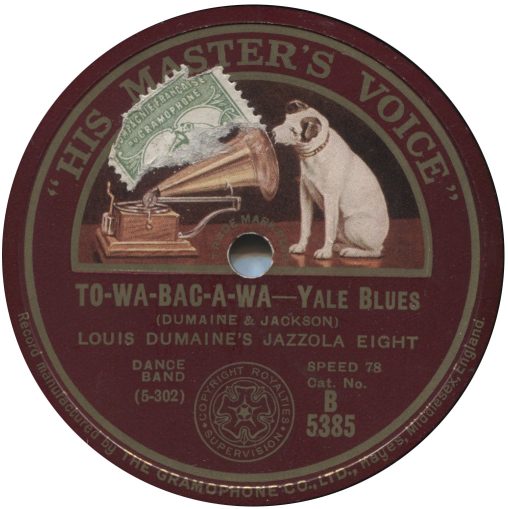
HMV B-5385 label image 'To-Wa-Bac-A-Wa' Louis Dumaine's Jazzola Eight


“To-Wa-Bac-A-Wa”
Louis Dumaine’s Jazzola Eight
(HMV B-5385 mx A-37978)               March 7, 1927


“Pretty Audrey ”
Louis Dumaine’s Jazzola Eight
(HMV-B 5385 mx A-37977)             March 5, 1927


From the Edward Mitchell collection, here is a British pressing of a record made by the Victor Talking Machine Company during a March 1927 field trip to New Orleans. The royalty stamp on the label suggests it was likely exported for sale in France.

Both sides are excellent examples of New Orleans-style jazz, which saw renewed interest and revival in the 1940s and 1950s as “Dixieland” jazz.

Louis Dumaine, a well-regarded cornet player and bandleader in New Orleans, cut four sides for Victor on March 5 and 7, constituting his band’s entire recorded output under its own name. On March 5, the band provided uncredited accompaniment for two sides by blues vocalist Genevieve Davis, and on March 7, a smaller ensemble of its musicians accompanied two blues selections by Ann Cook.

The American issue of this record was on Victor 20723, with “To-Wa-Bac-A-Wa” described as Creole Blues. The British issue, however, describes it as Yale Blues, likely because Yale Blues was both a song title and the name of a popular dance in Britain at the time. “To-Wa-Bac-A-Wa” later became famous as “My Bucket’s Got A Hole in It,” recorded by various artists and becoming a hit for Hank Williams.

Ralph Sylvester Peer, the session supervisor for the March 1927 New Orleans recordings, was a record producer and talent scout for “race” and “hillbilly” records at the OKeh and Victor labels. In that capacity, he was responsible for discovering many important jazz, blues, and country artists. You can find an interesting article about his career at this link.

Posted in Uncategorized | Tagged , | Leave a comment

Nat Shilkret And The Victor Orchestra – 1929

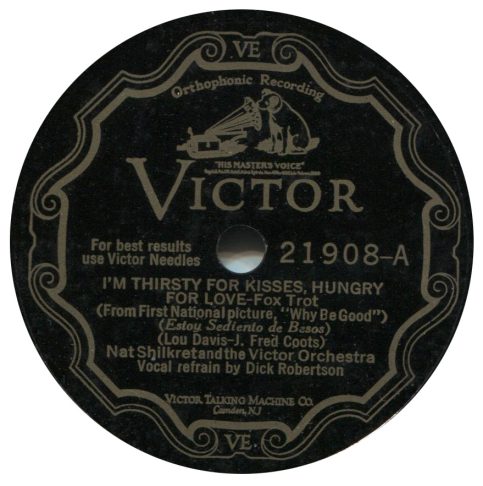
Victor 21908 A label image


“I’m Thirsty For Kisses Hungry For Love”
Nat Shilkret And The Victor Orchestra; Dick Robertson, vocal
(Victor 21908-A)                                       February 7, 1929


Here is one of many recordings recently added to Radio Dismuke’s playlist. I think it has a rather catchy tune.

The song was introduced in the 1929 film Why Be Good?, which was released during the industry’s transition from silent films to full sound. Wiring and equipping theaters for sound was expensive, and many, particularly in smaller cities and towns, had not yet been converted.

To ensure the widest possible distribution, the film was produced in a hybrid format. The story was filmed as a silent movie with no spoken dialogue, allowing it to be shown as a conventional silent film in locations still without sound. However, for audiences in theaters equipped with the latest Vitaphone sound-on-disc technology, the storyline was accompanied by a musical score, and there were song and dance scenes where the sound and film were fully synchronized.

For many years, until a copy was discovered in Italy in the 1990s, the film was believed to be lost, with only its soundtrack surviving on the much more durable Vitaphone discs.

Nathaniel Shilkret was the director of the Victor Talking Machine Company’s in-house studio band.  He made recordings across a number of musical genres from jazz and dance band music to classical, salon and Latin American music.

Dick Robertson was one of several highly prolific freelance studio vocalists of the era who were not exclusive to any particular label and appeared on recordings with both name bands and various labels’ in-house bands.


Posted in Uncategorized | Tagged , , , | Leave a comment

The Blues Chasers – 1925

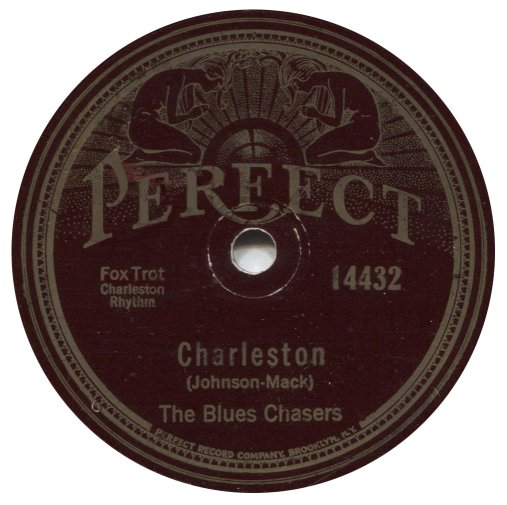
Perfect 1142 label image The Blues Chasers - "Charleston"


“Charleston”
The Blues Chasers
(Perfect 14432)                                    May 1925


“What A Smile Can Do”
The Blues Chasers
(Perfect 14432-B)                                    May 1925


From the Edward Mitchell collection, here are two recordings on a fun record that will turn 100 years old a few months from now.

For many years, it was widely believed that the actual band behind the pseudonyms these recordings were issued under was Nathan Glantz’s band due to it being listed as such in Brian Rust’s American Dance Band Discography and his Jazz Records 1897-1942.

Because I consulted Rust’s discographies when preparing my show notes, this was the information that I passed along when I played the “Charleston” side on Radio Dismuke’s recent New Year’s broadcast.

However, when putting this update together, I discovered that, in recent years, a number of discographers have come to believe that the band was, in fact, William Polla’s Clover Garden Orchestra.

This copy of the record is on the Perfect label, which was a lower-priced subsidiary label of the American branch of the French-based Pathe Records.  Unfortunately, most of Pathe’s recording session ledgers are presumed to have been destroyed.  Brian Rust did not provide information as to his source for believing that the band was Nathan Glantz’s.

The author of the Polla discography, The Recordings of William Conrad Polla’s Clover Gardens Orchestra, provides several pieces of evidence in support of the view that the band was Polla’s.  The most convincing to me was the fact Pathe’s parent company imported the master of “Charleston” and made it available for release in France on the Salabert label, which credited the band as the Clover Garden Orchestra.   It was common practice for Pathe to issue recordings from its American subsidiary for the French market using a band’s actual name rather than the pseudonyms that were frequently used on American issues. For more information, you can read the Polla discography via the Internet Archive at this link – scroll to page 6 for details about these recordings.

“Charleston” is the song that is still most widely associated with the 1920s decade and helped popularize the wildly popular dance of the same name.   The song was introduced in the 1923 Broadway production Runnin’ Wild, which had an all-black cast.

The first recording of “Charleston” was embedded within an October 3, 1923 Vocalion recording by the Ambassadors of “Old Fashioned Love,” another famous song from the production.  That recording is in Radio Dismuke’s playlist.

The first standalone recording of the song was made one week later by Arthur Gibbs and his Gang on Victor.

The recording presented here will be the eighth version of the song to be added to Radio Dismuke’s playlist.  In a previous blog posting, I featured an April 1925 Edison Diamond Disc recording of the song by the California Ramblers under the pseudonym of the Golden Gate Orchestra, which you can listen to at this link.

Both of the recordings in this posting were issued on Perfect under the pseudonym of “The Blues Chasers.”  But on parent label Pathe, they were credited to the “Westchester Biltmore Orchestra”

Pathe supplemented the revenues it received from sales of its own Pathe and Perfect discs by leasing out its master recordings to other record labels.  This recording of Charleston was one such recording – and it was issued on several labels under an array of pseudonyms.

On the Bell label, the recording was credited to the “Hollywood Ramblers.”  On Oriole, it was credited to the “Dixie Jazz Band.” On Banner, Regal and Domino, it was credited to the “Six Black Diamonds.” The National Music Lovers label credited it to the “Manhattan Musicians.” And, rather bizarrely, on Silvertone, a label sold through Sears & Roebuck, it was credited as Lanin’s Roseland Orchestra – which was the name of an actual band that had no part in this recording session.

No doubt that many record buyers over the past ten decades have purchased one of these releases believing that they have come across a different version of “Charleston” for their collection – only to discover upon playing it that it was the exact same recording they already had on some other label under a different pseudonym.

“What A Smile Can Do” is a largely forgotten song –  but I think the version on this record is quite charming.

While Victor and Columbia were increasingly using microphones in their recording sessions by May 1925,  Pathe/Perfect still used acoustical recording horns.

Posted in Uncategorized | Leave a comment

Charming Mexican Tango – 1922

Victor 19076-B label image. Max Dolan's Orchestra "My Old Love - Tango"


“My Old Love – Tango”
Max Dolin’s Orchestra
(Victor 19076-B)                                 November 13, 1922


Here is a recording that I stumbled across online while researching a different record.  I thought the song was very charming – and to my pleasant surprise, I was able to find a copy in my collection.

Unfortunately, my copy has some condition issues that proved to be a bit time-consuming for my software to clean up.  But that’s the way it goes with vintage records – you might or might not eventually come across another copy in better condition.  I was happy to discover I even had a copy at all, despite its condition.

“My Old Love” (“Mi viejo Amor“) was written by the prominent Mexican composer Alfonso Esparza Oteo.  You can read more about him at this link (in Spanish) or in English at this link via Google Translate.

Born in what is now Odesa, Ukraine, Max Dolin was an accomplished violinist and prominent conductor in San Francisco.  He is best remembered as the West Coast music director for the NBC radio network.

Victor’s recording ledgers indicate that the conductor for this New York City recording session was their in-house conductor, Nathaniel Shilkret, not Max Dolin.  There is no mention of whether Dolin himself was present or whether the musicians were members of Dolin’s orchestra or in-house studio musicians.  At the time, it was not uncommon for in-house staff to fill in for conductors or even entire bands who, for various reasons, might not have been able to attend a recording session.

Posted in Uncategorized | Tagged , , , | Leave a comment

Jazzy Mystery Band & Grey Gull’s House Band – 1929

Van Dyke 71804 b label image


“In Harlem’s Araby”
Dixie Devils
(Van Dyke 71804 B mx 3744)        November 1929


“Turn On The Heat”
Collegiate Jazzers
(Van Dyke 71804 A mx 3762)       Circa November/December 1929


From the Edward Mitchell collection, here are two recordings from a 1929 Van Dyke record.

Van Dyke was one of several subsidiary labels of Boston-based Grey Gull Records.  The various Grey Gull labels were among the least expensive records of the 1920s and are notorious for being made out of poor-quality material, which caused them to have noisy playing surfaces and to wear out quickly.  Starting in 1926, the company’s releases tended to have a rather quirky sound quality as a result of poor audio engineering and Grey Gull’s homegrown electrical recording system.

The identity of the band on this recording of “In Harlem’s Araby,” which I played on Radio Dismuke’s recent New Year’s broadcast,  has been the subject of speculation among discographers and record collectors for many years.  It is a very haunting recording and much jazzier than most Grey Gull sides.

This copy on the Van Dyke label credits the band under the pseudonym of the “Dixie Devils.”  However, on Grey Gull and its subsidiary labels Radiex and Supreme, the pseudonym used is the “Memphis Jazzers.”  Unlike Radiex and Supreme, Van Dyke’s labels and promotional material never made mention of its association with Grey Gull, which likely accounts for its release being assigned a different pseudonym.  The pseudonyms used on the Grey Gull labels usually do not correspond with any particular band.  They were used on recordings by Grey Gull’s in-house studio band as well as other bands that occasionally recorded for them.

It is believed by some that the band on “In Harlem’s Araby” was a mixed-race ensemble consisting of members of Grey Gull’s in-house band as well as black musicians, including Porter Grainger on piano.  Grainger was one of the composers of “In Harlem’s Araby” and of the other songs recorded during that same recording session.

For many years, into the early 1960s, it was widely believed that the band was King Oliver’s – indeed, circa 1950, a British jazz label reissued the side and credited it to “King Oliver’s Memphis Jazzers.”  However, shortly before he died, Andy Sannella, who participated in most Grey Gull recording sessions after 1926, denied that King Oliver was present.  Because Grey Gull recording ledgers are believed to be lost, the identity of the musicians on this recording is mostly a matter of speculation.  You can read more about this recording and the speculation surrounding it at this link.

I need to correct a comment I made about this recording during the New Year’s broadcast.

One of the things that Grey Gull frequently (but not always) did to reduce costs was to feature a popular song of the day that would appeal to buyers on a record’s A-side while using non-copyrighted songs, often written by Grey Gull’s in-house musicians, on the B-side in order to avoid paying the 2 cents per song composers’ royalty on the second side.  Because the wholesale cost of Grey Gull’s records was as low as 11 cents apiece,  that extra 2 cents royalty was a significant percentage of the company’s costs.

During the broadcast, I incorrectly stated that “In Harlem’s Araby” was an example of such a B-side.   The song was, in fact, copyrighted in 1924 with Fats Waller as one of Percy Grainger’s co-composers.  Percy Grainger also performed it on a 1924 recording on the Ajax label.

In January 1930, Adrian Schubert’s Salon Orchestra made a recording of the song that was issued on several American Record Corporation labels under different pseudonyms. That recording session featured many musicians who regularly performed with the Grey Gull house band, some of whom might or might not have participated in the recording featured here.  You can hear the Adrian Schubert version, which includes the song’s lyrics, on YouTube at this link.

The song on the flip side of the record, “Turn On The Heat,” comes from the 1929 movie musical Sunny Side Up.  Credited to the “Collegiate Jazzers” on Van Dyke, the recording was issued under the pseudonym of the “University Syncopators” on the Grey Gull, Radiex and Supreme labels.

There’s little mystery about the band on this side – it is Grey Gull’s in-house studio band.  The band’s membership changed from session to session, but it typically consisted of Andy SannellaMike MosielloCharles MagnanteCharles ButterfieldGeorge Hamilton GreenJoe Green, and, on occasion, Tommy Dorsey.  The vocal is provided by Irving Kaufman.

Grey Gull’s house band made a lot of interesting and entertaining records. While most of its output was intended to appeal to a mass-market audience seeking records they could dance to that featured the popular songs of the moment at the lowest possible price,  the band included some of the era’s top New York City jazz musicians.  However, as is the case with “Turn On The Heat,” the company’s poor audio engineering and recording equipment often gave the recordings a certain quirky and even harsh sound.

Those who tuned in to the New Year’s broadcast might recall Connor playing a recording of “Turn On The Heat.”  But that version was by Horace Heidt and His Californians.

Posted in Uncategorized | Tagged , , , | Leave a comment

3 Recordings With Upcoming 110th Anniversaries – 1915

Victor 17912-B label image Harry Macdonough - "I'm Simply Crazy Over You" - 1915 label image


“I’m Simply Crazy Over You”
Harry Macdonough, vocal
(Victor 17912 B)                                         September 15, 1915


“The Georgia Grind”
Signor “Grinderino,” barrel piano
(Victor 17884 A)                                        October 11, 1915


“Nobody Home” – Medley One Step
Victor Military Band
(Victor 35457 A)                                       May 5, 1915


Here are three of the four recordings I recently played on Radio Dismuke’s annual New Year’s broadcast to commemorate the 110th anniversary of the year 1915.   Since they are too old for inclusion in Radio Dismuke’s 1920s and 1930s popular music and jazz format, I thought I would post them here.  (The fourth recording is of historical interest more than musical interest and will likely be featured separately in a future posting.)

“I’m Simply Crazy Over You” is from the 1915 Broadway production Hands Up.  Among the cast was vaudevillian Will Rogers, just a few months before he achieved Broadway star status in Zigfeld’s Midnight Frolic.   Harry Macdonough was one of the early vocal artists to gain fame through phonograph records and appeared on hundreds of cylinder and disc recordings between 1899 and 1920.

“The Georgia Grind” is an interesting recording in that it is performed not by musicians but by a machine known as a barrel piano, credited tongue-in-cheek as Signor “Grinderino.”  Like barrel organs, the barrel pianos were commonplace on city streets in the late 19th and early 20th centuries.  They were operated by turning a crank, often by Italian immigrants, in exchange for tips.  You can view a brief YouTube video explaining how the machines work at this link.

This recording has two interesting connections to the recording of “I’m Simply Crazy Over You.”   Victor’s recording ledgers state that four takes of “Georgia Grind” were made. On takes 1 and 2, recorded October 5, 1915, the ledgers indicate that the machine was cranked by Harry Macdonough, who performed the vocal on “I’m Simply Crazy Over You,” and Victor music director Edward King.  Takes 3 and 4 were recorded six days later on October 11, with take 4 being the one that was ultimately issued.  The ledgers do not indicate who cranked the machine during the October 11 recording session. Still, it wouldn’t be unreasonable to guess that Macdonough or King might have been asked to crank it again during that second occasion.

The other connection, albeit an indirect one, is through the composer of “The Georgia Grind,”  Ford T Dabney, an accomplished and important ragtime-era black composer, pianist, bandleader, and entrepreneur.  From 1915 to 1921, he was the music director of Florenz Zigfeld’s  Midnight Frolics at the Roof Garden Club atop Broadway’s New Amsterdam Theatre, where Ziegfeld’s flagship production, The Ziegfeld Follies, was held.  Dabney appeared at the Midnight Frolics with his band, Ford Dabney’s Syncopated Orchestra, which made it the first black band to regularly appear in a Broadway theater.  As previously mentioned, the Midnight Frolics was where, shortly after appearing in Hands Up,  Will Rogers achieved his first taste of fame and was soon promoted downstairs to the Follies.

The Midnight Frolics and the Roof Garden Club were forced to close due to Prohibition, and most of the space where it was located was gutted out over the decades.  However, some elements of the old rooftop theater/club survived and were retained as part of Disney’s restoration of the New Amsterdam Theatre in the 1990s.  You can view a few of those remnants at this link.

“Nobody Home” is a medley recording of Jerome Kern compositions from another 1915 Broadway production, Nobody Home, which was based on the libretto of a 1905 British musical production, Mr. Popple (of Ippleton).  The songs featured in the medley are “Any Old Night,” “You Know and I Know,” and “Another Little Girl.”

While “Victor Military Band” might suggest marching music, much of the group’s output consisted of popular ragtime-era songs performed in dance tempo.  It wasn’t until jazz began to catch the public’s attention, starting in 1917, that bands exclusively devoted to providing dance music became prominent, with their leaders achieving celebrity status.  When the dance craze of the early 1910s through the early 1940s first took off, the record labels initially turned to in-house bands, such as the Victor Military Band and Charles A Prince’s band at Columbia, to supply the new popular demand for dance records.  Happily, most of their records sold in such quantities that they are not extremely difficult to find today. While both bands recorded other genres, such as light classical and traditional marching band music, their records bearing the description “for dancing” have a good chance of delighting those who are fans of instrumental ragtime.

Posted in Uncategorized | Tagged , , , , | Leave a comment