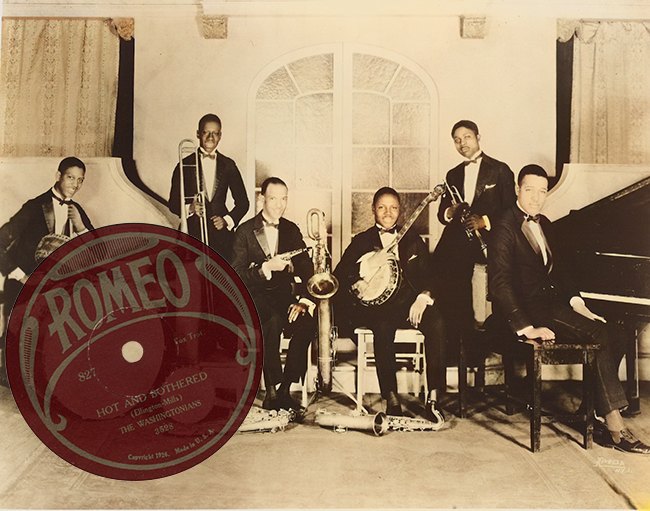
| “Hot And Bothered” The Washingtonians October 1928 (Romeo 827 mx 3528) |
From the Edward Mitchell Collection, here’s a recording I played a few months ago on Radio Dismuke’s annual New Year’s broadcast and have recently added to the station’s playlist – by Duke Ellington and His Orchestra, credited to The Washingtonians, which was one of several recording pseudonyms used by the band.
Recording sessions were a lucrative source of side income for New York City-based musicians, as, in those days, record companies typically paid musicians up front for each side recorded, regardless of how well the records sold. For this reason, Ellington saw to it that his primary recording affiliation was exclusive only in the use of the Duke Ellington name, leaving him free to record for other labels under different names.
The use of “The Washingtonians” was more meaningful than that of other pseudonyms used for the band’s recordings: It was the band’s actual name before Duke Ellington took it over from its original leader, Elmer Snowden, in 1924.
Ellington recorded at least four versions of “Hot And Bothered.” The most famous and, in my opinion, the best version was his first, recorded under Ellington’s own name on October 1, 1928 for OKeh, featuring a scat vocal by Baby Cox.
The version featured here on Romeo was recorded sometime later that same month.
Romeo was a subsidiary label of Cameo Records, which specialized in producing low-priced records. Romeo records were sold through the S. H. Kress dime store chain. Although Kress began as a strictly 5- and 10-cent retailer, it moved beyond that model in 1901, when it began offering additional items for sale at 25 cents, the price at which Romeo records were sold.
In late 1927, the owners of the American branch of Pathe Records acquired the financially struggling Cameo Records. While both companies continued to exist as separate legal entities, in July 1928, all operations were consolidated at Cameo’s existing offices and recording studios. From that point forward, Cameo, Pathe, and their respective subsidiary labels usually, though not always, shared the same recording sessions. Often, a second take would be made so that the recordings used on the Cameo labels would be slightly different than those for Pathe and its low-priced Perfect label. But sometimes the same master would be used for both label groups.
This recording was credited on the Cameo, Romeo, and Lincoln labels as The Washingtonians. On the Pathe and Perfect, it was credited to The Whoopee Makers. According to Brian Rust’s Jazz Records, the same master was used for all issues.
The Ellington band made another recording of “Hot And Bothered” on June 12, 1930, which was issued in the United States on Columbia’s low-priced Clarion, Diva, and Velvet Tone labels credited as Mill’s Ten Black Berries, and in the UK on Parlophone under Ellington’s own name.
On February 3, 1930, another version was recorded that appeared under Ellington’s name, along with “Mood Indigo” and “Creole Love Call,” on a Victor Program Transcription, an early, commercially unsuccessful attempt to introduce 33 rpm long-playing records. You can learn more about Victor Program Transcriptions and listen to three examples in an earlier posting.
The fidelity of Cameo/Romeo’s electrically recorded records was mediocre compared with those of Victor or Columbia, though typically better than certain other low-priced labels of the era. As with most low-priced labels, the records themselves were made with lower-quality, cheaper materials and tended to wear quickly under the weight of the heavy tone arms and steel needles of the era’s wind-up phonographs. For that reason, those that survive even in fairly decent condition tend to be noisy.