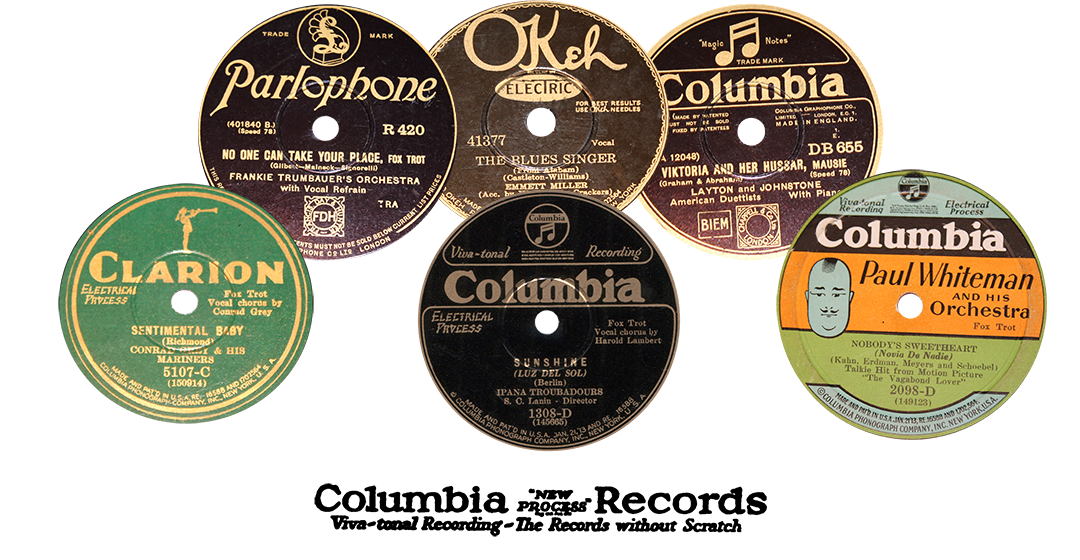
Our special “New Process Viva‑tonal” broadcast is devoted to records made either by the American or British branches of Columbia Records, including Columbia’s low‑priced subsidiary labels in the United States, as well as records issued by companies that Columbia acquired in the 1920s such as OKeh in the United States and the German‑based Lindström companies, which produced labels such as Odeon, as well as Parlophone, which was very successful in the United Kingdom.
The reason we will be highlighting these records is to honor what many collectors regard as the best records made during the late 1920s and early 1930s in terms of manufacturing and playback quality.
This quality was the result of two technological improvements introduced in the early 1920s. In 1923, the British branch of Columbia developed and patented what it advertised as its “New Process” playing surface, which was significantly quieter than other 78/80 rpm records designed to be played on conventional wind‑up record players with heavy tone arms and single‑use steel needles.
Part of what made Columbia’s records so quiet was their laminated surfaces. Prior to the post–World War II advent of vinyl records, records were pressed into a solid mixture of ingredients bound together with shellac. These ingredients had to simultaneously provide strength, so the record would not be too brittle, while also creating a playing surface that minimized extraneous noise. The challenge was that materials that provided the best strength tended to be very gritty, while materials that provided the quietest surfaces were not as strong and tended to be expensive. Each company had its own “recipe” of materials, with widely varying results in terms of sound quality and durability.
Columbia’s laminated records had a solid core made of material that provided rigidity and strength. A thin layer of paper separated the core material from an outer layer of shellac and other ingredients that formed the playing surface into which the record’s grooves were stamped. Columbia’s records had been laminated since 1907. Unfortunately, the ingredients used for the surface layer between 1907 and 1923 were less than optimal. Larger particles in the fibers and minerals in the mixture could work their way to the surface and break free from the shellac binding, creating pitting that resulted in microscopic roughness and increased surface noise.
What made the New Process records different was that the ingredient mixture for the surface layer eliminated organic fibers and used newly developed forms of plastic, in addition to shellac, as the binding agent. The remaining ingredients—synthetic resins and mineral fillers—were ground into an extremely fine dust. This resulted in a much tighter, smoother playing surface, which reduced noise‑causing friction against the stylus.
This new surface was not only quiet when new and in mint condition. While such records sometimes develop small, tight cracks that only extend into the laminated surface (which are usually easy to remove digitally or with a pop‑and‑click filter), the quietness of their surface has held up well over the decades. The heavy soundboxes and steel needles of the era’s wind‑up phonographs, which remained in widespread use well into the early 1940s, were extremely hard on records. However, records with Columbia’s New Process surface that survive today in average condition—or even below—tend to provide much better performance than other records from the period in comparably worn condition.
The second technological advance was one that would revolutionize the entire recording industry. During the early 1920s, Western Electric developed the first commercially practical system of electrical recording—that is, recording through a microphone using vacuum tube amplification instead of the mechanical process that relied on acoustic recording horns. This allowed for significantly improved frequency response, from deep bass to very high notes, as well as improved dynamic range, enabling the capture of delicate instruments and softer vocals that lacked the volume needed for acoustic recording. Suddenly, recorded music sounded lifelike instead of a flat, tinny, and distorted approximation.
Both Columbia and its larger rival, the Victor Talking Machine Company (along with the UK‑based Gramophone Company, which issued the His Master’s Voice label and of which Victor had acquired a controlling share in 1921), licensed the Western Electric system and began making electrical recordings in early 1925. Over the next two years, other labels scrambled to acquire their own electrical recording systems that did not violate Western Electric’s patents. Few matched Western Electric’s quality, and some were quite poor.
Like Columbia, Victor/His Master’s Voice had outstanding studio engineers and produced top‑quality recordings. What sets Columbia apart in playback quality, however, is the New Process surface.
In response, Victor began improving the compounds used for its records. By the mid to late 1920s, a Victor record in pristine condition could, at times, have a low noise level approaching Columbia’s. However, their higher content of shellac and organic materials meant that impurities could exist in the surface, break loose, and result in microscopic pitting—and therefore noise. This is why Victor records from that period that appear visually excellent can still sound surprisingly noisy when played.
During the period we will be focusing on in the program, American Columbia was owned by its former British subsidiary. In an attempt to avoid bankruptcy, Columbia sold its British branch to an investment group headed by its general manager, Louis Sterling, in December 1922—just one month before the introduction of the New Process surface. The sale was not enough to prevent bankruptcy, and Columbia entered receivership in October 1923. However, through an unexpected turn of events, the transaction ultimately saved the company.
Under Sterling’s leadership, British Columbia returned to profitability. In late 1924, one of Sterling’s contacts in the United States quietly sent him test pressings demonstrating Western Electric’s new electrical recording process. Recognizing its importance—and learning that Western Electric was negotiating with Victor—Sterling immediately traveled to New York to secure a license for Columbia.
Western Electric informed him that overseas rights would only be granted through an American affiliate. As a result, British Columbia acquired a controlling interest in its former American parent, enabling access to the technology in both the United Kingdom and Europe.
In October 1926, Columbia acquired the German company Carl Lindström AG, which issued major labels such as Odeon, Beka, and Parlophone. Lindström had been unable to transition to electrical recording and was at a growing disadvantage. The acquisition gave it access to Columbia’s licensed technology.
Columbia allowed Lindström to operate with considerable autonomy. Some of its labels adopted laminated New Process records, while others continued using traditional shellac discs. In the UK, Parlophone began issuing laminated records.
The following month, Columbia acquired OKeh. Although not owned by Lindström, OKeh had close historical ties, and its jazz catalog was highly successful in Europe. One motivation for the acquisition was to maintain access to this material. After the acquisition, OKeh quickly adopted both Western Electric recording and laminated pressing.
In 1928, Columbia acquired the French and British operations of the Pathé label.
The Great Depression had devastating effects on the record industry—especially in the United States. In Europe, economic pressures contributed to the 1931 merger of British Columbia and the Gramophone Company to form EMI.
In Great Britain, New Process laminated records were quickly discontinued after the merger in a cost‑cutting move, and Columbia and Parlophone were switched to lower‑cost pressings. However, in other countries, EMI continued—and in some cases expanded—the use of laminated records.
In Australia, for example, both Columbia and even His Master’s Voice issued laminated pressings—something that never occurred in the UK. As a result, Australian pressings of British and American recordings are highly sought after by collectors and audio restoration specialists for their exceptional sound quality.
The EMI merger also affected American Columbia. Because Victor held an interest in the Gramophone Company, the deal created antitrust issues in the United States. As a result, EMI was forced to divest Columbia, which was sold in 1932. After a series of ownership changes, Columbia was acquired in 1934 by the American Record Company (ARC).
Columbia did not thrive under ARC ownership. Its major artists were reassigned, and the label was reduced primarily to niche and lower‑selling releases. While some laminated pressing continued at the Bridgeport plant, most production shifted to lower‑cost records.
Occasionally, leftover laminated materials were used for other labels, resulting in rare laminated pressings of otherwise low‑quality records—highly prized anomalies today.
In 1938, Columbia was once again saved—this time through its historical connection to CBS. CBS acquired ARC and restored Columbia as its flagship label, investing in and improving the New Process lamination technology.
By the late 1930s, improvements in materials and recording reduced surface noise across the industry. After World War II, the transition to vinyl records and lighter playback equipment further improved sound quality. However, earlier records—including New Process discs—still contained abrasives to accommodate steel needles, limiting their ultimate quietness.
Even so, for listeners and collectors of 1920s and 1930s recordings, Columbia’s New Process technology remains a remarkable achievement—one that continues to impress nearly a century later.
For more information about the history of Columbia Records, check out the excellent Columbia Records, 1901-1934: A History by Tim Brooks on the Discography of American Historical Recordings website.