| “No One But You Knows How To Love” Bennie Krueger’s Orchestra (Vocal possibly by Walter Scanlan) September 11, 1926 (Brunswick 3323-B) |
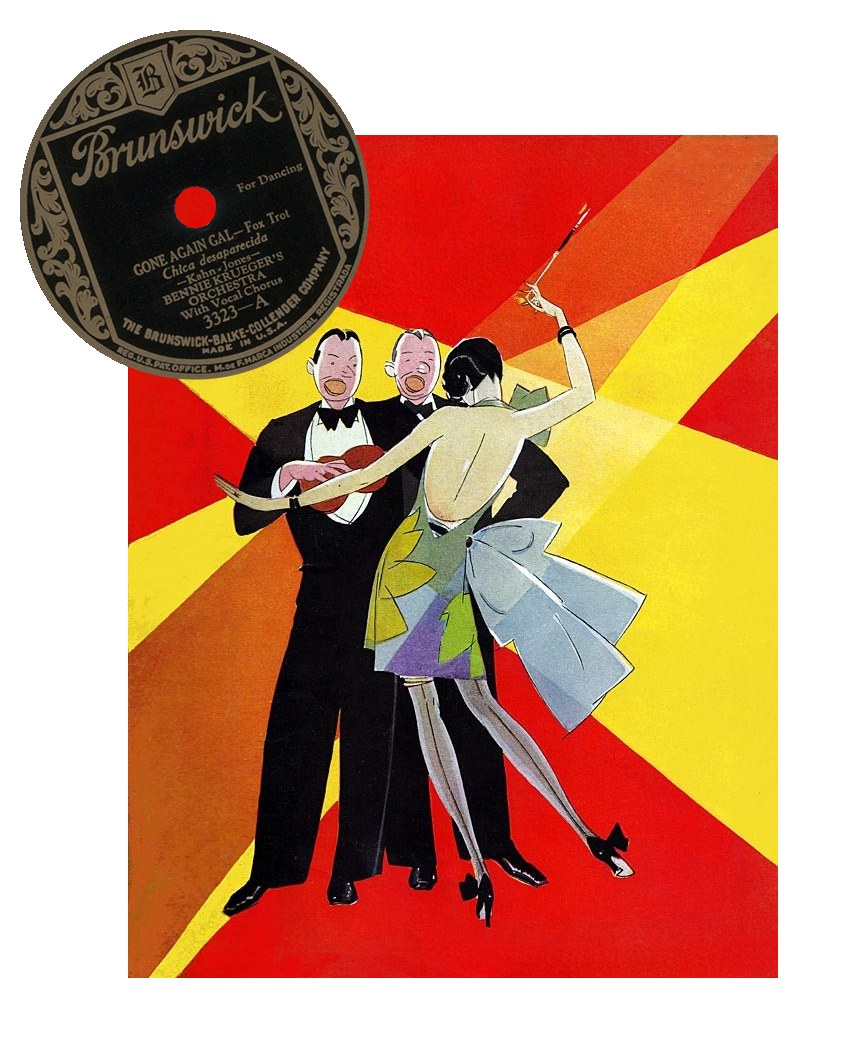
| “Gone Again Gal” Bennie Krueger’s Orchestra (Vocal possibly by Walter Scanlan) September 11, 1926 (Brunswick 3323-A) |
From the Edward Mitchell collection, here are two “hot dance” recordings from 1926 that exemplify the decade’s exuberant spirit, which, in part, led people to refer to the era as the “Roaring Twenties.”
Benny Krueger was a noted saxophone player whose band was based in Chicago during most of the 1920s, where these sides were recorded.
The addition of these recordings to Radio Dismuke’s playlist will mark the debut of both songs on the station.
“No One But You Knows How To Love” was composed by May Singhi Breen and Peter De Rose, with lyrics by Joe Trent and Allan Frazer.
“Gone Again Gal” was composed by bandleader Isham Jones and features lyrics by Gus Kahn. However, I was unable to find any evidence that the song was ever recorded by Isham Jones’s own band.
As was common at the time, vocal credit was not provided on the label beyond the phrase “with vocal chorus.” One online source identifies the vocals on both sides as those of Walter Scanlan, but none of my other usual sources for such information make mention of it.
Unfortunately, these recordings were made during the period when Brunswick was using its less-than-optimal “Light Ray” electrical recording process.
After rivals Victor and Columbia licensed the far superior Western Electric system, Brunswick turned to General Electric and licensed a modified version of that company’s experimental sound-on-film system called the Pallophotophone.
Unlike the Western Electric system, which used microphones and amplification to power the cutting head, Brunswick’s system utilized a recording horn that directed sound to a diaphragm, causing a tiny mirror – smaller than a pinhead – to vibrate. A constant beam of light was focused on the mirror. As the mirror vibrated, reflected flickers of light reached a photoelectric cell, which converted the fluctuations in light into an electrical signal that was then amplified to power the cutting head.
Unfortunately, Brunswick was never able to get the system to work well. Early recordings often had so much distortion that artists had to be called back to the recording studio to record new takes. Brunswick’s engineers continually attempted to make tweaks. However, once a distortion issue in a particular frequency range was resolved, a new distortion would often emerge in another.
Some recordings made by the process turned out better than others. I notice its shortcomings most on recordings such as these, where very loud passages of the entire band can come across as harsh or distorted. I have several records with really excellent performances by the Abe Lyman and Ben Bernie bands that were unfortunately impacted by it.
Despite heavy advertising promoting the alleged superiority of its “Light Ray” system, which it described as “Music By Photography,” Brunswick finally threw in the towel on it in 1927 and reached a confidential licensing agreement with Western Electric.