Independence Day in the United States is one of the rare occasions when it is still common for people of all ages to gather and enjoy – often at live performances – festive music from the late 19th and very early 20th centuries. Such performances are often followed by a fireworks display. And the music invariably includes one or more compositions by John Philip Sousa.
The virtual “concert” presented here is anything but live. All of the recordings are over 100 years old and were made before the advent of the microphone. But the instruments used by concert-style military bands reproduced well enough through the old acoustic recording horns to yield performances that are still enjoyable over a century later.
Two of the recordings featured here are especially historic because, out of the many hundreds of Sousa’s Band recordings that Victor issued between 1900 and 1929, they are among only a very small handful in which John Philip Sousa was personally present in the recording studio, conducting the band.
Below you will find an option to listen to all of the featured recordings, played back-to-back in “concert-style.” Below that, you will find options to listen to each recording individually.
Brief background information about the recordings is provided at the end of this posting.
If you enjoy the recordings here, you will also enjoy the Vintage Fourth of July Concert posting from 2021.
To listen to all recordings play through “concert style”
To listen to the recordings individually
| “Sabre and Spurs March” Sousa’s Band September 6, 1918 (Victor 18504-A) |
| “Solid Men To The Front” Sousa’s Band September 6, 1918 (Victor 18504-B) |
| “Bullets and Bayonets” Sousa’s Band October 2, 1919 (Victor 18752-B) |
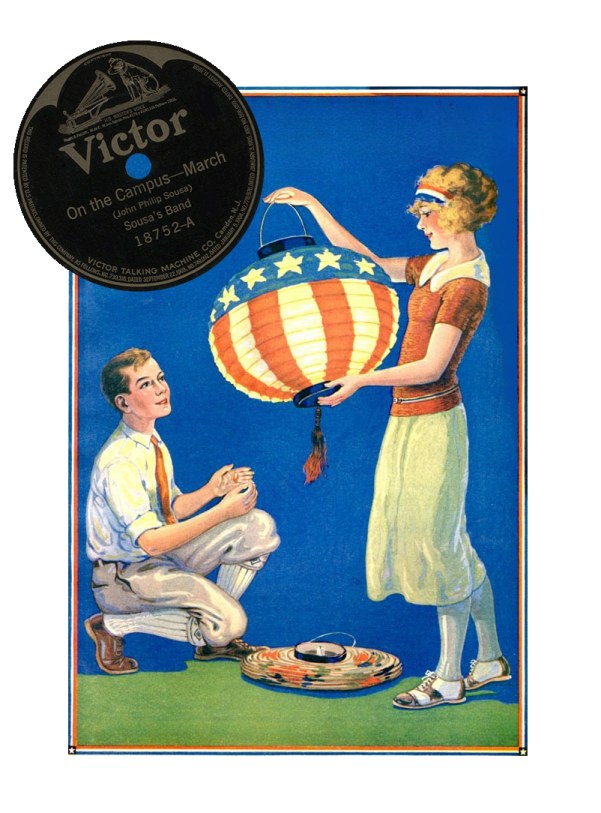
| “On The Campus” Sousa’s Band April 5, 1921 (Victor 18752-A) |
John Philip Sousa is best remembered as a highly prolific composer of military marches, such as “Stars and Stripes Forever,” though he also wrote other types of music, including 15 full-length operettas.
Less well-remembered is Sousa’s enormously successful career as a bandleader. He rose to prominence as the director of the United States Marine Band from 1880 to 1892, during which time he conducted the inaugural balls for presidents James Garfield and Benjamin Harrison.
Sousa left the Marines in 1892 to form his own, much more financially lucrative, civilian band. The band toured extensively throughout the world and, by 1931, had performed 15,623 concerts. Before the advent of radio and the popularity of Jazz Age dance bands, Sousa was by far the world’s most famous bandleader.
Unsurprisingly, the very early record labels were extremely eager to add recordings of Sousa’s band to their offerings. But Sousa’s opinion of recorded music was nothing short of outright hatred and hostility – going so far as to write a 1906 essay titled The Menace of Mechanical Music.
Sousa felt that recorded music would lead to cultural decay and the destruction of amateur music-making, as people would no longer be as inclined to make music and sing together at home. He also deeply resented the fact that early record labels were under no obligation to compensate him for the considerable amount of money they made off his compositions, and he was one of the artists who publicly lobbied for the Copyright Act of 1909, which required record labels to obtain mechanical licenses for any copyrighted compositions they recorded.
Even though Sousa did not approve of phonograph records, he nevertheless very much approved of the money he was able to earn from phonograph records featuring his band. Thus, he gave his consent for his band to record and pocketed the money, but, for decades, famously refused to personally enter a recording studio.
Thus, with only six exceptions, all recordings credited to Sousa’s Band were conducted by someone other than Sousa. And, on some issues, the band described as Sousa’s was, in fact, Victor’s in-house studio orchestra.
When the United States entered World War I in 1917, Sousa became heavily active in events promoting sales of Liberty Bonds, sold by the U.S. government to help fund the war. For this effort, he composed “The Liberty Loan March” and, for the first time in his decades-long career, personally conducted his band performing that song, along with “The U. S. Field Artillery March,” in a December 21, 1917 Victor recording session.
The following year, Sousa personally conducted a recording session for a second time in the September 6, 1918 session which produced two of the selections here, “Sabre and Spurs March” and “Solid Men to the Front.”
Despite the label credits, the October 2, 1919 recording of “Bullets and Bayonets” and the April 5, 1921 recording of “On the Campus” do not feature Sousa’s actual band but rather Victor’s in-house ensemble conducted by Josef Pasternack.
All of the songs presented here were first published in 1918 with the exception of “On The Campus” which was published in 1920.
Happy Independence Day!