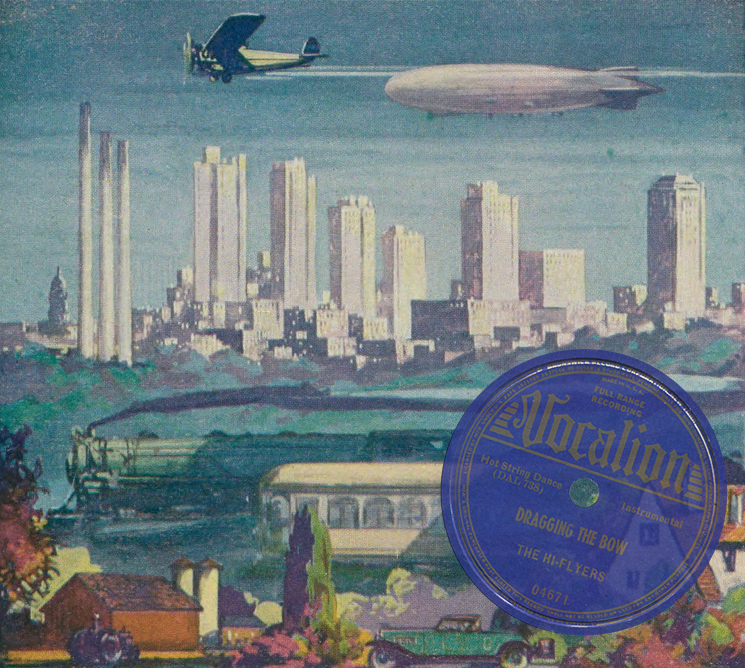
| “Dragging The Bow” The Hi Flyers December 6, 1938 (Vocalion 04671 mx DAL 738) |
| “Don’t Say Goodbye” The Hi Flyers; Steve Wooden, vocal December 6, 1938 (Vocalion 04671 mx DAL 742) |
Here are two recordings by an early Western swing band based out of Fort Worth, Texas, the city where Bob Wills and Milton Brown are widely credited with giving birth to the musical genre in 1931 by combining elements of traditional country music (known at the time as “hillbilly music”) with elements of jazz and popular dance band music.
The Hi-Flyers actually predated the birth of Western swing, having started as a conventional country string band in 1929 under the name the High Flyers. By 1932, they had changed their name to the Hi-Flyers and adopted a full-fledged Western swing style.
The band became well known through its regular radio program on Fort Worth station KFJZ and, for a period, on station KTAT.
In November 1930, the band recorded two sides as “The Texas High Flyers” during a Brunswick Records field trip to Dallas, though neither recording was issued. Beginning in June 1937 and continuing through March 1941, the Hi-Flyers were regular participants in periodic field trip recording sessions conducted by Vocalion and later OKeh Records in the Dallas/Fort Worth area, with around 54 sides ultimately issued by the band.
Both of these recordings were made on December 6, 1938, in a recording studio constructed out of Beaverboard on the third floor of a Zigzag Moderne building that still stands at 508 Park Avenue in Dallas. Steve Wooden, who sings the vocal on “Don’t Say Goodbye,” was also the band’s guitar player.
In July 1940, the Columbia Broadcasting System, which had acquired Vocalion and various other labels in its 1938 purchase of the American Record Corporation, discontinued Vocalion in favor of its newly revived OKeh label. As a result, after that date, all recordings made by the band – and subsequent pressings of the band’s Vocalion recordings – appeared on OKeh. Pre-1940 Vocalion recordings that were also pressed on OKeh retained the same catalog number.