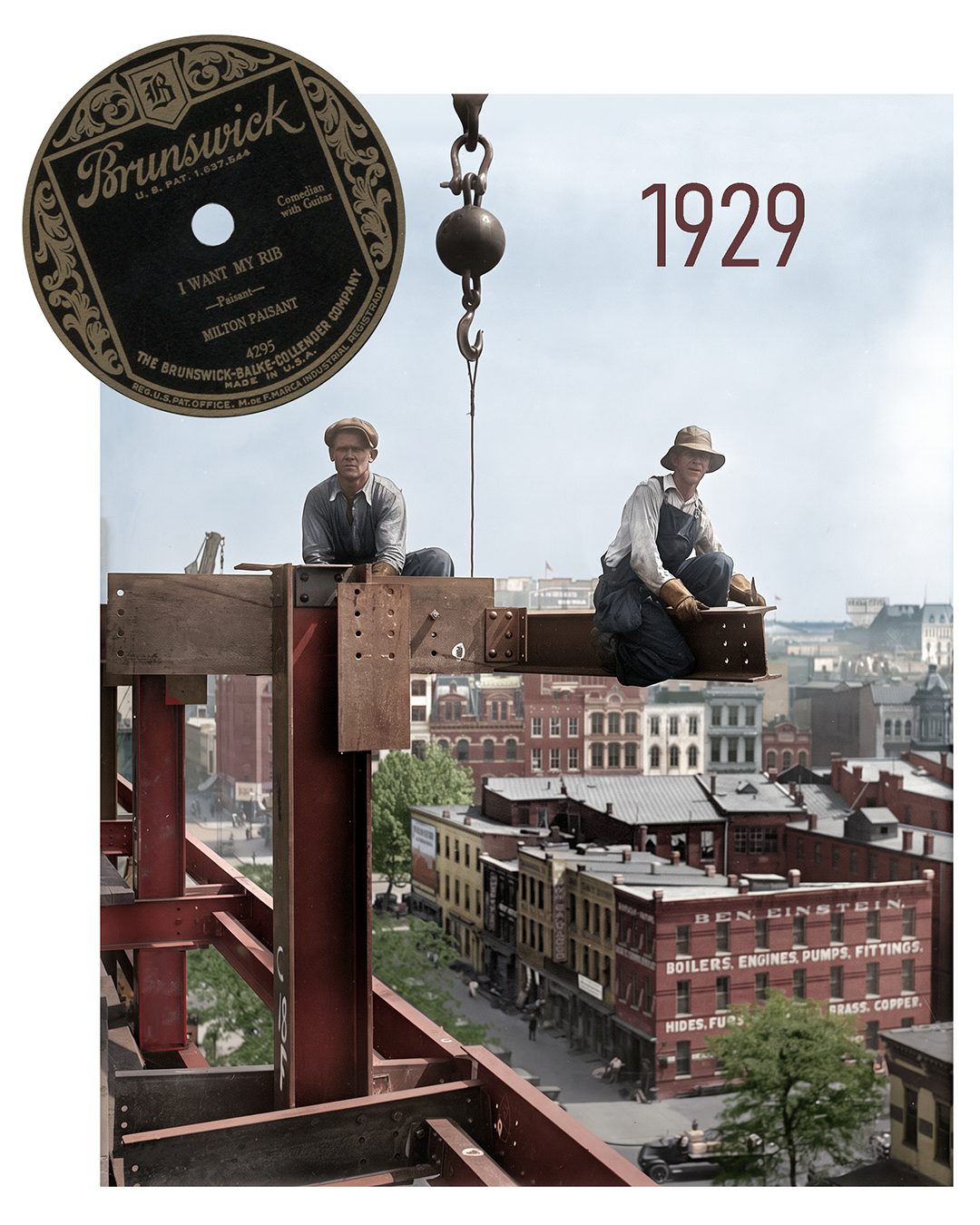
| “I Want My Rib” Milton Paisant, vocal & guitar March 5, 1929 (Brunswick 4295) |
| “It’s Tight Like That” Milton Paisant, vocal & guitar March 5, 1929 (Brunswick 4295) |
Here are the only two recordings made by a now-obscure New Orleans-based performer, Milton Paisant, during his career as a vocalist in the late 1920s and early 1930s. On both recordings, he accompanies himself on the guitar.
“I Want My Rib” is Paisant’s own composition and has lyrics that were most likely regarded as mildly risqué at the time.
“It’s Tight Like That” is a 1928 composition by Hudson Whittaker (a.k.a. “Tampa Red”) and Thomas A. Dorsey (a.k.a. “Georgia Tom”). Both men recorded the song for Vocalion in 1928. The record was very successful and, by 1929, a good many recordings of it had been made by both jazz and blues artists.
Born in 1897, Milton Paisant was a native of New Orleans and had served in World War I. A March 1923 news article included him among those who had received auto mechanics certificates from a free evening school sponsored by the local Knights of Columbus.
The earliest mention of him that I could find as an entertainer was in the December 22, 1925, New Orleans Times-Picayune, which indicated that Paisant and H. Pat Crane, billing themselves as the Jazz Pair, had appeared in a vaudeville-style performance at the Maurice Theater as part of a fundraiser for the Doll and Toy Fund, which distributed toys to children in poor families. The article mentioned that because of torrential rain on the evening of the performance, attendance was low. It also noted that the entertainers had volunteered their services.
The next mention was in the March 31, 1927, New Orleans State, which promoted a radio broadcast, the New Orleans State Hour, sponsored by the newspaper on radio station WJBO, featuring the Jazzie Pair, which consisted of Pat Crane and Milton Paisant.
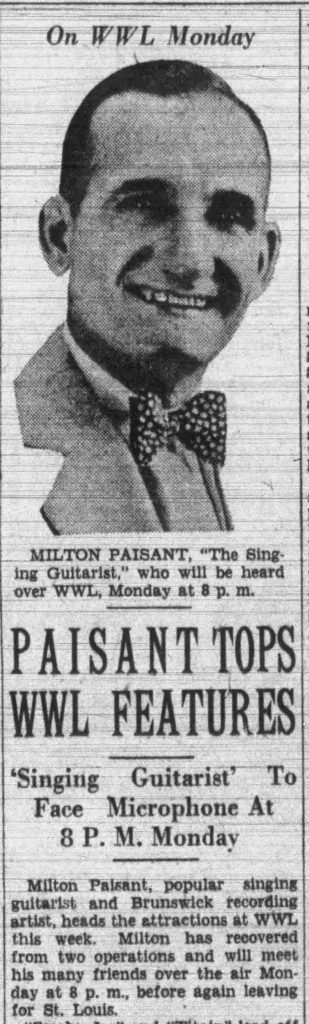
In March of 1928, he landed his own weekly Friday evening program on station WSMB and was billed as “The Singing Banjoist.” After just a few episodes, however, that had changed to “The Singing Guitarist.”
These March 5, 1929 recordings were made as part of Brunswick’s regular field trips to record local talent in various regions of the country. The record began appearing in stores in April 1929. That same month, his program had moved to WJBO.
On June 11, 1929, his program moved again, this time to 9:00 PM Tuesday evenings on WWL. This was a significant move because WWL broadcast over a clear channel frequency, with a nighttime signal that could be picked up throughout the South and into the Upper Midwest, reaching audiences well beyond the New Orleans area.
After his move to WWL, Paisant’s program began to receive positive mentions by newspaper radio columnists as far away as Ohio, as well as a few mentions in the entertainment trade industry publication Billboard.
The increased exposure undoubtedly led to what may or may not have been an attempt by Paisant to take his musical career to the next level.
On April 27, 1930, it was announced that: “Milton Paisant, singing guitarist, has joined the staff [of St. Louis station] KMOX and will be heard nightly on the Sun Dodgers program, from 12:30 to 1:30 o’clock, [i.e. 12:30-1:30 AM] and at intervals daily.”
(“Sun dodgers” was Jazz Age slang for people who stayed out dancing, drinking, and socializing in nightclubs and speakeasies and went to bed at dawn, thereby “dodging” the sunlight.)
KMOX was a highly regarded station which also had a large nighttime reach over a clear channel frequency in a city that was 79 percent larger than New Orleans. The wording of the announcement suggests that Paisant was likely hired as a permanent member of the staff, not a short-term guest.
Nevertheless, after radio listings throughout May showing Paisant on the KMOX broadcast schedule, beginning June 1, the listings suddenly show him appearing regularly on station WLW in Cincinnati.
While Cincinnati was smaller than New Orleans, and while Paisant did not broadcast as many days of the week as he had in St. Louis, in many respects a move to WLW could have been considered a step upward. Owned by Powel Crosley Jr., who also manufactured Crosley radios, WLW was one of the most highly regarded stations in the United States. Not only did it operate on a clear channel frequency, since 1928 it had been authorized to operate at 50,000 watts, the highest legal limit in the US. It wasn’t until later in 1930 that KMOX began operating at 50,000 watts.
WLW operated at the lower end of the radio dial at 700 kHz. AM radio signals from stations at the low end of the dial travel farther than those from stations of equal power at higher points on the dial. This, plus operating at 50,000 watts, made WLW one of the most powerful stations in the United States in terms of its geographic reach, with a nighttime signal that could be picked up along the entire East Coast down to Cuba and westward to the Rocky Mountains, earning it the nickname “The Nation’s Station.”
In the early 1930s, a position at WLW was widely perceived as a stepping stone towards a job with one of the national networks.
If this was Paisant’s intention, it did not work out. By the end of July, he was back in New Orleans at WLS, which a local paper described as his return “from a tour of various stations.”
While technically correct, such a description was most likely a way of putting a positive spin on the situation. It has never been the norm for radio personalities to embark on a “tour” of stations the way that entertainers once toured the vaudeville circuits.
Radio programs in those days frequently had a single sponsor, and if that sponsor dropped out and a new one could not be found who was interested, the program would be replaced by one that potential sponsors felt was a better fit for their product. And audience size, of course, mattered. The qualities that endeared a performer to radio audiences in one city might have been met with indifference by audiences in a different city.
It is also possible that Paisant’s return to New Orleans was entirely voluntary. As a married man with two children, moving from one city to another so quickly might have had an impact on his family. It is likely that the income Paisant earned from his weekly radio program in New Orleans and occasional live appearances was not sufficient to support a family, and he had an additional source of income, perhaps from his certification as an auto mechanic. It is entirely conceivable that an inability to replace income from such a sideline activity while in another city led him to conclude that he simply couldn’t afford to chase a longshot dream of breaking into entertainment on a big-time basis.
Regardless, Paisant continued to appear regularly on various New Orleans stations and make local live appearances for the next several years. At the time of his return to New Orleans, his on-air billing had changed from “The Singing Guitarist” to “The Lonely Troubadour.”
Paisant also composed at least one additional song besides “I Want My Rib.” Federal Copyright records show a January 24, 1934 registration listing him as the composer of the words and lyrics of a song called “Everything You Do.” The registration indicates that the song had not yet been published. Most likely, it was a song that he wrote for his own performance on the radio.
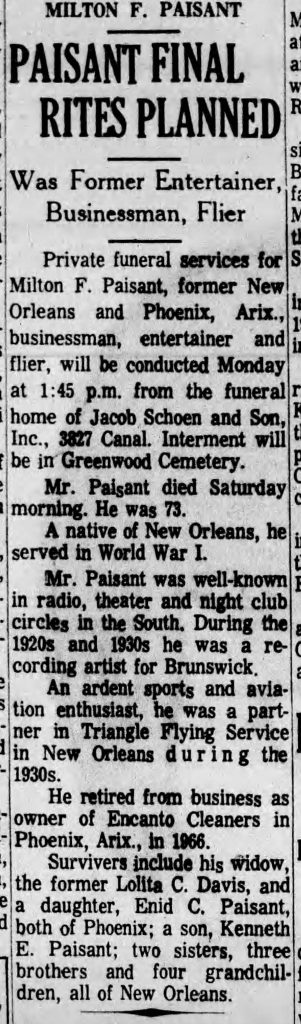
The latest published mention I could find of Paisant’s career as a vocalist was a June 22, 1936 radio listing. After that date, all mentions of him are in the context of piloting airplanes as part of local flying club activities and as the co-owner of Triangle Flying Service, which operated out of Shushan Airport (now known as Lakefront Airport). The company provided flight instruction and perhaps additional services.
November 1948 announcements in New Orleans newspapers of the upcoming marriage of Paisant’s son Kenneth describe him as “the son of Mr. and Mrs. Milton Paisant of New Orleans and Phoenix, Arizona.” The couple seems to have completed their move to Phoenix at some point in the latter half of 1949.
A January 5, 1950 article in the Arizona Republic shows a Paisant returning to what I suppose could be considered part of the entertainment world in a very different capacity. The article announced an upcoming square dance sponsored by the Phoenix Parks and Recreation Department and the Sun Square Dancers. Among the “callers” that were expected to participate was Milton Paisant.
This was at the height of the mid-century square dance craze when an explosion of interest made it a popular social pastime throughout the United States. For the next four years, there were frequent announcements of local square dancing events for which Paisant was listed as one of the callers.
During the early 1950s, Paisant also returned to the recording studio to appear as the caller on at least three square dancing records for a small Phoenix-based label, Old Timer Records.
At some point no later than 1955, Paisant purchased an existing dry cleaning business called Encanto Cleaners. While I am not certain, the fact that the business was listed as being up for sale in February 1948 leads me to speculate that it is highly likely that the November 1948 marriage announcements describing Mr. and Mrs. Paisant as being from New Orleans and Phoenix were the result of them preparing to take over the business.
Paisant continued to operate the cleaning business until his retirement in 1966. At the time of his death in 1970, he resided in Metairie, Louisiana.
Part of my reason for providing such granular detail about Paisant is that I was unable to find any sort of general overview of his life and career. To obtain that, one would need to do what I did: dig through mentions in period publications. Thus, I have saved time and effort for anyone else who might be curious to learn more about him, as well as provided a starting point for anyone who might wish to dig deeper.
But another reason is that many aspects of his career were not at all uncommon at the time in the music and entertainment world.
Breaking into the entertainment business has always been difficult. The number of perfectly talented people desperately eager to break into it has always vastly exceeded the number of available paying jobs.
Had Paisant, for some reason, been unable to attend when Brunswick came to New Orleans with its portable recording equipment, he would be completely forgotten today, even in New Orleans, where he was clearly well-known and popular. 1920s and 1930s newspaper entertainment sections and radio listings are filled with once well-known names that now mean nothing to even hard-core fans of the era’s music.
The vast majority of the era’s professional musicians and singers, even those who achieved regional fame and were able to remain active for decades, never saw the inside of a recording studio.
Paisant’s career started gaining traction during an especially difficult period when the economy was sinking ever deeper into the Great Depression. Just as significant was the fact that the advent of radio and even more so, talking pictures, completely killed off the vaudeville circuits in just a handful of years.
A decade earlier, many thousands of entertainers were able to earn a living traveling from town to town performing in theaters that were part of such circuits. The pay was usually not great, and it could be a very hard life, especially on the less prestigious circuits, but it did provide performers lots of opportunity to hone their skills and refine their acts.
Paisant began appearing on the radio at a time when thousands of talented vaudevillians with years of experience under their belt were losing their jobs and seeking new ones. A handful were able to successfully transition and went on to become big names in network radio and, later on, television. The vast majority had no choice but to seek opportunities in other fields.
Paisant’s musical career was more successful than many other talented performers in that he was able to achieve regional fame as a solo act and maintain it for several years. My suspicion is that he eventually shifted his focus because his aviation endeavors offered a more reliable or lucrative use of his time. The fact that he later emerged as a caller for local square dance events, which likely paid very little, if anything at all, clearly suggests that he enjoyed performing and being in the spotlight.
The performances that we today enjoy through old 78 rpm records are only a small tip of the iceberg of the era’s talent and musical offerings.