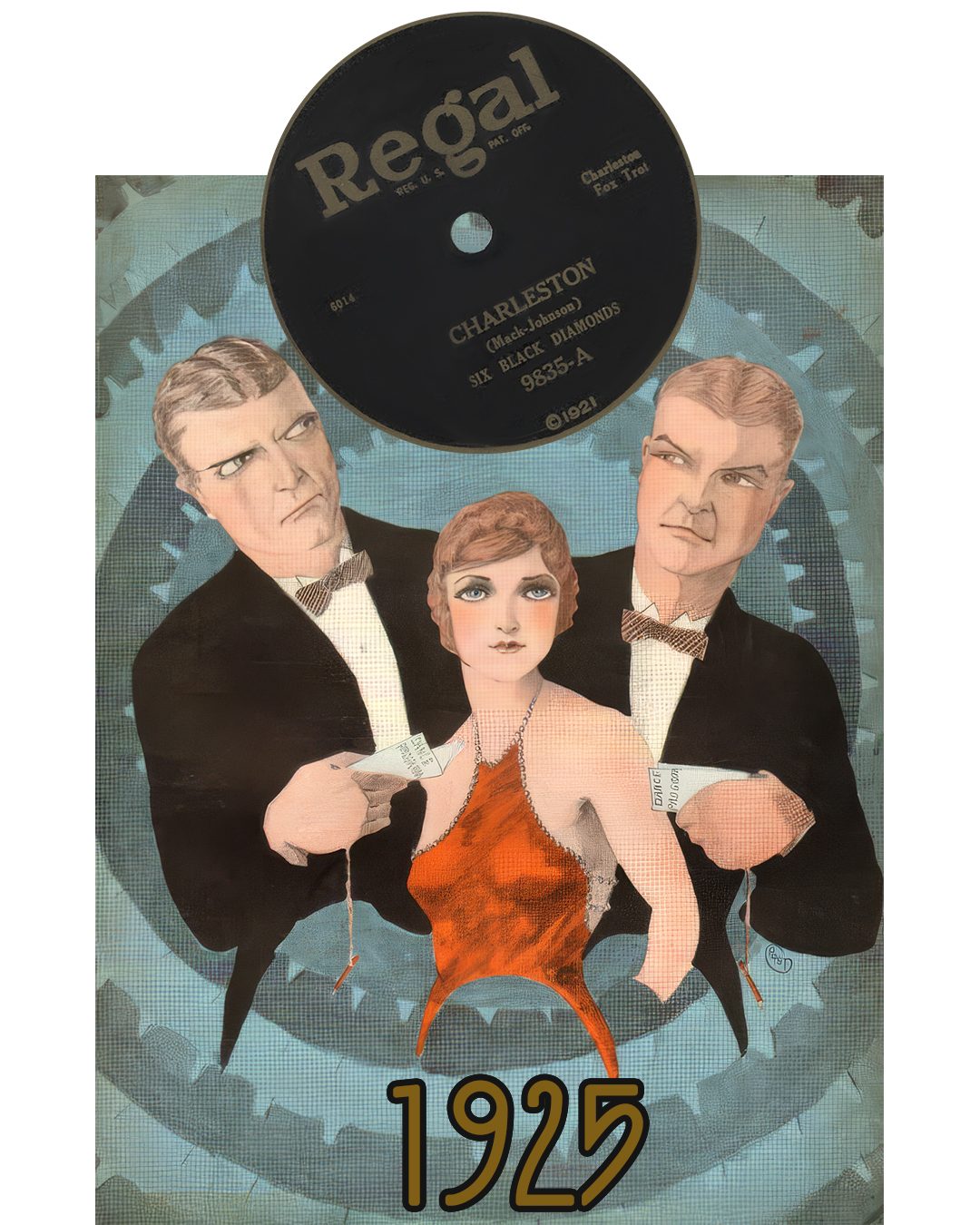
| “Charleston” Six Black Diamonds May 14, 1925 (Regal 9835 A mx 6014) |
| “Sweet Georgia Brown” Six Black Diamonds circa May 1925 (Regal 9835 A mx 6015) |
From the Edward Mitchell collection, here are recordings featuring “hot” arrangements of two iconic 1920s songs that are still familiar to modern audiences.
“Charleston” was composed in 1923 by James P Johnson and featured lyrics (though rarely heard in most recorded versions) by Cecil Mack for the all-black cast Broadway musical comedy Runnin’ Wild. The song inspired the dance and subsequent dance craze of the same name and remains closely associated with the culture and spirit of the 1920s in the popular imagination. This will be the eighth version of the song to be added to Radio Dismuke’s playlist.
“Sweet Georgia Brown” was composed by bandleader Ben Bernie and Maceo Pinkard with lyrics by Kenneth Casey. Bernie’s own Hotel Roosevelt Orchestra was the first of many to record the song, and the record was a big seller. Since 1952, the song has been well-known as the theme song of the Harlem Globetrotters.
By May 1925, Victor and Columbia were already making recordings with microphones, and Brunswick was using its own alternative version of electrical recording. However, records on smaller labels, such as the ones these recordings were issued on, were still made using acoustical recording horns.
The Six Black Diamonds was a recording pseudonym used for a variety of bands on a multitude of mid- to low-priced labels produced by the Regal Record Company and distributed by the Plaza Music Company. Regal/Plaza also supplemented its revenues by leasing its masters to other record manufacturers.
As was typical of Regal/Plaza recordings, both of those featured here were issued under a dizzying assortment of pseudonyms on multiple labels.
In addition to the copy here on Regal 9835, this recording of “Charleston” was also issued as the Six Black Diamonds on Banner 1540. On Domino 3510, it was credited to the Six Black Dominos. On Oriole 413, sold through the McCrory dime store chain, it was credited to the Dixie Jazz Band. On the mail-order National Music Lovers label, it was credited to the Manhattan Musicians. And on the Sears Roebuck Co. in-house label Silvertone, it was credited as Lanin’s Roseland Orchestra, which was the name of an actual band, but that does not necessarily mean that it was the band appearing on the record.
It also appeared on Perfect 14432, credited to the Blues Chasers. Perfect was the lower-priced subsidiary of the Pathe label. Pathe was a completely separate company from Regal/Plaza and had its own recording facilities. But the company would sometimes supplement its offerings by leasing masters from other labels.
I was not able to find any consensus as to whose band made the recording. One source provides contradictory information depending on which label the identical recording was issued on, while the Discography of American Historical Recordings (DAHR) credits it to Regal/Plaza’s in-house studio band.
The recording of “Sweet Georgia Brown” did not appear on as many labels. DAHR credits it as being by Jack Stillman’s Orchestra, the name also used on its Bell label pressing, which featured a completely different song on its flip side. On Regal, Banner, and Oriole, it had “Charleston” on the flip side and used the same pseudonyms mentioned above. It was also issued on Silvertone 2490, but I have not been able to locate the pseudonym used on that issue.
My personal guess is that, given that the two recordings have consecutive matrix numbers, there is a decent possibility that they were made during the same recording session, which would suggest that they were both made by the same band.
The good news for collectors seeking their own copy of these recordings is that their issuance on so many labels increases one’s chances of eventually finding one. The bad news is that if a collector already has a copy and stumbles across a record of the same song by a different band, they may not realize that it is merely another copy of what they already have.