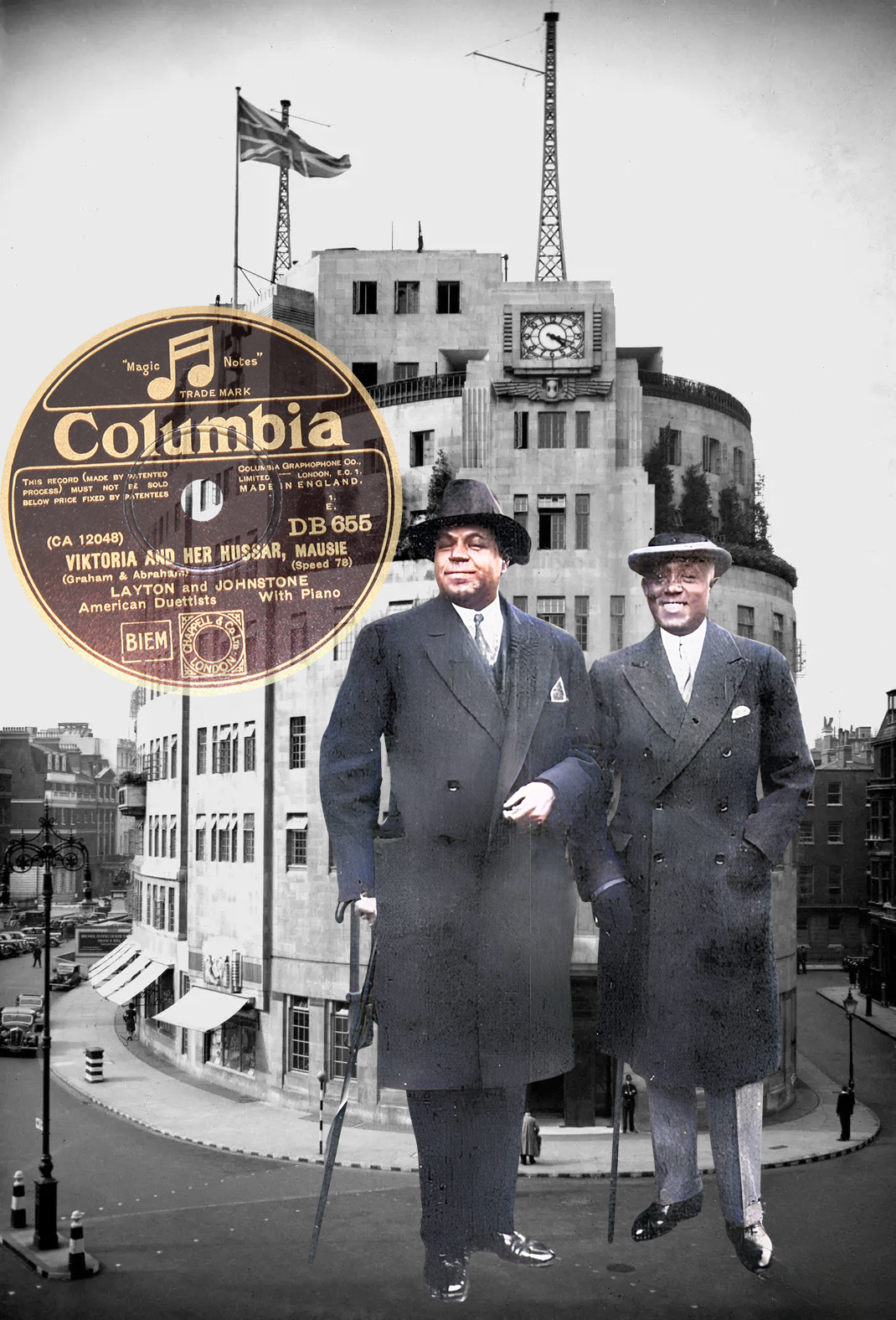
| “Mausie” Layton And Johnstone October 1931 (Columbia DB 655 mx CA 12048) |
| “Goodnight” Layton And Johnstone October 1931 (Columbia DB 655 mx CA 12040) |
Here are two very nice British recordings courtesy of Matt from College Station’s collection, which Matt presented on Radio Dismuke’s New Process Viva-Tonal Broadcast, which aired a few weeks ago.
Turner Layton and Clarence “Tandy” Johnstone were an American piano/vocal duo who, like a number of other 1920s-era Black American artists, found the racial climate across the Atlantic far more welcoming than at home and established highly successful careers there.
While they performed throughout Europe, it was in England that they became a household name and ranked among that country’s top celebrities. Their popularity extended across all social lines – they were well regarded by both elite and working-class audiences alike. Among their admirers was the Prince of Wales.
Between 1928 and 1935, each had reportedly earned around £64,000, an amount that, in today’s money, would be approximately £5.43 million in the UK or $7.1 million in the USA.
The duo parted ways in 1935 after divorce court documents came to light in the British media, indicating that Clarence Johnstone had an interracial affair with Raymonde Sandler, the wife of noted salon orchestra leader and BBC radio star Albert Sandler.
The former Mrs. Sandler followed Johnstone to New York City, where they were married in December 1935. Unfortunately, Johnstone’s musical style, which had been a hit with British audiences, was not as well received in America, and he struggled to find work in the entertainment industry, eventually taking jobs as a Western Union messenger and a janitor. Their marriage fell apart in the early 1940s, and Johnstone died penniless in a New York sanitarium in 1953.
The scandal did not impact Turner Layton’s popularity, and after the breakup, he resumed his career as a successful solo performer until he retired in 1946.
Both of these songs come from Paul Abraham’s Viktoria und ihr Husar. Abraham was a groundbreaking Jewish Hungarian composer who combined traditional Austro-Hungarian operetta with elements of American jazz. Viktoria premiered in Budapest on February 21, 1930. Its German premiere was in Leipzig on July 7, 1930. By August 15, it had transferred to Berlin, where it became a huge hit, resulting in recordings of popular arrangements of its songs becoming hits in their own right. An English-language version of the show opened in London on September 17, 1931, with adapted lyrics by Harry Graham as heard on these recordings.
Abraham’s subsequent productions, Die Blume von Hawaii and Ball im Savoy, were also highly successful. The December 23, 1932, premiere of Ball im Savoy in Berlin is considered by many to have been the last major cultural event of Weimar Germany before Hitler took power the following month. Despite the production’s popularity, because Abraham and most of the artists associated with it were Jewish, it was forced to close in early April as a result of attacks on the theater and audience by thugs from Hitler’s Brownshirts paramilitary organization. Abraham had to flee Germany and eventually Europe. His works were subsequently banned by the Nazi regime as “degenerate.”
By the early 1940s, Abraham had relocated to Cuba and then the United States, where he had difficulty finding work. His mental health began to deteriorate to the point where he was famously seen standing on a New York City traffic island with his baton, believing that he was once again conducting an orchestra. Beginning in 1946, he spent 10 years in New York area psychiatric hospitals before friends and fans in Germany raised funds for his return to that country.
After the war, Abraham’s works enjoyed a popular revival in 1950s Germany and are still well remembered and performed in German-speaking countries. Unfortunately, none of his productions made their way to the United States during their initial 1930s heyday, where they are still largely unknown. Thus, period recordings of popular music adaptations of his songs almost always come from the United Kingdom or Europe, which I think is sad. In my opinion, his delightful and often haunting melodies place him among the ranks of the era’s best composers of popular music.