International Novelty Orchestra / George Olsen And His Music – 1924

Victor 19475-B label image


“Beale Street Blues”
George Olsen And His Music
(Victor 19457-A)               July 25, 1924


“Boll Weevil Blues”
International Novelty Orchestra; Ed Smalle and Vernon Dalhart, vocal
(Victor 19457-B)               August 8, 1924


Here is a pre-microphone era record from the Edward Mitchell collection. The recording on one side turned 100 years old just a few days ago, and the one on the other side will turn 100 within the next couple of weeks.

“Beale Street Blues” is a famous 1917 W. C. Handy composition named after a street in Memphis, Tennessee, which, at the time, was part of that city’s black entertainment district. Many jazz artists have performed the song and continue to do so. This version is quite hot, especially for George Olsen compared with most of his band’s recordings after the advent of electrical recording the following year.

What caught my attention about this record and made me curious enough to pull it and give it an audition was the title on the flip side: “Boll Weevil Blues.”  The Central American insect, which first appeared in the United States in the 1890s, was very much a topical subject when this recording was made as, by the 1920s, it had a devastating impact on cotton crops and local economies throughout the southern states.

This was not the only song from the period with the title “Boll Weevil Blues.”  Several artists made recordings of a 1921 song with that title composed by Cliff Hess. While music and lyrics are protected by copyright laws, song titles are not.

This particular composition was by two extremely obscure composers,  Emabel Palmer providing the music and Charles Postal McCurdy providing the lyics.  Both hailed from Augusta, Arkansas.  Apparently, it was the only song either of them published, and neither a genealogy website referencing McCurdy nor an obituary for Emabel Palmer makes mention of them having written a song that was both published and recorded.  Around the time this song was copyrighted in March 1924, McCurdy had been working as a teacher at Fakes Chapel, about 10 miles northeast of Augusta.

I cannot help but wonder how, in an age dominated by the Tin Pan Alley music publishing firms and fierce competition to get a song published by one of them, two unknowns from a very small town in rural Arkansas were able to get their song not only published but recorded.

I have found four references to recordings of the Palmer-McCurdy song, three of which have a common denominator: vocal performances by Ed Smalle and Vernon Dalhart, neither of whom were under exclusive contract with any single label.

Their first recording of the song was for Edison on June 20, 1924, accompanied by John Cali on banjo and issued under the pseudonym of Arkansas Trio.   In July 1924, Smalle and Dalhart recorded the song for OKeh, accompanied by Harry Reser on banjo.

On June 25, 1924, Smalle and Dalhart made a recording of the song for Victor that was not issued.  According to the Discography of American Historical Recordings, Victor ledgers indicate that the recording was “made on approval” – meaning that Victor had not contracted for the recording and the artists made it with the hope that Victor would buy it.

Apparently, Victor executives liked it enough that Smalle and Dalhart were invited to make the recording presented here on August 8, 1924, backed by the International Novelty Orchestra, a pseudonym for Victor’s in-house orchestra led by Nathaniel Shilkret.

On November 3, 1924, an instrumental recording of the song was made on the Gennett label by the Miami Lucky Seven, a regional band from the upper Midwest.

Given that Smalle and Dalhart’s first recording of the song on Edison was issued under the pseudonym of the Arkansas Trio, which was not used on any other Edison record, I have to wonder if the pseudonym is more than a mere coincidence and might have been inspired by where the song originated.  And the note in the Victor ledgers that their initial recording for that company was “made on approval” indicates that the song was being actively plugged by Smalle and/or Dalhart.

Thus, it occurs to me that perhaps someone familiar with Emabel Palmer or Charles Postal McCurdy might have brought the song to the attention of either Smalle or Dalhart, who then decided to plug their version of it to the record labels.  If that was the case, it would explain how a song by two unknowns from Arkansas was recorded and picked up by a major New York music publishing house.

On the Edison recording and the earlier, unissued Victor recording, both Smalle and Dalhart are credited on the record companies’ ledgers for the kazoo playing, and I think it is a safe bet that they did so on this recording.



Posted in Uncategorized | Leave a comment

Recent Playlist Additions 1930-1936


Here’s a sampling of some of the recent audio restorations that have been added to Radio Dismuke’s playlist.   Brief information about the selections can be found following the recordings. 


“Old Fashioned Love”
Clyde McCoy And His Orchestra
(Decca 509-A mx C 9960)                          April 25, 1935


“Azul”
Agustin Lara; vocal, piano
(Peerless 1383 mx 270 A)                              1933


“Concha Nacar”
Agustin Lara; vocal, piano
(Peerless 1383 mx 268 A)                            1933


“Tell Me Why You Smile Mona Lisa”
Victor Young And His Orchestra;  Frank Munn, vocal
(Brunswick 6309)                                   May 11, 1932


“Bring It On Down To My House”
Bob Wills And His Texas Playboys; Tommy Duncan, vocal
(Vocalion 03492 mx C 1500)                 September 30, 1936


“Mean Mama Blues”
Bob Wills And His Texas Playboys; Tommy Duncan, vocal
(Vocalion 03492 mx C 1495)                September 30, 1936


“Jig In G”
Emilio Caceres And His Club Aguila Orchestra
(Victor 24614-B)                     April 4, 1934


“I’ll Be Blue Just Thinking Of You”
Buddy Blue, vocal
(Crown 3021-A mx 1015)      September, 1930


“You’re All I Need”
Freddie Rose; vocal, piano
(Decca 523-A mx 39770)             July 26, 1935


“I Love You From Coast To Coast”
Jack Shilkret And His Orchestra; Chick Bullock, vocal
(Melotone 7-02-14 mx 20375)             December 9, 1936


Clyde McCoy’s version of “Old Fashioned Love” was both old-fashioned and modern when it was recorded in April 1935.  By then, the song was already an “oldie,” having been written by James P. Johnson and Cecil Mack for the 1923 Broadway production Runnin’ Wild.  The show, with an all-black cast, also introduced their song “The Charleston,” which sparked the mid-1920s Charleston dance craze.  On the other hand, the closing passages of Clyde McCoy’s recording very much foreshadow the swing era, which, according to music historians, officially began four months later with Benny Goodman’s famous and highly successful engagement at the Palomar Ballroom.

Agustin Lara was a famous Mexican composer.  The two haunting recordings here, in which he provides the vocal and accompanies himself on the piano, are of his own compositions.  Both songs are well-known in the Spanish-speaking world but, for whatever reason, never really caught on in the United States.

“Tell Me Why You Smile Mona Lisa” is one of the relatively few popular German songs of the era recorded by American bandleaders. It is from the 1931 German film Der Raub der Mona Lisa/The Theft of the Mona Lisa and was written by Austrian composer Robert Stolz. Stolz is best remembered as a composer of operettas, but he also wrote for the film industry.

Bob Wills (along with Milton Brown) launched a new musical genre, western swing, in Fort Worth, Texas, during the early 1930s. This genre combined elements of country music with jazz and became extremely popular by the end of the decade, particularly in the Southwestern United States.

Jazz violinist Emilio Caceres was another musician who was extremely popular in Texas and, eventually, beyond in the 1930s.  The band had a long-term engagement at and broadcasted from San Antonio’s Club Aguila. “Aguila” is Spanish for “eagle.”   The club was owned by the Gephardt Chili Powder Company, which manufactured Gebhardt’s Eagle Brand Chili Powder, among other products, and introduced the wider world to another famous Texas invention, Tex-Mex cuisine.

Another Texan who made an impact on the musical world in the 1930s was Smith Ballew, recording here as “Buddy Blue,”  a pseudonym frequently used on his recordings for labels other than the one that currently had the exclusive on issuing recordings under his own name.

I suspect, but can’t confirm, that Ballew is accompanied here by Joe Venuti on violin and Eddie Lang on guitar.  Someone who has uploaded a copy of this recording to YouTube says in the upload notes that Joe Venuti was on this recording.  However, I have not found any definite confirmation in any of my reference material.  But Venuti and Lang did freelance with Crown Records’ in-house studio band and appeared on other Smith Ballew Crown recordings.  Thus, I suspect that chances are pretty good that they are on this recording as well.  Regardless, I think this is a very nice performance by Ballew and whoever the violin and guitar players might have been.

Freddie Rose provides another example of a famous composer accompanying himself on the piano – though the song he plays here was not one of his compositions but rather one co-written by Walter Jurmann and Kaper Bronisław, a songwriting team that was famous in Weimar-era Germany before they were forced to flee that country when Hitler’s National Socialists came to power.  They eventually landed a long-term contract in the United States with the MGM film studio. “You’re All I Need” is a song they wrote for the 1935 MGM film Escapade.

In the 1920s Rose composed several jazz songs that became hits and also made a good number of vocal recordings for Brunswick.  But, in the early 1930s, he moved to Nashville, Tennesee, where he began to increasingly focus on country music.  He eventually became a music publisher and a major force in the country music industry.

Jack Shilkret was a successful bandleader and the younger brother of Nathaniel Shilkret, who headed up in-house bands for the Victor label.

Posted in Uncategorized | Leave a comment

Eddie Mitchell And His Orchestra – 1924

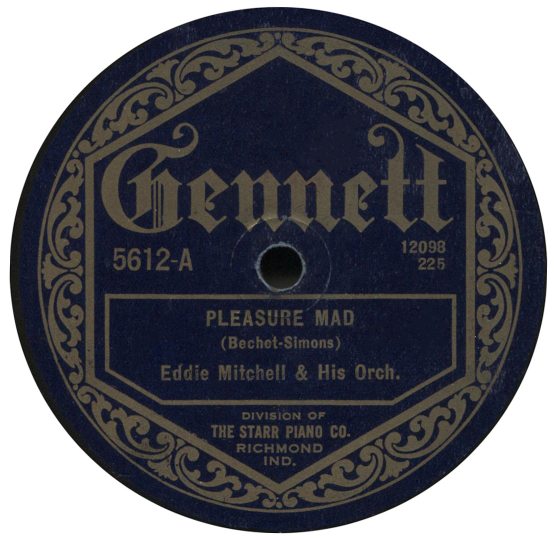
Gennett 5612-A label image


“Pickin’ ‘Em Up And Layin’ ‘Em Down”
Eddie Mitchell & His Orchestra                        December 12, 1924
(Gennett 5612-B mx 12100)


“Pleasure Mad”
Eddie Mitchell & His Orchestra                        December 12, 1924
(Gennett 5612-B mx 12098)


From the Edward Mitchell Collection, here are two sides that constitute the entire recorded output of a 1920s bandleader who was also called Eddie Mitchell.

After Eddie passed away, I heard someone mention that he had sought out and acquired a record by a bandleader who shared his name.  So this is a record I have been on the lookout for while sorting through his collection and selecting recordings to digitize for  Radio Dismuke’s playlist.    And it just so happened to be a very good record.  I am not sure how long it took him to find it or how much he had to pay/trade to get it, but it is a hard-to-find record.

The Eddie Mitchell band was based out of Columbus, Ohio and regularly performed at Olentangy Park. in nearby Clintonville, Ohio.  Mitchell, a violinist, worked as an automobile salesman by day while running the band on the side.

Unlike most record labels whose recording studios were in New York City, Gennett’s studios were in Richmond, Indiana, the hometown of the label’s corporate parent, the Starr Piano Company.   At the time, the Upper Midwest and Great Lakes regions, with their numerous large and middle-sized cities within a day’s driving distance from each other, were a hotbed of jazz talent and excellent regional territory bands.

For many regional bands, traveling to New York to record was cost-prohibitive, not just because of the travel expenses but also because of the lost revenue from gigs they would not be able to make during their absence.  Then, as now, musicians earned most of their money through live performances rather than record sales. By 1924, labels such as OKeh and Columbia began making occasional field trips with special portable equipment to record regional talent and musical genres.  Nevertheless, such field trips could only record a fraction of the era’s local and regional artists.

While Richmond, Indiana was only a small city, its location enabled it to record a lot of excellent talent that traveled throughout the Midwest and parts of the South, earning it the nickname “the cradle of recorded jazz.”

For the Eddie Mitchell band, the distance between Columbus and Richmond was roughly 100 miles.  During the recording session, the band also made two takes of a third song, “Helen Gone,” but for whatever reason, they were never issued.

You can read more about the Eddie Mitchell band and see a photograph of the band inside the Gennett recording studio, where these two selections were recorded at this link.


Posted in Uncategorized | Leave a comment

Paul Whiteman And His Orchestra – 1934

Victor 24769-B label image


“I Get A Kick Out Of You”
Paul Whiteman And His Orchestra; Ramona, vocal
(Victor 24769-B)                                                        October 26, 1934


“You’re The Top”
Paul Whiteman And His Orchestra; Johnny Hauser, Peggy Healy, vocal
(Victor 24769-A)                                                        October 26, 1934


Here are 1934 versions by the Paul Whiteman Orchestra of two songs from the musical production Anything Goes, which are still performed and well-known.

Anything Goes made its Broadway debut on November 21, 1934, and closed just under a year later after 420 performances.   Since that time, it has enjoyed many revivals and countless local and regional performances.  Cole Porter wrote both the music and the lyrics.

When Paramount Pictures made a film version of the musical in 1936, one of the lines in the song “I Get A Kick Out Of You,” “Some get a kick from cocaine...”  was regarded as too scandalous for the censors of the era’s strict Motion Picture Code and was thus changed in the film to “Some like the perfume from Spain….“

These recordings by the Paul Whiteman Orchestra were made about a month before the show’s Broadway debut and this was one of the top-selling records of the song.

Radio Dismuke’s playlist features a few other versions of both songs. Among them are recordings issued on a 1934 Bluebird 78 rpm record by George Hall and his Hotel Taft Orchestra with vocals by Loretta Lee and Sonny Schuyler that I personally consider to be the best recordings of both songs.

Posted in Uncategorized | Leave a comment

Five Birmingham Babies/Golden Gate Orchestra 1925

Perfect 14416-B label image


“Just A Little Drink”
Golden Gate Orchestra;  Arthur Hall, vocal
Perfect 14416 mx 105964-3)                                                                April 13, 1925


“You’re In Wrong With The Right Baby”
Five Birmingham Babies
(Perfect 14416-B mx 105966-1)                                                          April 14, 1925


Here is a jazzy orange shellac Perfect record from the Edward Mitchell collection that hit record dealer shelves in June 1925.

Both of these pre-microphone era recordings are performed by members of the California Ramblers, an important 1920s jazz band that recorded hundreds of sides under numerous pseudonyms for most of the American record labels of that decade.

The Golden Gate Orchestra was one of the band’s most frequently used recording pseudonyms.  The Five Birmingham Babies was a pseudonym used by Pathe and its budget-priced subsidiary label Perfect for a smaller ensemble of California Ramblers musicians.

Among the sidemen performing on “Just A Little Drink” are future bandleaders Adrian Rollini, Tommy and Jimmy Dorsey, and Red Nichols.  Adrian Rollini and Red Nichols returned to the recording studio the following day to perform on “You’re In Wrong With The Right Baby.”

This recording of “Just A Little Drink” was also issued on Pathe 036235 under the pseudonym of the Palace Garden Orchestra and on Pathe 10899 as Max Terr And His Orchestra.

“You’re In Wrong With The Right Baby” also appeared on Pathe 036235 and was credited as the Five Birmingham Babies.   The issue of “Just A Little Drink” on Pathe 10899 was paired with a different song.


Posted in Uncategorized | Leave a comment

Fletcher Henderson & His Orchestra – 1929

Columbia 1913-D label image


“The Wang Wang Blues”
Fletcher Henderson & His Orchestra
(Columbia 1913-D mx 148541)      May 16, 1929


“Blazin'”
Fletcher Henderson & His Orchestra
(Columbia 1913-D mx 148540)      May 16, 1929


Here are two very “hot” recordings from the Edward Mitchell collection by Fletcher Henderson And His Orchestra.

I think the recording of “Wang Wang Blues” is especially interesting. The song dates back to 1920, and its first recording by the Paul Whiteman Orchestra was a big seller.  It was co-composed by three members of the Paul Whiteman band, Henry Busse, Gussie Mueller, and Theron E. “Buster” Johnson. The song’s lyrics were written by Leo Wood.

This will be the fourth version of “Wang Wang Blues” to be added to Radio Dismuke’s playlist. The others include a 1928 Hawaiian guitar version by the Sam Ku West Harmony Boys and a 1934 recording by Henry Busse’s Orchestra.

You will also hear on the station a never-issued recording of the song made a few months after Fletcher Henderson’s on October 2 by Mal Hallett and His Orchestra for Edison. The intention was for the recording to be issued on Edison’s new “needle type” line of conventional 78 rpm records (as opposed to Edison’s thick, vertical grooved Diamond Discs, which had lost most of their market share). But, before the month ended, Edison closed down his record and phonograph business and never issued the recording.

Mal Hallett’s band recorded multiple takes of the song, one of which was issued a few years ago on a Jazz Oracle CD. The version heard on Radio Dismuke is from an extremely rare test pressing donated to Early 1900s Music Preservation of a different take than the one that was issued on the Jazz Oracle CD.

We do know that another test pressing of the take we have exists at the Edison National Historic Park. But we do not know if any other copies exist besides the one that was donated to us. It is undoubtedly the rarest recording in Radio Dismuke’s playlist, and I am not aware of any other place where one can hear that particular take.

In my opinion, the Mal Hallett version of “Wang Wang Blues” is not only the rarest but also the best.  But that does not take away from the fact that this version by Fletcher Henderson is simply outstanding.  I am very excited about adding it to Radio Dismuke’s playlist.

The song on the flip side, “Blazin’,” was composed by Joe Sanders, of Coon-Sanders Nighthawks fame.

During the opening four seconds of “Blazin'” one can hear what sounds to me like electrical hum.  While cleaning up the recording, I was concerned that it might have somehow been added by an issue with my transfer equipment.  But when I placed the record back on the turntable to confirm, it was clear that the sound is inherent in the record.

It occurs to me that it might be electrical hum introduced by an issue with Columbia’s recording equipment. Or perhaps it was generated by a musical instrument I cannot identify.

It would be very easy to edit out that hum-like sound without impacting the rest of the audio during those four seconds.  But, even if I knew for certain it was an error with Columbia’s equipment, I would still leave it in as such a defect would be part of the recording’s history.

Posted in Uncategorized | Leave a comment

Nat Shilkret And The Victor Orchestra – 1927

Victor 20682-B label image


“Stop, Go!”
Nat Shilkret And The Victor Orchestra, Johnny Marvin, ukulele, vocal
(Victor 20682-B)                                       May 26, 1927


“Something To Tell”
Nat Shilkret And The Victor Orchestra, Johnny Marvin, ukulele, vocal
(Victor 20682-A)                                       May 26, 1927


Here is a record from the Edward Mitchell collection with two catchy songs from a mostly forgotten musical comedy, The Madcap.

The New York production ran from January 31 through April 28, 1928, at the Royale and Casino Theaters.  These recordings were made when the show was still in out-of-town tryouts.  It initially opened in January 1927 under the name Green Fruit.  By April, the show had gone back into rehearsal with a new cast except for the show’s star, Mitzi Hajos, and was given a new name, Chibi, which was changed again to The Madcap by the time it opened up at Poli’s Theatre in Washington DC on April 19.

This record was released to Victor dealer’s stores in September 1927.

Nat Shilkret was the music director for Victor’s in-house studio orchestra.  Johnny Marvin was an early crooner famous for accompanying himself on the ukulele during the 1920s ukulele craze.

Posted in Uncategorized | Leave a comment

George Olsen And His Music – 1929

Victor 22213-B label image


“South Sea Rose”
George Olsen And His Music; Ethel Shutta, vocal
(Victor 22213-B)                       November 3, 1929


“What Do I Care”
George Olsen And His Music; Ethel Shutta, vocal
(Victor 22213-A)                       November 3, 1929


From the Edward Mitchell collection, here is a record by George Olsen and His Music with the vocal on both sides provided by Olsen’s wife, actress Ethel Shutta.

“South Sea Rose” is the title song from the 1929 comedy film South Sea Rose, an early all-sound film of which no known copies have survived.  This recording will be the second version of the song in Radio Dismuke’s playlist – the other is by the A&P Gypsies, from another record in Eddie Mitchell’s collection that he let me make a transfer of for the station a few years ago.

“What Do I Care” comes from the 1929 musical stage production Harry Carroll’s Revue at the Music Box Theater in Hollywood, California. Harry Carroll was the composer for several Broadway productions and for his own musical revues that appeared on the vaudeville circuits throughout the 1920s.

For his 1929 revue, Carroll secured a long-term lease of the Music Box Theater and renamed it Harry Carroll’s Music Box Theatre – apparently with the intent of staging productions there on an ongoing basis.  An advertisement for the production boasted an “all-star cast of 70,” including “40 wonderful girls.”

Carroll’s venture was not successful. The show closed after five weeks, and Carroll was forced to sell his beach house in Santa Monica to pay for the production’s debts.

“What Do I Care” was more successful than the show that originated it. In the months after the production closed, several artists recorded it.  Carroll, Jesse Greer, and Raymond Klages shared the song’s composer credits.

This recording will be the second version of “What Do I Care” in Radio Dismuke’s playlist – the other being by Adrian Schubert’s Orchestra, issued under the pseudonym of the Imperial Dance Orchestra.

Hollywood’s Music Box Theatre still stands and is now called the Henry Fonda Theatre. At some point, its facade was “modernized”/uglified and either replaced or covered with metal paneling that looks similar to the side of a shipping container.  However, its interior still has many of its 1920s-era details.

Posted in Uncategorized | Leave a comment

Abe Lyman And His California Orchestra – 1928

Brunswick 4175 label image


“Won’t You Tell Me Hon (When We’re Gonna Be One)”
Abe Lyman And His California Orchestra;  Paul Neely, vocal
(Brunswick 4175)                                November 26, 1928


“Give Your Little Baby Lots of Lovin'”
Abe Lyman’s California Orchestra;  unknown vocalist
(Brunswick 4175)                               December 22, 1928


Here are two sides from a 1928 Abe Lyman record from the Edward Mitchell collection.

First (though probably not most important!), the discrepancy between the band’s name on one side of the record versus the other rests with someone at Brunswick and not me (I make enough typos to be eager to point out when they are not mine!). I will speculate on why such a discrepancy might have occurred later in the posting.

Abe Lyman led one of the more nationally famous West Coast bands and was among Brunswick’s top-selling artists in the 1920s and early 1930s.  For much of the 1920s, it was the house band at the legendary Cocoanut Grove nightclub at the Ambassador Hotel in Los Angeles.

These and all of Lyman’s 1928 recordings were made in his hometown of Chicago, where the band provided the music for that city’s very successful stage production of Good News, which ran from February through November.  During that period, the band also recorded a few songs from the production, including a 12-inch two-part medley record.  Lyman and the band also appeared in the 1930 film version of Good News.

During the same recording sessions that produced the sides here, the band also recorded an instrumental version of each song for release in the German and possibly other foreign language markets.

Lyman’s band made records from 1923 to 1942. Musical styles evolved at an extremely rapid pace during that period, and bands had to change along with them to remain popular. Thus, Abe Lyman’s records from one period will have a very different sound than those of another. But my experience is that, regardless of the era, most of them are worth looking into.

As for the discrepancy in the band’s name on the opposite sides of this record, at some point around the time these recordings were made, there was a transition of the band’s name (whether the name the band itself went by or merely how it was listed on its Brunswick recordings, I am not sure) from “Abe Lyman and His California Orchestra” to “Abe Lyman’s California Orchestra. ”

Looking at the labels of various issues, recordings from the same November 26, 1928 recording session as “Won’t You Tell Me Hon” were issued under both names.

“Give Your Little Baby Lots of Lovin'” was the only song the band recorded in its December 22, 1928 recording session.

Most recordings from the band’s early 1929 sessions seem to have been issued under “Abe Lyman’s California Orchestra.” However, I found one example still listed as “Abe Lyman And His California Orchestra.”

It occurs to me that it is possible that when later pressings of the band’s previous recordings were made, the name on the label was updated, which would explain why recordings from the same session might appear under both. But seeing such a discrepancy on opposite sides of the same disc is a bit unusual.


Posted in Uncategorized | Leave a comment

The Georgians – 1923

Columbia A-3864 label image


“Snakes Hips”
The Georgians
(Columbia A-3864 mx 80900)          March 14, 1923


“Farewell Blues”
The Georgians
(Columbia A-3864 mx 80887)           March 6, 1923


From the Edward Mitchell collection, here is a record featuring The Georgians, an excellent jazz ensemble led by Frank Guarente that was a sub-unit of the larger Paul Specht Orchestra.

The Georgians were the first “band within a band,” something that became common with the more famous bands during the swing era of the late 1930s and early 1940s (for example, Paul Whiteman and His Swing Wing, Tommy Dorsey and His Clambake Seven, Artie Shaw and His Gramercy Five, etc.).

“Snakes Hips” was composed by Spencer Williams, who wrote several compositions that continue to be performed by various jazz groups.

The Georgians were the first to record the song, though the Original Memphis Five made a recording for Brunswick three days later, issued under the pseudonym The Cotton Pickers, and a recording for Victor eight days later, issued under their own name.

I’ve seen mention online that “Snakes Hips” refers to belly dancing, but I could not find further information to confirm the accuracy of that.

However, the song came out in an era when there was a fascination in the West with ancient and/or traditional cultures perceived as “exotic,” which had a big influence on everything from architecture to fashion and on music in the form of popular “Oriental foxtrot” compositions.

A few months before this recording, the excavation of the tomb of ancient Egyptian pharaoh Tutankhamun made international headlines and sparked a widespread interest in ancient Egyptian aesthetics, which soon spread through popular culture.  The pseudo-Egyptianesque theme of the song and this recording are both consistent with that trend.

“Farewell Blues,” a 1922 composition by Paul Mares, Leon Roppolo, and Elmer Schoebel, was recorded by dozens of groups in the 1920s and 1930s and continues to be performed.


"Snakes Hips" sheet music cover image

Click on image for larger view.


Posted in Uncategorized | Leave a comment