These recordings were made on June 18 and 19, 1928 in Seattle, Washington on one of Columbia’s regular field trips that sent their mobile equipment to various parts of the USA to record regional talent for which travel to their New York recording studios would have been cost-prohibitive.
During those two days, the band recorded a total of four sides, the other two being “Trumpet Sobs” and “Alice Blue Gown” which were issued on Columbia 1526-D
Both of the songs here were already over a decade old when the band recorded them.
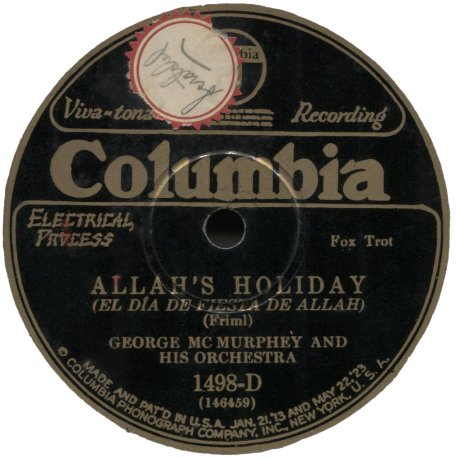
“Allah’s Holiday” is a Rudolf Friml composition from the 1915 Broadway production Katinka. A lot of ragtime renditions of the song were recorded during the late 1910s.
“Poor Butterfly” was composed by Raymond Hubbell with lyrics by John L. Golden for the 1916 musical revue The Big Show at the New York Hippodrome. The song has been recorded by many artists over the decades A 1954 recording of the song by The Hilltoppers climbed to number 15 on the Billboard best-selling music charts.
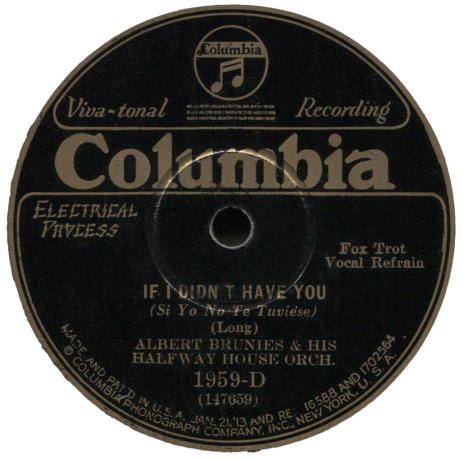
“If I Didn’t Have You”
Albert Brunies & His Halfway House Orch; Johnnie Saba, vocal
(Columbia 1959 D mx 147659) December 17, 1928
“Just Pretending”
Albert Brunies & His Halfway House Orch; Johnnie Saba, vocal
(Columbia 1959 D mx 147658) December 17, 1928
Here are a couple of enjoyable recordings from a record in the Edward Mitchell collection by a jazz band that was popular in the New Orleans area throughout most of the 1920s. These were made during one of Columbia’s regular field trips to that city and were recorded in the old Godchaux Building.
The band was based out of the Halfway House, a dance hall that took its name from the fact that it was located approximately halfway between New Orleans and Lake Pontchartrain.
There are several other recordings by this band in Radio Dismuke’s playlist and they all have a similar jazzy but laid-back style. The recordings here are from the band’s last recording session – though Albert Brunies did record again years later during the LP era.
At this link you will find a detailed article about the band, Albert Brunies, the other musicians in his family and the Halfway House. Note: the article indicates that the Halfway House is still standing, which it was when the article was published. Unfortunately, the building was subsequently demolished in 2010.
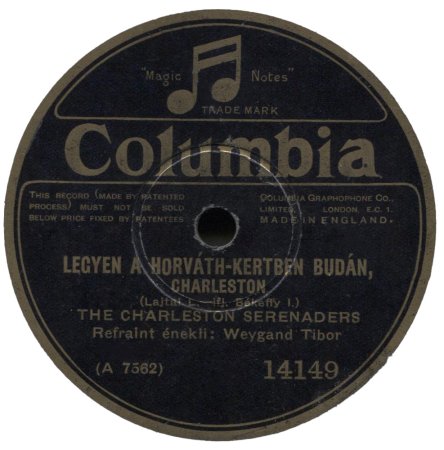
“Ne félj a csóktól babám” (“Don’t be afraid of kisses, baby”)
The Charleston Serenaders; Weygand Tibor, vocal
(Columbia 14149 mx WA 7561) circa June 27, 1928
“Legyen a Horváth-kertben Budán” (“Be in the Horváth Garden in Buda”)
The Charleston Serenaders; Weygand Tibor, vocal
(Columbia 14149 mx WA 7562) circa June 27, 1928
Here’s a record from the Edward Mitchell collection featuring two recordings by a popular 1920s and 1930s Hungarian vocalist and film star backed up by a nice, somewhat jazzy dance band.
Both of these songs were written by Lajos Lajtai and István Békeffy for the 1928 Hungarian operetta A régi nyár (The Old Summer). In early 20th-century Europe, operettas were the source of many songs performed by jazz and dance bands in the same way that Broadway musicals were in the United States. This particular operetta was also made into a 1942 Hungarian film.
“Legyen a Horváth-kertben Budán” (“Be in the Horváth Garden in Buda”) refers to a famous and historic park in Budapest. The song has a definite Eastern European flair.
The band’s arrangement on “Ne félj a csóktól babám” (“Don’t be afraid of kisses, baby”) reminds me a bit of the sort of music played in the musical revues in German cabarets during the era.
Tibor Wegand was one of Hungary’s more popular male vocalists in the 1920s and 1930s and appeared in several Hungarian films. You can view a nice clip of him singing a very catchy song in one such film from 1936 on this YouTube video.
There is contradictory information as to when and where these recordings were made.
The Grammophon Portal website lists the recordings as having been made in Vienna in 1929. The Austrian-based Society for Historical Sound Recordings website lists them as having been made in Vienna in 1928.
However, other sources state that they were recorded in London in 1928. I am strongly inclined to believe this to be the case.
WA matrix number prefix that appears in the runout groove on both sides of the record was primarily used by UK Columbia for recordings that were made in Britain.
Furthermore, since matrix numbers were issued consecutive order, WA 7561 and WA 7562 would have been assigned in late June, 1928. By January 1929, the WA matrix numbers were up to WA-8275.
Under the “Charleston Serenaders” listing in his British Dance Bands On Record 1911-1945Brian Rust states:
“Pseudonym on Columbia for Van Phillips and his Band, q.v., and for various American bands also.”
At the end of his listings for the Van Phillips band, Rust states the following:
“A considerable number of sides were made in 1928 and 1929 by a studio orchestra that seems to have included Van Phillips, under the nominal direction of Stan Greening; but all were of material designed for Continental issue, in languages such as French, German, Danish and Hungarian, with many vocals in those languages. In view of the enormous number of these, and of their not having been issued in the UK, – we feel it is better to exclude them as being outside the scope of this book.”
I think it is most likely that the recordings here were part of the above-mentioned sides.
A bit of further circumstantial evidence can be found under Rust’s section for Stan Greening’s band for a June 27, 1928 London recording session that produced a recording of “Mississippi Mud” that ended up not being issued. The matrix number assigned to that recording was WA-7563 – just one digit higher than the matrix numbers for the recordings here.
Given that matrix numbers were issued consecutively and the previously mentioned connection between Greening and the Charleston Serenaders pseudonym, that suggests a very strong likelihood that the recordings here were part of that same June 27, 1928 recording session. That is also what I used as the basis for the estimated recording date.
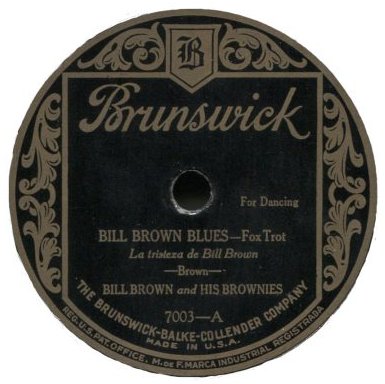
“Hot Lips”
Bill Brown And His Brownies
(Brunswick 7003-B) March 17, 1927
“Bill Brown Blues”
Bill Brown And His Brownies
(Brunswick 7003-A) March 17, 1927
Here’s a rare record from the Edward Mitchell collection, one of only two made by a very nice black jazz band based out of Pittsburgh, Pennsylvania.
I was not able to find a lot of information about Bill Brown And His Brownies. Brown was a trombonist and his band was active between 1925 and 1935. Most references to the band are regarding the fact that John Kirby was, for a while, a member. While it was based out of Pittsburgh, during the mid-to-late 1920s the band regularly appeared at top Harlem nightspots such as the Alhambra Ballroom and the Savoy Ballroom.
This record was the third of Brunswick’s 7000 “race” series. “Race records” was an industry term at the time for recordings by black artists that were primarily marketed to black record buyers.
The band had its only other recording session on December 26, 1929 which resulted in two sides issued on Brunswick 7142, “Zonky” and “What Kind of Rhythm Is That?”
John Kirby was in the 1929 recording session but not the 1927 recordings featured here.
I was impressed by both of these recordings and wish the band had been able to make far more recordings than it did.
“Hot Lips” dates back to 1922 and was co-composed by Henry Busse who was one of the original members of the Paul Whiteman Orchestra. Whiteman’s band was not the first to record the song but it had the top-selling recording. The song, with Busse’s trumpet solo, remained part of the band’s live performances throughout the rest of the 1920s. After Busse formed his own band, the song became its opening theme. Busse made recordings of it in 1934 for both Columbia and Decca.
I have always enjoyed Busse’s 1934 Decca recording of the song – but, in my opinion, Brown’s hot jazz rendition is, by far, the best version of the song I have come across.
“Bill Brown Blues” was composed by Brown himself and I suspect could have perhaps been used as the band’s opening theme song. Brunswick also issued this recording of “Bill Brown Blues” on its lower-priced Vocalion label (Vocalion 1128) with Johnny Dodds Black Bottom Stompers’ “Melancholy” on the flip side. The Vocalion issue is harder to find than the Brunswick.
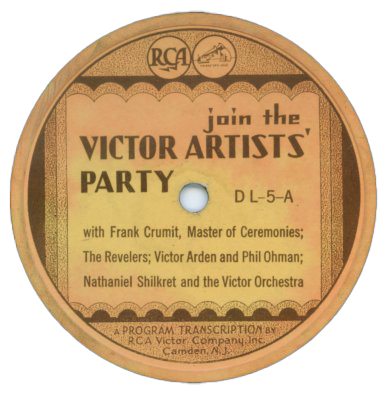
“Victor Artists Party”
Frank Crumit, announcer and vocal; Victor Arden & Phil Ohman; The Revelers; Nathaniel Shilkret & The Victor Symphony Orchestra
(Victor Program Transcription D L 5-A) July 30, 1931
“Dance Medley (You’ve Got Me Crying Again, Down A Carolina Lane, Honestly”)”
Isham Jones And His Orchestra; Joe Martin, vocal (“You’ve Got Me Crying Again” “Honestly”); Eddie Stone, vocal (Down A Carlona Lane)
(Victor Program Transcription L 16021) February 14, 1933
“Popular Selections (Home, Save The Last Dance For Me, A Faded Summer Love)”
Wayne King And His Orchestra; Tom, Dick & Harry, vocal
( Victor Program Transcription L 16000) November 23, 1931
Courtesy of Matt From College Station’s collection, here are recordings from three rare Victor Program Transcription discs, an early, commercially unsuccessful attempt at a 33 rpm long playing record a full 17 years before the advent of the modern LP record.
One of the big challenges since the dawn of the recording industry was the extreme time limitation of how much music could be made to fit on a record. The average 10-inch record during the 78 rpm era could hold approximately 3 minutes of audio on each side and 12-inch records could hold about 4 minutes worth.
There are only three ways to extend the playing time of a record: make the record larger, make the record’s grooves smaller, or slow down the speed. Victor’s Program Transcriptions were an attempt at the latter. The more commonly found 10-inch discs were able to contain up to about 10 minutes of audio and some were also issued in a 12-inch size.
The records differed from the later LPs in that they did not have microgrooves and they were either made out of shellac or, more commonly, a plastic material called “Vitrolac” which had a much noisier playing surface than the vinyl that modern LPs use.
Unfortunately, the new format was a commercial failure, largely because the records were introduced at the worst possible time when the Depression had still not reached its bottom. In 1932 Victor’s total record sales were only 10 percent of the label’s 1927 high point. All of Victor’s 1920s-era competitors had either folded or would be absorbed into the American Record Corporation. The only thing that kept Victor alive was the deep pockets of RCA which had purchased the label in 1929 and also owned the highly profitable NBC radio network.
Not only was it a bad time for selling records, because most record buyers were still using windup-style phonographs, they would have had to purchase a new record player to listen to them as they could only be played on a phonograph with an electrical pickup and capable of playing the slower speed.
Victor’s new machines for playing the records started at $274 (approximately $5,310 in 2024 dollars) and went up to $995 (approximately $22,343 in today’s dollars).
Needless to say, not many people bought the new records.
By 1934 Victor had stopped making new issues, though some of its existing ones continued to be listed in Victor’s catalog as late as 1939.
Oddly, Victor did not make a serious attempt to take full advantage of the new format’s benefits for the one market for which the records made the most sense: classical music, whose fans also tended to be more affluent. Unlike the issues featured here aimed at a popular audience which were specifically recorded for the format, most of the classical issues merely consisted of compilations of dubs from previously issued 78 rpm releases.
The 33 rpm speed did not die out completely before the 1948 introduction of the LP. 16-inch 33 rpm broadcast transcription discs that could hold 15 minutes per side were the standard format used by radio stations to capture and play pre-recorded programming into the 1960s when they were finally supplanted by tape recordings.
“Victor Artists Party” was the first Program Transcription to be issued and is a demonstration record introducing the new format. The record was also provided as a bonus for those who purchased Victor’s $350 (approximately $7,500 in 2024 dollars) RAE-59 model phonograph.
The announcer is Frank Crumit who was popular during the 1920s and early 1930s as a composer and singer of often folksy novelty songs. Also featured are the piano duo of Victor Aden and Phil Ohman, The Revelers, a vocal quintet whose records inspired the formation of the better-remembered German group, the Comedian Harmonists, and Nat Shilkret conducting Victor’s in-house orchestra playing Ferde Grofé’s “Mardi Gras.”
While all three of the songs featured in Isham Jones‘ “Dance Medley” disc were also issued on 78 rpm, the recording here was made separately during the same recording session. The band appeared on a few other Program Transcription discs as well. The selections on this are not at all jazzy but are a nice example of the more sedate “sweet” style of dance music that became popular during the early Depression years between the end of the Jazz Age and the dawn of the Swing Era. Matt played this disc on Radio Dismuke’s recent New Year’s broadcast.
The Wayne King Orchestra’s “Popular Selections” was the first record released in Victor’s L-16000 series of Program Transcriptions, which the Isham Jones disc was also from. These were lower-priced 10-inch Program Transcriptions that were single-sided and sold for 85 cents (about $18.25 in 2024 dollars). By contrast a double-sided popular series Victor 78 rpm cost 75 cents (about $16 in 2024 dollars).
Of the three Wayne King selections, the only one that was recorded separately for issue on 78 rpm was “Save The Last Dance For Me.”
The Wayne King disc was recorded in the ballroom of the old Webster Hotel in Chicago, a venue that Victor utilized for many of its recording sessions in that city. Happily, the hotel’s building still stands and now houses apartments. You can see photos of its spectacular still-intact 1920s lobby at this link.
I was not able to learn if the hotel’s ballroom survives but, as this recording demonstrates, its acoustics were amazing. For whatever reason, during the early years of electrical recording, American record labels tended to heavily dampen their recording studios compared with their European counterparts. But, on this recording, particularly towards the beginning, the room provides just enough echo effect to make it come to life.
Imagine what such a band must have sounded like in the 1920s and 1930s live in such a ballroom without the limitations of the era’s recording technology (and the fidelity of these Program Transcription discs was even less than that of Victor’s 78 rpms of the period).
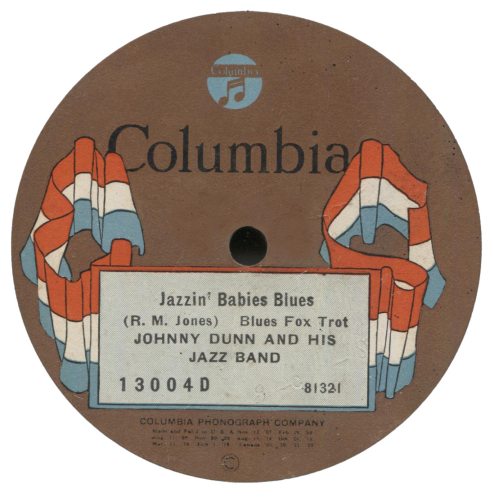
“I Promised Not To Holler But Hey! Hey!”
Johnny Dunn And His Jazz Band
(Columbia 13004 D mx 81322 ) October 30, 1923
“Jazzin’ Baby Blues”
Johnny Dunn And His Jazz Band
(Columbia 13004 D mx 81321) October 30, 1923
Here are two pre-microphone era jazz recordings from a hard-to-find record in the Edward Mitchell collection.
This record was one of only eight issued in Columbia’s 13000-D catalog number series of so-called “race records.” In an era when it was common for hotels to skip over the number 13 when designating floor and room numbers, Columbia officials quickly realized that widespread superstition about that number would cut into sales of any catalog number series that started with it. Thus the numbering block used for its “race” series was almost immediately changed to 14000-D.
“Race records” was an industry term used to describe records by black artists performing music that was in high demand by black record buyers. Such records featured a diversity of musical styles including blues, jazz, gospel, “hot” dance band, and sometimes classical and operatic.
The first label to issue “race records” was OKeh when, after the phenomenal success of its 1920 recording of Mamie Smith’s “Crazy Blues,” it became clear that there was a large, lucrative and under-served market for black performers and musical styles that had been almost completely overlooked by the handful of record labels that existed prior to the 1920s. Other labels soon came out with their own line of “race records” and a black-owned independent label also emerged. Over time, increasing numbers of white record buyers became aware of and sought out such records.
Columbia began selling “race records” in 1921 but they were issued under the same catalog numbering scheme as its general interest and popular records. Earlier in the same month that the selections here were recorded, financially troubled Columbia was forced into receivership. During the reorganization period, the company introduced a colorful new “flag label” design and a brand-new catalog numbering system that gave its “race records” their own numbering block.
The industry also had a less-than-flattering term for records that were marketed to rural white audiences, “hillbilly records.” By the early 1950s the terms “race records” and “hillbilly records” had given way to the less derogatory rhythm-and-blues and country-and-western categories. Today, the old “race records” are highly sought after by collectors and tend to fetch premium prices, especially if they are in excellent condition.
Johnny Dunn was regarded as one of the top New York City-based jazz cornet players during the early 1920s, though his fame was eventually eclipsed by other artists such as Louis Armstrong. He made his last recordings in 1928 before permanently moving to Europe where continued to perform but did not make any more records. He died in Paris, France in 1937 from tuberculosis.
This recording “I Promised Not To Holler But Hey! Hey!” was the band’s third try at recording the song. They had previously attempted to record it in sessions held earlier in the year on February 20 and again on March 13, but, for whatever reason, those takes were rejected. My guess is they were very happy to have finally gotten that one knocked off their list.
“Brother Can You Spare A Dime”
Charlie Palloy & His Orchestra; Charlie Palloy, vocal
(Crown 3392-A mx 1878) October 1932
“Cheer Up (Good Times Are Comin’)”
“Leo Reisman And His Orchestra; Lew Conrad, vocal
(Victor 2245- A) June 11, 1930
“The Gold Diggers’ Song (We’re In The Money Now)”
Jack Berger And His Hotel Astor Orchestra; Ted Holt, vocal
(Bluebird B 5054-A) May 5, 1933
Here are three topical recordings, courtesy of Matt From College Station’s collection, about the Great Depression.
Most of the period’s popular songs about the Depression were upbeat with lyrics that emphasized optimism or, at the very least, a “glass is half-full” perspective. “Brother Can You Spare A Dime,” which debuted in the 1932 revival of the musical revue Americana, was a definite exception.
Bing Crosby and Rudy Vallee made the most famous recordings of the song. The Charley Palloy version here, which Matt played on Radio Dismuke’s recent New Year’s broadcast, was not as well-known. The recording was issued on Crown, a short-lived low-price label that was distributed through the F. W. Woolworth dime store chain. A detailed profile of Palloy and his career can be found at this link.
“Cheer Up (Good Times Are Comin’)” is a much more typical Depression-themed recording. A lot of bands besides Leo Reisman and His Orchestra recorded the song, including Ben Selvin And His Orchestra, Phil Spitalny’s Music, Roger Wolfe Kahn And His Orchestra as well as Jack Albin’s Hotel Pennsylvania Music.
“The Gold Diggers’ Song (We’re In The Money)” was introduced by Ginger Rogers in the opening segment of the film Gold Diggers of 1933. The song remains well-known and sometimes finds its way into films, television programs and, more frequently, commercials. Bandleader Jack Berger is mostly forgotten today but, in the early 1930s, he was well-known through national radio broadcasts and his band was a fixture for several years at New York’s Hotel Astor. More information about Jack Berger can be found at this link.
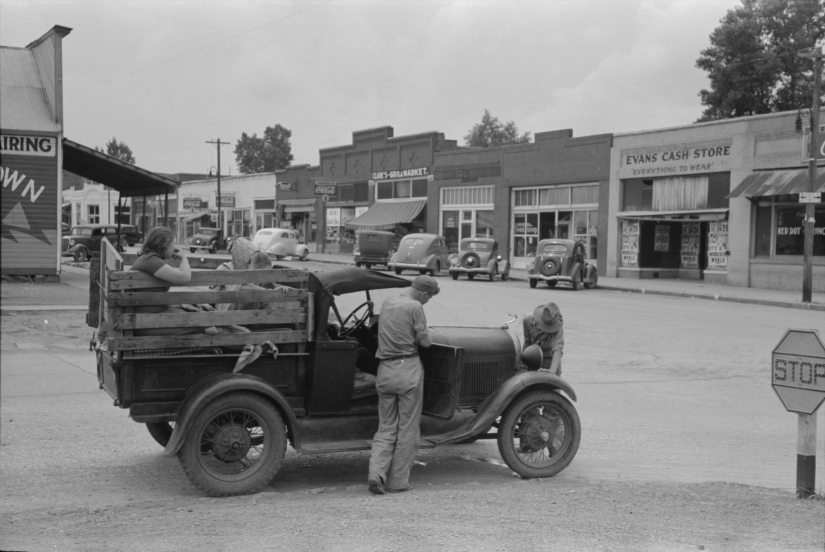
About the image – Every time I have posted the above image I have received questions about it. I stumbled across it several years ago on the Library of Congress website. It is from July 1939 and is one of several on the website taken by photographer Lee Russell that feature a family from rural Oklahoma as they begin their cross-country journey in an old truck in search of new opportunities in California.
There was something about the photo that I found particularly captivating and I became curious as to where it was taken. Unfortunately, the only information provided on the Library’s website is: “Migrant family’s car stalled in main street of small town near Henrietta [i.e., Henryetta,] Oklahoma.”
After a lot of playing around in Google Maps, I eventually was able to identify the location as being Morris, Oklahoma. Sadly, the town was hit by a deadly tornado on April 26, 1984 that destroyed 85 percent of its structures, including any in the photo that might have remained. Here is a Google Streets view of approximately the same spot today. The buildings that now line the cross-street are of very plain modern construction and my guess is they are replacements that the insurance companies were willing to pay for when the originals were destroyed.
I just became aware of a very nice and touching tribute to the late Early 1900s Music Preservation board member and Radio Dismuke contributor Edward Mitchell that a young collector posted to his YouTube channel a few months ago.
In it, he talks about the impact Eddie had on him as he sought to explore and learn more about the music of the 1920s and 1930s and 78 rpm records. He also talks about the community of vintage music YouTubers that Eddie became a part of.
The video also talks about various YouTubers gathering for yearly online listening parties to hear Eddie on Radio Dismuke’s annual New Year’s broadcasts. I was not aware that such listening parties were occurring and thus don’t know if Eddie was aware of them or not. But I thought that was very neat.
The tribute also includes comments by a couple of other YouTubers regarding their online friendship with Eddie.
I know that Eddie would have been profoundly touched and moved by this tribute. On many occasions, I heard Eddie talk about interacting with people he had met through his YouTube channels and it was clear that the community he found there meant a lot to him. And I am amazed at how people who did not know Eddie for as long as I did and who only knew him online are able to so accurately capture Eddie’s personality.
After his passing I wrote that the Eddie one heard on Radio Dismuke broadcasts was the same Eddie we knew in real life. Since that time I have met people from other areas of Eddie’s life and interests that I was not part of but had heard him talk about often who shared various anecdotes about him. In all instances, I found myself nodding my head thinking, “Yep! That’s Eddie!” He was truly down-to-earth and authentic. If he ever paid you a compliment or said a kind word, I guarantee you that it was heartfelt and authentic (and, likewise, he did not hold back when expressing his scorn for those he felt had behaved unjustly).
I think this is a wonderful tribute to Eddie and wanted to share it with all those who enjoyed listening to the interesting stories and background information that he provided during our broadcasts.
The creator of this video, by the way, is in the process of writing a book about the 1920s and 1930s bandleader Will Osborne. He points out elsewhere on his channel that, at present, there is no source that has more than a page or two of information about Osborne and his career – which is the case with many who were famous stars during the era but have largely been forgotten. I will be keeping an eye out for its publication and will put up a posting once it becomes available.
“The Very Thought Of You”
Red Nichols And His World Famous Pennies; King Harvey, vocal
(Bluebird B 5548-A) July 18, 1934
This recording is from the collection of Matt From College Station who let me digitize it for Radio Dismuke. I think it is a very pleasant version of a song famously recorded by Al Bowlly with the Ray Noble Orchestra in England. When the Ray Noble recording was released in the United States, it quickly climbed to the top of the Billboard music charts. The song has been recorded by a variety of artists over the decades and is regarded as a pop standard.
I was not able to find biographical information about vocalist King Harvey other than he was a guitar player and vocalist for both the Herbie Kay and Red Nichols bands.
While preparing this posting, I saw that Ricky Nelson, son of 1930s bandleader Ozzie Nelson, revived the song in 1964 with a big-selling rock and roll version. I thought that was interesting because King Harvey’s voice strikes me as being similar to Ozzie Nelson’s.
I am currently working on a few other recordings from Matt’s collection, some of which I will share in future postings.
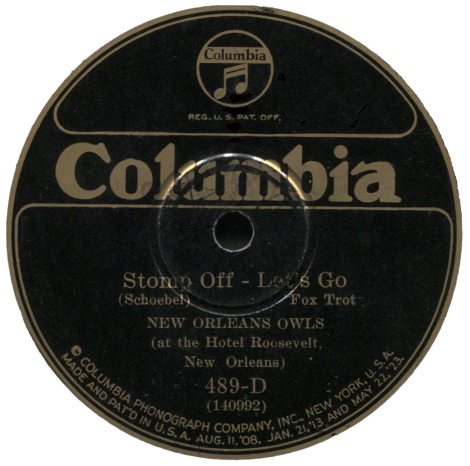
“Stomp Off – Let’s Go”
New Orleans Owls
(Columbia 489 D mx 140992) September 24, 1925
“Oh Me! Oh My!”
New Orleans Owls
(Columbia 489 D mx 140993) September 24, 1925
Here’s a hard-to-find record from the Edward Michell collection featuring two excellent examples of New Orleans-style jazz (which would later be commonly referred to as “Dixieland”) from a historic recording session held at the Hotel Roosevelt in New Orleans.
The recordings were not just the first recording session for the New Orleans Owls, they were part of the first field recording session to utilize the new electrical recording process via a mobile recording van. The recording session ended early due to technical difficulties that you can actually hear in portions of both recordings in the form of odd noises and distortion, a particularly noticeable example of which can be heard just after 2:03 into the “Stomp Off- Let’s Go” side. I saw some speculation online that it might have been caused by an issue with the cutting head, possibly brought on by high New Orleans humidity.
Fortunately for jazz enthusiasts ever since, despite the obvious technical flaws, Columbia nevertheless decided to bring both recordings to market.