Harold Leonard And His Red Jackets – 1922

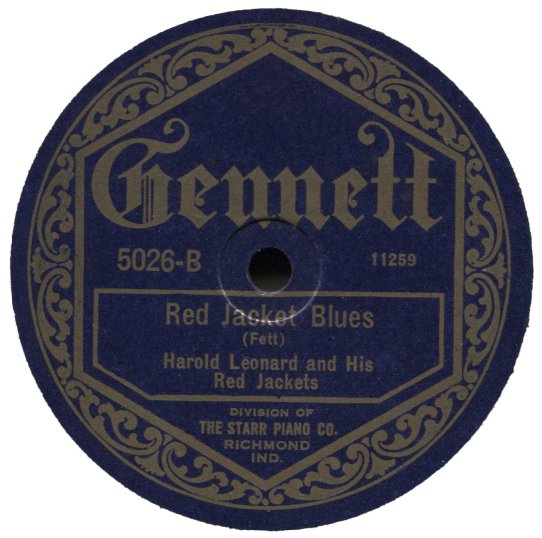
Gennett 5026-B label image

“You Know Why”
Harold Leonard And His Red Jackets
(Gennett 5026-A mx 11261)                                           December 11, 1922


“Red Jacket Blues”
Harold Leonard And His Red Jackets
(Gennett 5026-B mx 11259)                                           December 11, 1922


Here is a pre-microphone era record from the Edward Mitchell collection featuring a band with an interesting and rather unique sound. The ensemble consisted of a violin, a sax section, a piano, a banjo, and drums.

“You Know Why” is a charming dance number with an arrangement that comes across well through the primitive recording technology.    Indeed, I think the piano solo passage sounds quite nice for a recording of that era, given that it was an instrument that was often difficult to record.

“Red Jacket Blues” is an interesting composition that makes me wish this could have been recorded three years later after microphones began to be used in recording sessions.

The arrangement heavily features Harold Leonard playing the violin and reminds me of something one might hear from some of the later country music bands. Violins did not record well at all with the old technology.  Very often, for recording sessions, they would instead use a Stroh violin, a variation of the instrument featuring a horn to amplify the sound.   I don’t know whether or not one was used for this recording session.

Harold Leonard’s band is best remembered as the house band of the Hotel Windsor in Montreal in the mid-1920s and the Waldorf-Astoria Hotel from 1926-1927 when it was still at its original location where the Empire State Building would be constructed a few years later. During periods when the band wasn’t associated with the hotels, it went by the name of Harold Leonard and his Red Jackets.

Both of these recordings were made at the Gennett studios in Richmond, Indiana as part of the band’s very first recording session.

Other than his association with the famous hotels, I was not able to quickly find in any single source much information about Harold Leonard or his band.

Based mostly on various publications from the era,  prior to its extended engagement at the Hotel Windsor, the band was based in Chicago and was a unit of the Benson Organization, a band booking agency founded by cellist Edgar Benson, that dominated the procurement of live music for that city’s hotels and night spots during the 1920s.  The organization’s flagship band is well-known to record collectors and fans of the era’s music as the Benson Orchestra of Chicago, which made many records on Victor.

Famous recording bandleaders whose bands were also units of the Benson Organization included Isham Jones, Charlie Straight, Don Bestor and Jack Chapman.

For hotels and other venues, the agency eliminated the hassle of recruiting and negotiating with individual bands. For bands, the trade-off was between their independence and a steady supply of gigs.

The band’s last records were made during its association with the Waldorf-Astoria.  I was not able to find much about what became of Harold Leonard after his band’s engagement at that hotel.   The latest mention I found in my limited research was in a June 1929 issue of Variety, which mentioned  Leonard had become an orchestra booking executive at the Benson Organization and still had a band, now billed as Harold Leonard and his All Americans,  with a current engagement at Chicago’s Palmer House.
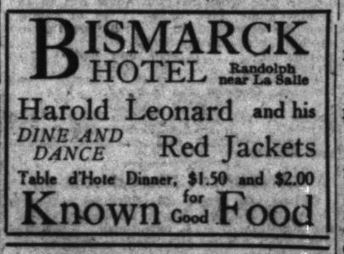
1923 Advertisement. Jack Leonard and his Red Jackets at Bismark Hotel

From September 1923

Posted in Uncategorized | Leave a comment

Harry Reser’s Syncopators – 1925

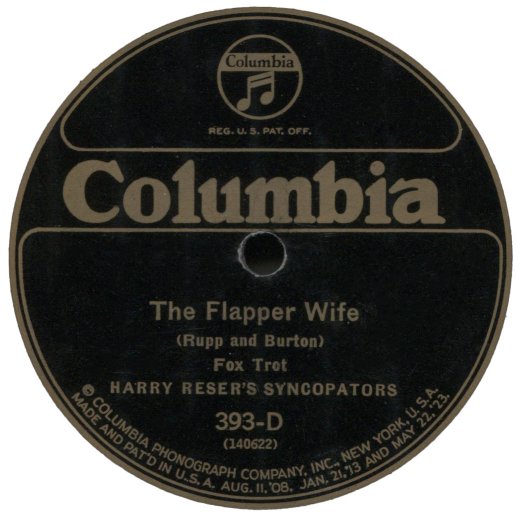
Columbia 393-D label image


“The Flapper Wife”
Harry Reser’s Syncopators
(Columbia 393-D mx 140622)                                  May 25, 1925


“Craving”
Harry Reser’s Syncopators
(Columbia 393-D mx 140612)                                   May 26, 1925


Here’s a record from the Edward Mitchell collection that impressed me. In my opinion, it ranks among the best of the “hot dance” records from the mid-1920s Charleston craze.

On this blog’s January 17 update, I featured an excellent recording of “The Flapper Wife” by Harry Raderman’s Jazz Orchestra that I had been looking for ever since I first heard it on a YouTube video.  That recording of the song was made the same month as the Harry Reser version of it here.  But Reser’s version was made the month after Columbia started using the new electric recording technology that utilized microphones rather than acoustic recording horns.

The arrangement for the first 55 seconds of the Reser recording is similar to Raderman’s. The biggest difference is the vastly improved fidelity of the new technology.  But that is followed by the first of two very nice extended Harry Reser banjo solos of the same “sparkling” style that he brought to his radio band, the Clicquot Club Eskimos.

“Craving” starts out up-tempo but laid-back. The primary term I would use to describe the first portion of this recording is “charming.” But, a little over halfway through, the arrangement abruptly changes direction and becomes quite “hot.”  If one ever needs to find a musical passage that exemplifies the “Roaring ’20s,”  the latter portion of this recording would certainly fit the bill.

“Craving” was composed by bandleader Ben Bernie and Kenneth Casey.   Ben Bernie’s band made a recording of the song in January  1925, which was issued on Vocalion 14965.  I was able to find a copy of it on YouTube. (Note: the person who uploaded the record to YouTube mismatched the audio and video on both sides; thus the audio for “Craving” was uploaded under “Keep Smiling At Trouble” while the audio for the latter song was uploaded under the information for “Craving.”)

The Ben Bernie version of the song is not as “hot” as Reser’s, and, of course, in January 1925, Vocalion was not yet recording electrically.  But it is still quite nice.  If I can find a copy of it in Eddie’s collection, I will definitely add it to Radio Dismuke as well.

We are so fortunate that both of these Reser recordings were made just in time to be captured electrically.  If you compare Reser’s “The Flapper Wife” with the Harry Raderman version I posted in January and linked to above, you can immediately hear the radical improvement over the old technology.  But, while Victor and Columbia began recording and releasing records with the new technology in the spring of 1925, neither company made public announcements about it until much later in the year so that they could have time to build up a new catalog and provide dealers a chance to sell off their existing inventory of records that would soon be perceived as obsolete.


Posted in Uncategorized | Leave a comment

Jack Denny And His Orchestra – 1926

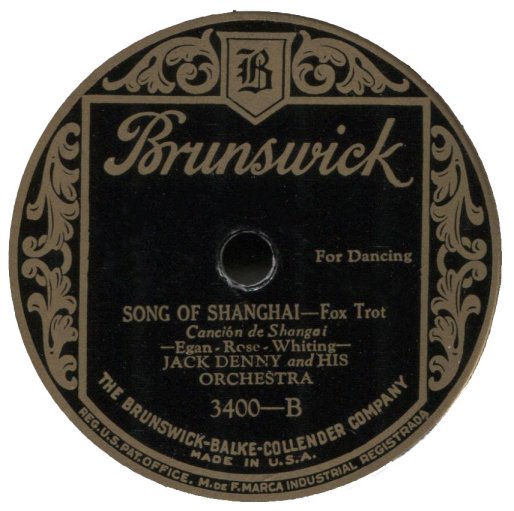
Brunswick 3400-B label image


“Song Of Shanghai”
Jack Denny And His Orchestra
(Brunswick 3400-B)                                   December 15, 1926


One of the cultural fads in the West during the 1910s and 1920s was a fascination with things perceived as foreign and exotic, especially with regard to ancient and traditional cultures of the Middle East and Asia.  This had a big influence on the era’s architecture, design, and fashion.

In the world of popular music,  Tin Pan Alley music publishers happily fed and further fueled the fad with countless “Oriental fox trot” and “Indian intermezzo” compositions. Probably the best-remembered song of this genre is the 1921 hit “The Shiek of Araby,” which was written in response to the enormous success of the Rudolf Valentino film The Sheik.

“Song of Shanghai” is a 1926 composition by Raymond B Egan, Vincent Rose, and Richard A. Whiting.  Other recordings of it besides Jack Denny’s were made by the Ben Selvin Orchestra (as the Radiolites), Ernie Golden’s Hotel McAlpin Orchestra (as the WMCA Broadcasters), and the Duke Yellman Orchestra.

American-born Jack Denny’s band was based out of Canada during the 1920s and became known to American audiences through radio broadcasts from Montreal’s Mount Royal Hotel over CBS. In 1931, the band relocated to New York City to accept a high-profile job as the resident house band at the Waldorf-Astoria Hotel.  During this period, the band had a unique sound as it included no brass instruments.

Unfortunately for Denny, jealousy got the best of him and resulted in a career setback.  When the hotel brought in Xavier Cugat’s rumba band as an opening act, the audience’s response to its hot Latin rhythms was so enthusiastic that Denny delivered an ultimatum to hotel management: they must get rid of Cugat or else he would quit.  Management took him up on his offer to quit, and the Xavier Cugat Orchestra became the Waldorf-Astoria’s house band for the next sixteen years.

The recording on the flip side of this record, also by Jack Denny’s band, “I Love The Moonlight,” has been in Radio Dismuke’s playlist for quite a while.  I am not sure how and why I somehow omitted “Song of Shanghai,” as I think it is the most interesting and unusual of the two. It is a rather pretty song, and Denny’s version sounds more like something one would expect to hear from a popular concert orchestra rather than a typical 1926 dance band.

Posted in Uncategorized | Leave a comment

Margaret Young – 1922-1923

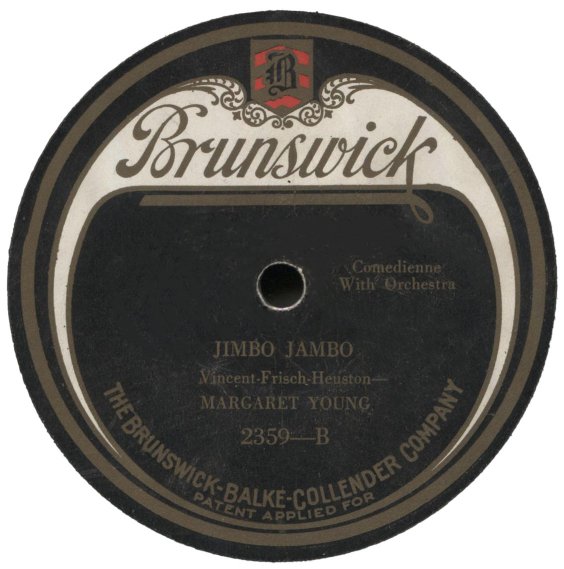
Brunswick 2359-B label image


“Jimbo Jambo”
Margaret Young, vocal
Brunswick 2359-B                       circa October/November 1922


“Tomorrow”
Margaret Young, vocal
Brunswick 2359-A                     circa October/November 1922


“The Bad Little Boys Aren’t Goody-Good”
Margaret Young, vocal
Brunswick 2386-B                     circa December 1922/January 1923


“Counterfeit Bill”
Margaret Young, vocal
Brunswick 2386-A                    circa December 1922/January 1923


Here are four recordings from the Edward Mitchell collection by Margaret Young, a jazz singer who was popular in vaudeville and on phonograph records during the early 1920s.

If the song “Jimbo Jambo” sounds familiar, it might be because it was featured on the television series Boardwalk Empire, where it was performed by Vince Giordano & The Nighthawks with Rufus Wainwright providing the vocal.  You can them perform it on YouTube at this link. (If you enjoy the music of the 1920s and 1930s and find yourself in New York City, you owe it to yourself to see where and when Vince Giordano’s band is performing.)

Margaret Young made her last records in 1925 and subsequently faded away as an entertainer.  She came out of retirement in 1949 and made a few records for the Capitol label.

Young’s sister Eleanore was married to the composer Richard A. Whiting. They had two daughters: the well-known 1940s—1950s vocalist Margaret Whiting and actress Barbara Whiting.

There is no mention on the records’ labels or in discographies of whose band accompanied Young on these recordings. But it is very jazzy and sounds great. For pre-microphone recordings, I think the production quality of these is quite nice, and Young’s voice and singing style are well-suited for the technology.

Apparently, no documentation exists for the exact date that these selections were recorded.  I obtained the estimated dates from two sources: Brian Rust’s American Dance Band Discography and the Discography of American Historical Recordings, both of which differ by a month in their estimation.  In all instances here, the source of the earlier estimated date is Brian Rust and the later date is the DAHR.

Posted in Uncategorized | Leave a comment

Zez Confrey And His Orchestra – 1928-1929

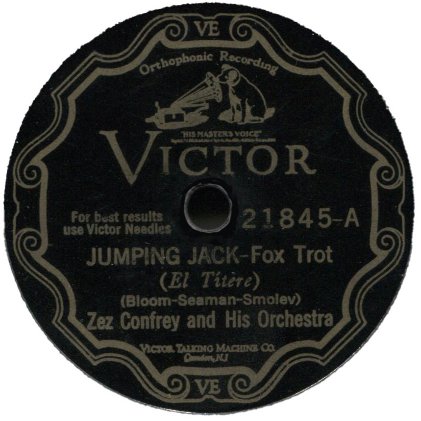
Victor 21845-B label image


“Jumping Jack”
Zez Confrey And His Orchestra
(Victor 21845-A)                                December 07, 1928


“Jack In The Box”
Zez Confrey And His Orchestra
(Victor 21845-B)                             January 3, 1929


Here are two excellent examples of novelty ragtime, a subgenre of ragtime that emerged in the United States just as ragtime began to fade away in favor of jazz. One of the originators of the genre was composer and pianist Zez Confrey.

Despite the artist’s credit on the label, the actual band was a Victor in-house studio ensemble most likely directed by Nat Shilkret but possibly Leonard Joy.  Confrey does not perform on either of these recordings, and it is not known whether he was even present when they were made.

The genre is sometimes referred to as novelty piano, as most of its compositions were written for that instrument. It differed from earlier forms of ragtime by its musical complexity. Because the sale of music during the ragtime era was mostly in the form of sheet music for use on home pianos, for a composition to be financially successful, published arrangements needed to be simple enough to be successfully performed by the average amateur pianist.

The advent of automated player pianos enabled people to enjoy exact replicas of performances by the world’s best pianists in their own homes, and novelty ragtime piano compositions were perfect for showcasing their technical virtuosity.

The genre was not limited to the piano.  Arrangements were published to be performed by dance bands and salon orchestras – and this is my favorite form of the genre.

Novelty rags were occasionally performed and recorded by American dance bands throughout the 1920s.  But it was in, of all places, mid-1930s Germany that the orchestral variety of the genre reached its greatest popularity and where the best-recorded examples were made.  It wasn’t merely another American musical import – many really nice novelty rags were written by German composers.  The best and most frequently found German examples were recorded by Otto Dobrindt and His Piano Symphonists and Hans Bund And His Bravour Dance Band (issued in England as Jack Bund).

Of the two compositions featured here, “Jack In The Box” is the most famous and was composed by Zez Confrey.

If you enjoyed these recordings, I try to feature as many recordings of orchestral novelty ragtime as I can obtain in Radio Dismuke’s playlist.

You can also find the following examples I have previously featured elsewhere on this blog.

“Will O’ The Wisp” and “Rouge Et Noir” by Otto Dobrindt’s Piano Symponists
“Puppe und Kobold” by the Bravour Tanz-Orchester

I am not sure if the composition in the following recording was intended as a novelty rag, but it is definitely performed in the same spirit:

“Sleepy Chinese” by The Castilians


Posted in Uncategorized | Leave a comment

Sacasas Royal Havana Orchestra – 1940

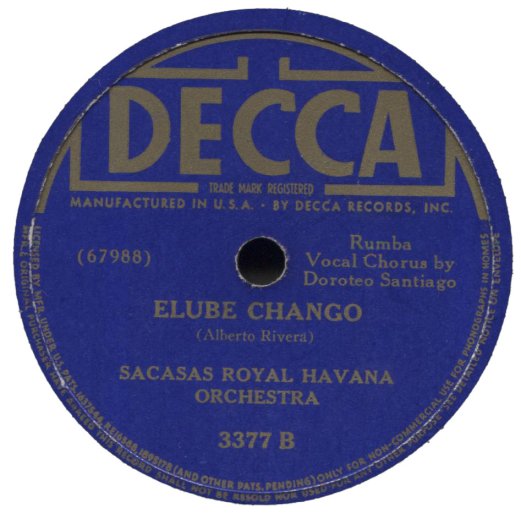
Decca 3377-B label image


“Elube Chango”
Sacasas Royal Havana Orchestra; Doroteo Santiago, vocal
(Decca 3377-B mx 67988)                     August 19, 1940


“The Breeze And I”
Sacasas Royal Havana Orchestra
(Decca 3377-A  mx 67986)                       August 19, 1940


Here are two rumba recordings from 1940, too recent for Radio Dismuke’s 1920s & 1930s format.  But I was sufficiently impressed by the sound of this band that I cannot resist sharing them.

Cuban dance bands were very popular in the United States in the 1930s and 1940s, particularly on the East Coast and in New York City, where, for many years, the Xavier Cugat Orchestra was the house band at the Waldorf-Astoria Hotel.

Anselmo Sacasas was a Cuban pianist who, in 1937, founded the Casino de la Playa Orchestra which became one of Cuba’s most highly regarded bands. While the band was successful, it was organized as a cooperative and Sacasas did not feel he was being appropriately compensated and left to form a new band in the United States in 1940.

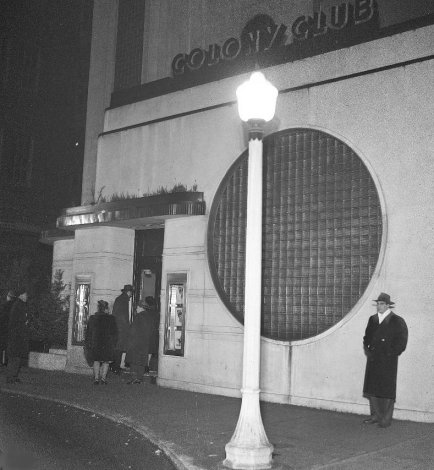
When this recording was made, the band had an extended engagement at the Colony Club in Chicago, an upscale mobster-owned nightclub where patrons could also engage in illegal gambling. The club was raided and closed the following spring. Sacasas continued to lead Latin bands throughout the 1940s and 1950s.

“The Breeze and I” is an adaptation of a 1927 piano piece called “Andaluza,” which was part of the “Andalucia Suite” by Cuban composer/musician Ernesto Lecuona. In 1940, Salvador “Toots” Camarata, a trumpet player and arranger for the Jimmy Dorsey Orchestra, reworked the song with lyrics by Al Stillman as “The Breeze And I.” Dorsey’s recording of the song was very successful, rising up to the number 2 position on the Billboard charts. Xavier Cugat also had a successful recording of the song.

Colony Club Chicago

Image courtesy https://chuckmanchicagonostalgia.wordpress.com/


Posted in Uncategorized | Leave a comment

Jelly Roll Morton And His Orchestra – 1929

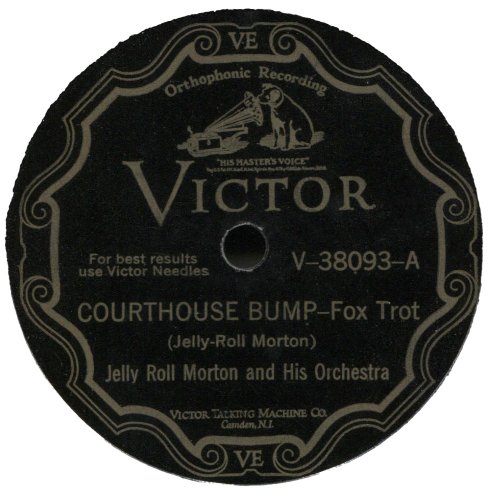
Victor V-38093-A image


“Courthouse Bump”
Jelly Roll Morton And His Orchestra
Victor V-38093-A                        July 9, 1929


“Sweet Aneta Mine”
Jelly Roll Morton And His Orchestra
Victor V-38093-B                    July 10, 1929


Here are two very nice recordings by Jelly Roll Morton and His Orchestra from the Edward Mitchell Collection that will be added to Radio Dismuke’s playlist on this week’s update.


Posted in Uncategorized | Leave a comment

Two Songs Commemorating Charles Lindbergh’s Transatlantic Flight – 1927

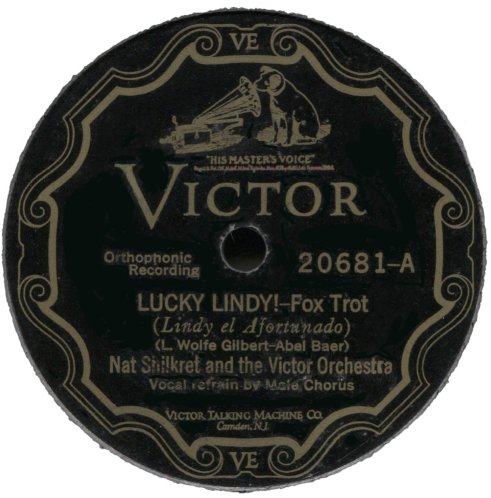
Victor 20861 label image

“Lucky Lindy!”
Nat Shilkret And The Victor Orchestra;
Richard Crooks, Lambert Murphy, Frank Luther, Frederic Baer, Fred Patton, vocal
(Victor 20681-A)              May 26, 1927


“America Did It Again”
Nat Shilkret And The Victor Orchestra;
Billy Murray, Charles Harrison, James Stanley, Stanley Baughman, Carl Mathieu, vocal
(Victor 20681-B)         May 31, 1927


Charles A. Lindbergh’s pioneering solo transatlantic flight from New York to Paris on May 20-21, 1927 was not only that year’s top news story; it also sparked on both sides of the Atlantic a mass cultural celebration of human and technological achievement on a scale not seen again until 1969 when Apollo 11 landed on the moon.

In 1927, the sale of sheet music for the pianos ubiquitous to middle-class parlors was still a driving force and major source of revenue for the music industry. The large Tin Pan Alley music publishing companies were always quick to crank out songs about any topic that captured the public’s imagination.

The Lindbergh flight was no exception; songs commemorating the event were quickly composed and rushed to press. Eventually, over 300 songs related to Lindbergh were submitted to the U.S. Copyright Office.

“Lucky Lindy!” composed by Abel Baer with lyrics by L. Wolfe Gilbert is reported to have been the first of the Lindbergh songs with a copyright date of May 25, 1927, just four days after Lindbergh touched down in Paris. The recording here by Victor’s in-house orchestra, directed by Nat Shilkret, was made the day after the song was copyrighted.

My hunch is that the music publishers and the record labels were probably communicating about forthcoming Lindbergh songs before the composers were even finished writing them.

“America Did It Again,” with words and music by Ted Koehler and Marty Bloom, was recorded by the Shilkret orchestra on May 31, 1927.  The fact that the song was not formally copyrighted until June 7 also suggests early collaboration between the publishers and the record labels.

Lindbergh’s flight was definitely a trailblazing achievement.  But the same cannot be said for the lyrics of many of the songs that commemorated it.

For whatever reason, there seems to have been a fascination for Charles Lindbergh’s mother.  Both of these songs make mention of her as does another famous Lindbergh song, “Lindbergh (The Eagle of the U.S.A.).”   

Indeed, the top of the first page of the sheet music for “Lucky Lindy” even features a dedication: “Dedicated to the mother of ‘Lucky Lindy'”

Gee – did they even know much about her?  Why not dedicate it to the guy who actually risked his life in a rickety airplane?

The lyrics to “America Did It Again” contain the following passage:

I battled the sky, to do or to die
‘Till I saw that old River Seine
“Hello, Mother” this is your boy
I’m calling from Paris, to tell you with joy
I flew for you, and the Red White and Blue

When I first played the record, I immediately wondered if transatlantic phone calls were even possible at that time.  A quick search revealed that the very first transatlantic phone call occurred less than five months earlier, on January 7, 1927, between London and New York.

I don’t know if things would have been set up by late May for such a call to be patched through between London and Paris. But even if they had, it would have been enormously expensive.

Even domestic long-distance calls within the USA at that time were expensive and typically required many minutes for a team of people in multiple cities to patch a call through to its final destination.  Occasionally, in early sound films, one will see a scene showing how long-distance calls were placed.  The person calling would provide the operator with the name, city, and number of the person they wished to speak with and then disconnect.  Once the call was successfully put through – which could take as much as 20 minutes, depending on where the call needed to be routed – the operator would ring the caller back and advise that the other party was on the line.

Presumably, given the apparent fascination with his mother, if Lindbergh had placed such a call using a still novel and extremely expensive technology, that, too, would have made headlines.  But, the day after Lindbergh landed, the New York Times ran an article about Mrs. Lindbergh waiting at her home in Detroit for word as to whether or son had successfully landed or perished.  No mention at all was made of such a phone call.

I wonder how many people back in 1927 were as skeptical of those lyrics as I was. And I wonder if, when the publishers commissioned such songs, they told the composers, “With so many young people buying records and listening to the radio these days, mothers of grown children have become an increasing percentage of our sheet music buyers—so make sure you mention Lindbergh’s mother!”

While these songs are hardly the best examples of the wonderful music that the era had to offer,  I do think recordings about then-current and now-historical events are fun to come across.


Posted in Uncategorized | Leave a comment

June Pursell – 1929

Brunswick 4635 label image


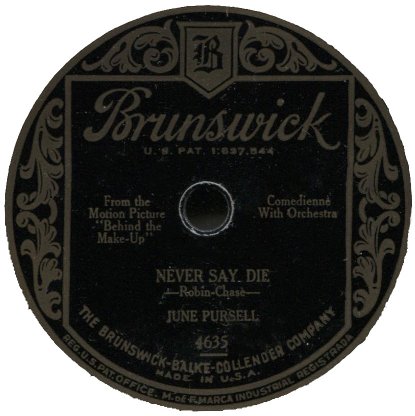
“Never Say Die”
June Pursell, vocal
(Brunswick 4635)           November 8, 1929


“The Album Of My Dreams”
June Pursell, vocal
(Brunswick 4635)           November 8, 1929


Here are two recordings by a mostly forgotten vocalist who was briefly famous from the mid-1920s until she disappeared from public view in 1934.

June Pursell rose to prominence on the West Coast through regular radio broadcasts over station KNX Los Angeles.  Her radio fame enabled her to get a contract on a vaudeville circuit that toured the West and Midwest.  In 1925, she made two trial recordings for Victor, which were not issued.  Between 1928 and 1930 she recorded several sides for Brunswick, some as the featured artist and others as a vocalist for the Roy Fox and Earl Burtnett bands.

In 1927 Pursell starred in an early Vitaphone musical short feature, June Pursell – Hollywood’s Radio Girl.  She appeared in two subsequent films,  The Hollywood Review in 1929 and Viennese Nights in 1930.

In early 1932, Pursell moved to New York City after receiving a contract for her own five-day-a-week radio program over the NBC Red Network from station WEAF New York. That same year she recorded four sides on Victor as vocalist with Jack Denny And His Waldorf-Astoria Orchestra.

For reasons apparently unknown,  Pursell stopped appearing in newspaper radio listings in 1933.

In February 1934, several local newspaper articles reported Pursell returning to her hometown of Indianapolis for the first time in ten years to appear in a show at that city’s Lyric Theater. After that, she seems to have disappeared from public mention, and I was not able to find any source that provided the date she passed away.

Her Wikipedia entry states that she married a man named Thomas H. Culkin in January 1952, citing a Scranton, Pennsylvania newspaper.   But that is incorrect.  The June Pursell mentioned in that newspaper article was born in 1929.

The Wikipedia article also states that she composed two songs that were copyrighted in 1956 and credit her as the author of both the music and the lyrics: “I Couldn’t Love You More If I Tried” and “What Good Am I Without You.”  The latter song is not related to either the 1930 Milton Ager or the 1964  Kim Weston and Marvin Gaye compositions that have the same title.   I was not able to find any information that was able to confirm whether or not the June Pursell who copyrighted the two songs in 1956 was the same person as the 1920s – early 1930s singer and radio star.

The song “Never Say Die” comes from the 1930 film Behind The Make-Up.  While this recording was made in November 1929,  the record did not appear in stores until February 1930, the same month the film debuted in theaters.    The uncredited band backing Pursell up on both of these recordings was Earl Burtnett’s Los Angeles Biltmore Orchestra.

Posted in Uncategorized | Leave a comment

Hans Söhnker & Metropol-Vokalisten – 1937

Odeon O-25913a label image.

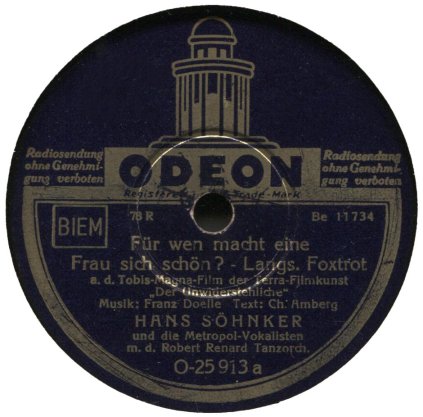
“Für wen macht eine Frau sich schön”
Hans Söhnker und die Metropol-Vokalisten, vocal; with Robert Renard Tanzorch
(Odeon 0-25913 a mx 11734)                           June 23, 1937


Here is a very catchy tune from the 1937 German film Der Unwiderstehliche (The Irresistible Man), which starred Hans Söhnker, who also performs the vocal on this recording.  The song’s title translates to “Who Does A Woman Make Herself Beautiful For?”

Hans Söhnker was a well-known actor who appeared in over 100 films between 1933 and 1980.  During World War II, Söhnker lived a double life, obediently appearing in propaganda films while, at the same time, using his summer house to hide Jews from the authorities.  He was one of a small group of actors and actresses who were part of a network that smuggled Jews out of Nazi German to the safety of Switzerland.  Had he been caught, it would almost certainly have cost him his life.

The Metropol-Vokalisten was a vocal quartet that patterned itself after the Comedian Harmonists (who, in turn, patterned themselves after imported recordings by the American harmony group The Revelers).

Robert Renard was one of many recording pseudonyms used by Otto Dobrindt’s in-house orchestra for various record labels produced by the Carl Lindström Company, such as Odeon, Parlophon, Gloria, and others.

This recording was made in the Lindström recording studios in Berlin at
26 Schlesische Straße.  The huge complex, which included a record pressing plant, printing plant, and company offices, survived the war and is still in use by a variety of tenants.


Posted in Uncategorized | Leave a comment