Click on the image above for a larger view.
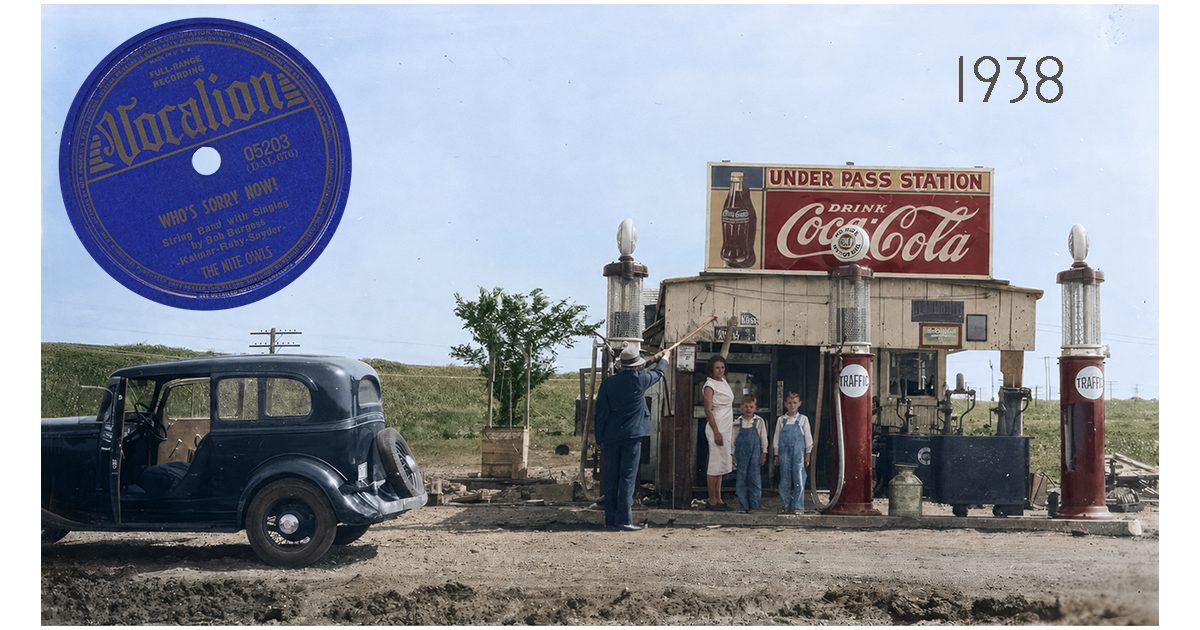
Colorized photo of a family-owned gas station in North Texas. The man and the woman are pointing to the high-water mark from the May 18, 1935, flood. The original image can be found here. Based on clues provided by descriptions of other photos in the same collection, as well as 1938 aerial photographs, it is highly likely that the station was located here (opens in Google Street View), just north of Ponder, Texas. Assuming that is the correct location, the underpass to which the station’s name refers can be seen in the Google Street View and in this photo, which was most likely taken by the same photographer. The Traffic brand gasoline advertised on the pumps was a lower-grade gasoline made by Gulf Oil, which sold for 2 to 3 cents less than Gulf’s next-highest-grade. It was popular with cash-strapped Depression-era motorists, especially those driving older cars that did not require the increased performance of higher-grade gasoline. However, to prevent it from cannibalizing sales of its higher-grade products, Gulf only distributed it to certain regions.
| “Beale Street Blues” The Nite Owls; Luke Owens, vocal May 12, 1938 (Vocalion 05203 mx DAL 507) |
| “Who’s Sorry Now” The Nite Owls; Bob Burgess, vocal December 2, 1938 (Vocalion 05203 mx DAL 676) |
Here are two Western Swing recordings that will be part of Radio Dismuke’s next playlist update, which I think are especially nice.
Western Swing is a musical genre widely credited as originating with Milton Brown and Bob Wills in Fort Worth, Texas, around 1930.
During the early 20th century, Texas was a cultural and musical melting pot. Before 1836, Texas was part of Mexico, and that country has had a significant cultural influence on the state ever since. During the early 1900s, there were still regions of Texas where German and Czech were the dominant local languages due to 19th-century immigration.
Those immigrants not only brought their languages with them but also their rich musical heritage, which profoundly influenced the music of Northern Mexico. The music that emerged in Northern Mexico, in turn, traveled northward and influenced the homegrown music of the descendants of those immigrants.
One way to describe Western Swing is as a fusion of the local music of Texas and Northern Mexico with traditional Appalachian-style country music, Southern blues, jazz, jazz-influenced American dance band music, and the Hawaiian-style guitar music that was popular during the 1920s.
Western Swing was especially popular in the Southwest and southern Plains states during the 1930s and 1940s, particularly in Texas and Oklahoma as well as parts of Arkansas.
The Nite Owls were a Western Swing ensemble based in San Antonio, Texas, during the late 1930s. It was smaller than a typical Western Swing band and had no more than three or four members at any given time. In addition to Luke Owens and Bob Burgess, who provide vocals on the recordings here, its membership also included guitarist Bob Symons and bassist Jack True.
The group’s fame and activities seem to have been limited to the San Antonio area. No references to the group have been found in archived 1930s newspapers from Austin, Dallas, or Fort Worth.
San Antonio newspapers indicated that the band had its own regular program on station KONO between May 1937 and January 1940. That station had an extremely weak signal and would have been difficult to pick up beyond the immediate San Antonio area. This is most likely why there are no mentions of the group even in Austin newspapers, despite the city being only about 75 straight-line miles from San Antonio.
The group performed primarily at smaller venues, such as restaurants, bars, and local dance halls. This is probably why even the San Antonio newspapers contain only a few mentions of the group’s in-person appearances. Newspaper advertising was expensive and often not economically viable for very small venues, especially if they were already at or near capacity without it.
In my opinion, this recording of “Beale Street Blues” is one of the best renditions I have come across. The song was composed in 1917 by W. C. Handy and is named after Beale Street in Memphis, Tennessee, which, during the early decades of the 20th century, was the principal entertainment district for the city’s black population. The song has been recorded countless times and continues to be performed, especially by traditional jazz and Dixieland groups.
“Who’s Sorry Now?” was also an “oldie” when the recording here was made. Published in 1923, the song was composed by Ted Snyder with lyrics by Bert Kalmar and Harry Ruby. Several artists recorded it in 1923; the biggest-selling version was most likely that of the Isham Jones Orchestra on Brunswick. The song enjoyed a significant revival when a late 1957 recording by Connie Francis became a major hit in 1958, selling over a million copies.
Both recordings were made during separate Brunswick/Vocalion field trips and recorded in a makeshift studio constructed out of Beaver Board on the third floor of the Warner Film Exchange Building at 508 Park Avenue in Dallas.
Built in 1929, the building served as the distribution hub of Warner Brothers films for movie theaters in North Texas. When Warner Brothers purchased Brunswick and its subsidiary label Vocalion in 1930, the Brunswick regional office relocated to the building’s third floor, where it also had warehouse space.
By 1931, record sales were in freefall because of the Great Depression, and Warner Brothers wanted out of the record industry. Because of the difficulties of realizing a good price for a record company in such an environment, Warner Brothers leased the company’s trademarks and back catalog to the American Record Corporation (ARC), which, up to this time, had focused on inexpensive “dime store” records. In exchange, ARC paid Warner Brothers a set royalty for every Brunswick, Vocalion, and Melotone record sold. Thus, while Warner Brothers no longer operated Brunswick/Vocalion, they still had a financial interest in the labels’ success.
For decades, the 508 Park building sat abandoned and was targeted by vandals. At one point, it was in danger of demolition. Fortunately, the building was purchased, preserved, and is now part of the broader Encore Park project. One of the long-term plans is for the building to once again house recording studio space on the same third floor where these recordings were made.
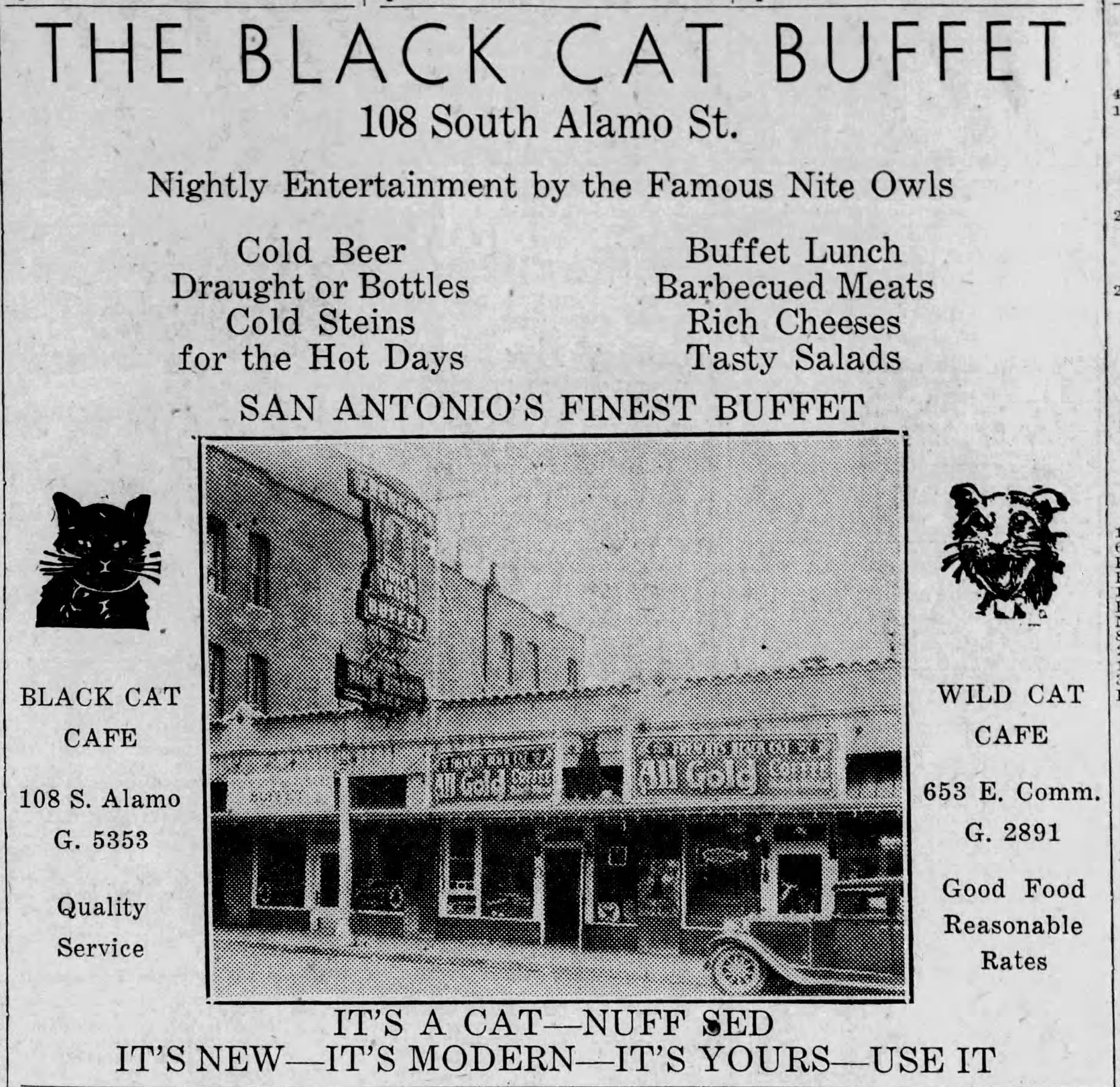
From March 25, 1934, San Antonio Light.