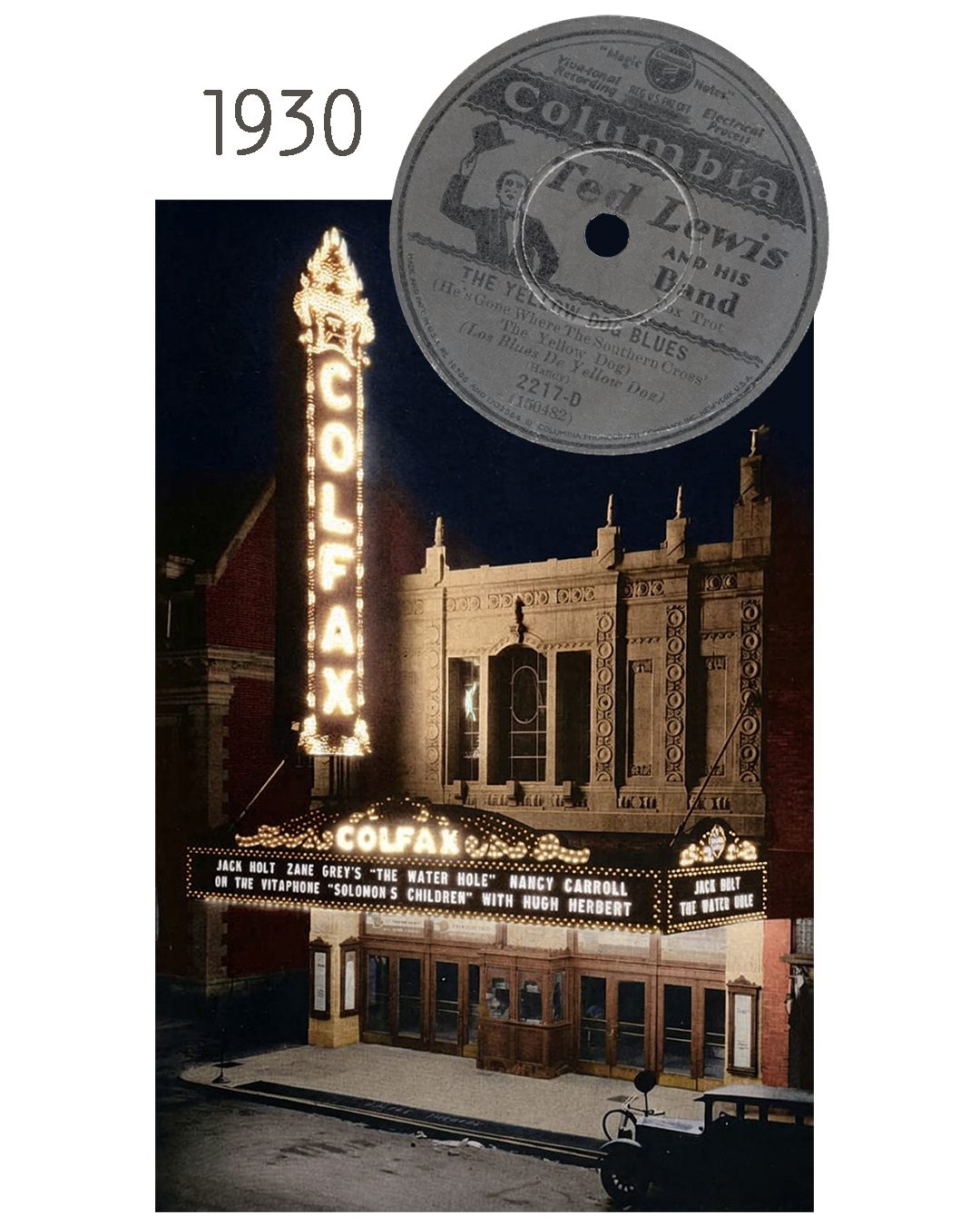
Colfax Theater, South Bend, Indiana. Opened in 1928. Destroyed in 1994.
| “The Yellow Dog Blues” Ted Lewis And His Band April 18, 1930 (Columbia 2217-D mx 150482) |
| “Sobbin Blues” Ted Lewis And His Band April 24, 1930 (Columbia 2217-D mx 150490) |
From the Edward Mitchell collection, here are two jazzy instrumental recordings by Ted Lewis and His Band that will be included in Radio Dismuke’s next playlist update. Both songs were already several years old and well on their way to becoming jazz standards when Lewis recorded them.
The record features a special picture label that Columbia used on all Ted Lewis pressings between 1929 and 1933. Columbia had previously provided a special picture label for Paul Whiteman’s recordings as part of its effort to lure Whiteman after his contract with Victor expired in 1928. Ted Lewis was one of the highest-paid bandleaders of the 1920s and one of Columbia’s best-selling artists. I suspect that offering Ted Lewis his own picture label was part of Columbia’s negotiations to retain him when his contract came up for renewal in 1929.
The Ted Lewis label was not as elaborate or colorful as the Paul Whiteman label (an example of which can be seen and heard in this blog’s July 14 posting) and featured a gray background with descriptive text and a silhouette of Lewis in black.
Unfortunately, the quality of the ink, the paper, or perhaps both used in the label was not as high as that used for the Whiteman label or for Columbia’s standard labels. More often than not, even when the playing surface of such records is in great condition, the ink is faded and, in some spots, worn off. The paper is also more prone to being soiled from routine handling.
Columbia also introduced picture labels for Rudy Vallée and Harry Richman. However, they were much more minimalistic, featuring an etching-like line drawing of the artist and his signature in place of the “Magic Notes” at the top of the label. By 1933, the Ted Lewis picture label had also been simplified to this design. Ted Lewis picture labels with this later style, as well as the Harry Richman picture label, are rare, as they were made during the worst period of the Great Depression for the record industry, and pressing numbers tended to be extremely low.
“Yellow Dog Blues,” originally published in 1914 as “Yellow Dog Rag,” was a W. C. Handy composition inspired by Shelton Brooks’s 1913 song “I Wonder Where My Easy Rider’s Gone?” Yellow Dog refers to a local nickname used in the early 20th century for the Yazoo Delta Railroad in Mississippi.
“Sobbin’ Blues” dates back to 1923 and was composed by Art Kassel (link via Google Translate) and Vic Berton.
While Lewis was as much a showman as he was a musician, his band was always staffed with top-tier talent. According to Brian Rust, at the time of these recordings, the band’s roster included Muggsy Spanier, Harry Raderman, and Jimmy Dorsey.