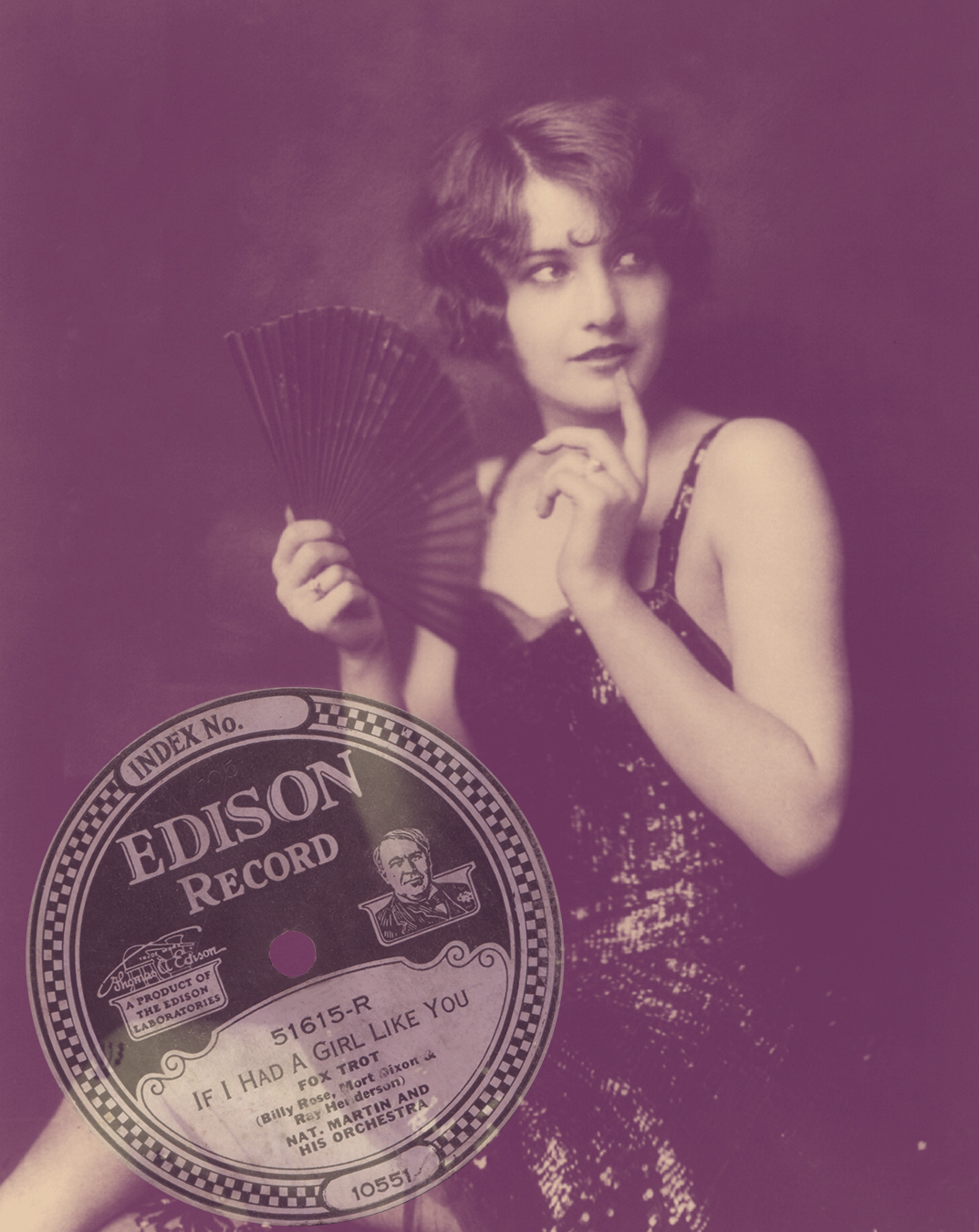
Ziegfeld showgirl Barbara Stanwyck in 1924 photo by Alfred Cheney Johnston
| “If I Had A Girl Like You” Nat Martin And His Orchestra August 7, 1925 (Edison 51615-R mx 10551 B 1 3) |
Here is an Edison Diamond Disc recording from the Edward Mitchell Collection that I thought was rather charming and that will be among the selections added to Radio Dismuke on this week’s playlist update.
Composed by Billy Rose, Mort Dixon, and Ray Henderson, “If I Had A Girl Like You” was briefly popular in 1925 and recorded by most of the era’s major record labels. However, it is completely different from the 1930 Louis W. McDermott song of the same name, recorded by Rudy Vallee, Annette Hanshaw, Phil Spitalny, and others. Because copyright protection does not extend to a work’s title, it is not uncommon for multiple compositions to have the same title, especially when one looks across decades and musical genres.
Largely forgotten today, Nat Martin’s band was well-known in the New York City area during the 1920s, rising to prominence as the pit band for the highly successful Marx Brothers‘ musical revue, I’ll Say She Is, which ran for over 300 performances at Broadway’s Casino Theater between May 19, 1924, and February 7, 1925. (The show also enjoyed revivals in 2014 and 2016).
As a result of its Broadway success, the band recorded eight sides for Edison between October 31, 1924 and the August 7, 1925 session from which the selection featured here comes. The band recorded an additional side for Edison on November 27, 1927, but it was never issued.
After I’ll Say She Is closed, the band traveled to Detroit for an extended high profile engagement at the Oriole Terrace ballroom. It subsequently appeared at various venues in New York City and surrounding areas, as well as on radio. For a period, it was reportedly one of the more expensive local bands to book.
After 1928, mentions of Nat Martin in industry trade publications suddenly dropped off.
I was able to find a mention in an April 1929 publication of the AFM musicians’ union of a Nat Martin and other musicians from New York Local 802 as “traveling members” eligible to work in Washington DC.
I also found a brief mention in the July 1935 issue of Variety stating:
With the jazz band biz (sic) what it is, Maestro Nat Martin has returned to the optician business with a shop in Radio City.
A March 1938 listing for a Nat Martin in the membership roster of the AFM Local 803 in New York (assuming it is the same Nat Martin) suggests that he either continued to work, or hoped to work, as a musician, at least on a part-time basis. However, the union’s May 1939 roster indicates his membership had been terminated. Typically, a musician who left for work in a different city would be listed as a transfer, not a termination.
I also found the following tidbit in the July 2, 1945 issue of Broadcasting And Broadcast Advertising:
Nat Martin from WCHV Charlottesville, Va., is new chief announcer and music director of WOPI Bristol, Tenn.
I was not able to find anything to verify that this was the same Nat Martin as the bandleader. However, there were several former bandleaders who, when confronted with the rapid post-war decline of the dance band business, were able to transition to successful careers in radio. In 1945 some local radio stations still featured live musical programing, and, if this was the case, the title of “music director” would have included actually directing live musicians, which he was certainly qualified to do.
When this recording was made, Edison’s primary competitors, Victor and Columbia, had already been recording with microphones for several months. It wasn’t until the summer of 1927 that Edison switched from its old fashioned acoustical recording horns to electrical recording.
Prior to the advent of electrical recording, Edison records, especially those of the 1920s, had, by far, the best, most realistic sounding recordings. But they could not compare to the improved fidelity made possible by the new technology that Victor and Columbia had licensed from Western Electric. It has been said that, as a result of his extremely impaired hearing, Thomas Edison had difficulty appreciating just how much of an improvement it was.
This was one of many examples of Edison’s inability to keep up with rapidly evolving changes in the record industry that led to sharply declining sales and the label’s demise in 1929 just a few days before the October stock market crash.
On the other hand, in my opinion, performances on the later acoustically recorded Edison records can sometimes be more pleasant to listen to than those of some of the alternative electrical recording systems used by labels that weren’t able to license the Western Electric system – for example, the notoriously inconsistent so-called “Light Ray” process used by Brunswick between 1925 and 1927, which can occasionally sound very harsh, despite technically having higher fidelity in terms of frequency response.